
“In 1492, Columbus sailed the ocean blue,” as we all learned in elementary school, with the financial backing of King Ferdinand and Queen Isabella of Spain. Later in our formal education, we learned that this event would eventually set the conditions for completing the “triangle” of the transatlantic slave trade: Enslaved humans from Africa were sent to North America. There, their forced labor produced the raw materials that would then be sent to Europe to be manufactured into goods, which would then be shipped to African merchants in exchange for enslaved people.
In another chapter of history, likely in another class altogether, we were taught about the Spanish Inquisition. Through waves of antisemitic violence that began in the late 14th century, many Jews in Europe were forced to convert to Christianity under the threat of death.
In the years that followed, suspicions arose among some that these conversions didn’t “take,” and that converted Jews were secretly practicing Judaism. This led to the approval of a papal decree establishing the Inquisition, which allowed questioning suspected “crypto-Jews,” often using means of torture to extract “confessions.” Then, a decree was passed to expel all Jews from Spain who refused to convert to Christianity.
That decree was signed by King Ferdinand and Queen Isabella in 1492, the same year Columbus sailed the ocean blue.
The descendants of the Sephardic Jews—those Jews who were expelled from Spain—wouldn’t arrive in North America for more than a century, as a small part of broader Jewish migration into the continent. And it wouldn’t be until the mid-18th century that the forced migration of Africans to North America would reach its peak.
Still, it is difficult to overstate the historic threads that tie those who would eventually become African Americans and Jews in America together. These threads, and the centuries of harmony and tension they created, are the focus of Black and Jewish America: An Interwoven History, the new PBS documentary by Henry Louis Gates, Jr.
Throughout the documentary’s four episodes, Gates narrates the rhyming histories of Black and Jewish Americans, focusing not just on their oppression and trauma, but on the indelible mark they have made on the United States. He also highlights the transformational alliance between the two communities in fighting for the civil rights of African Americans, as well as the pressure points that have made the alliance vulnerable to collapse.
A Common Story

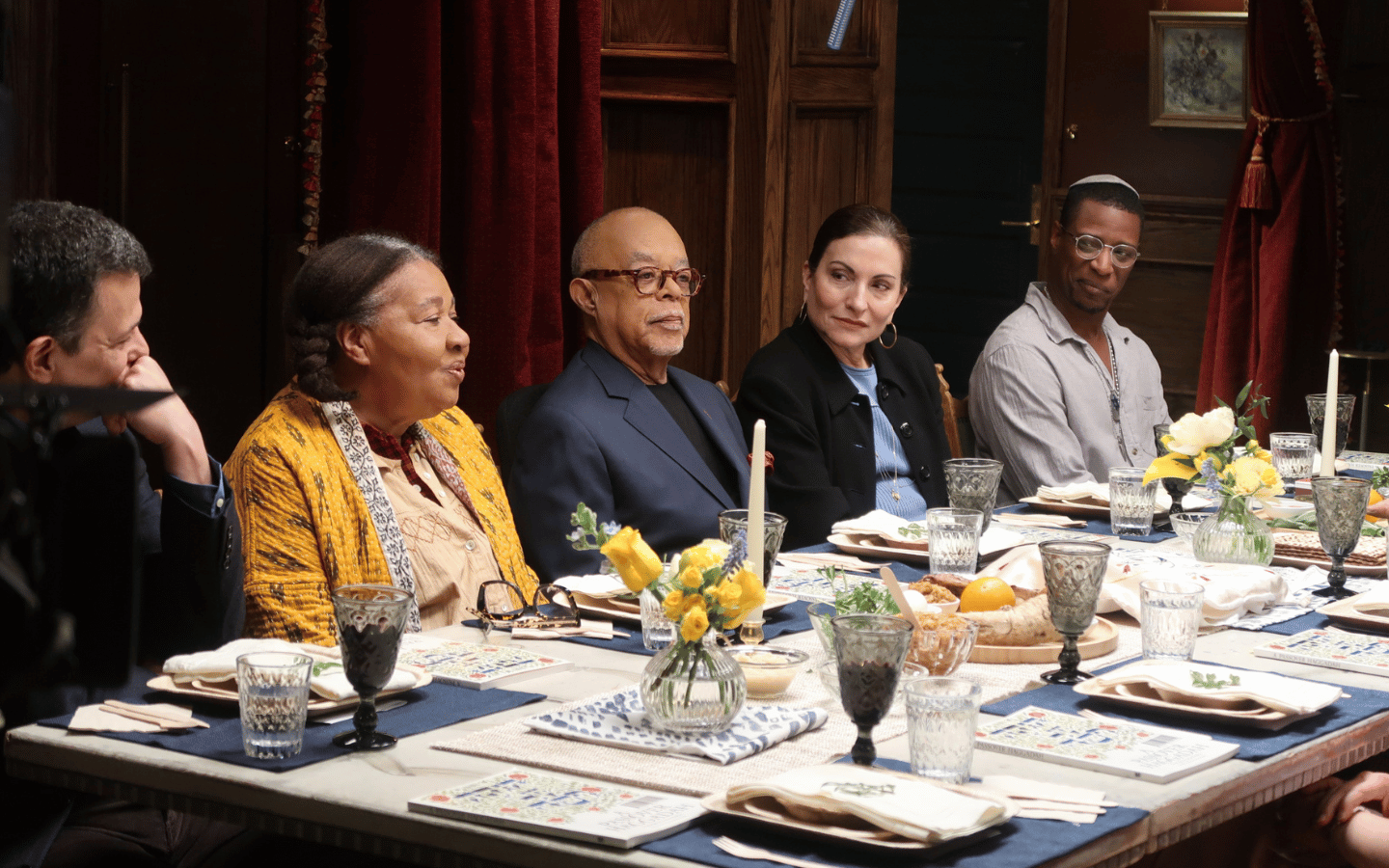
(Credit: McGee Media)
In the final episode of Black and Jewish America, Gates gathered a group of African American and Jewish scholars, writers, and rabbis—including three Black Jews—for a seder meal to discuss their shared stories. The conversation centered around the story of the Exodus in the Hebrew Bible.
For Jews, Exodus is their ancient story that orients their identity. For African Americans, it was the narrative in the Bible that their enslavers sought to keep from them, but which they interpreted and embraced as their own—a story that became sustenance for centuries.
Though the original story of the Exodus occurred to what would become known as the Jews, its details were strikingly similar to the plight of enslaved Africans and their North American ancestors. It included suspicion, violence, and generations of brutal persecution. It also included Moses and Moses-like figures who heralded the Divine call to “Let my people go.” These sacred connections became the source of the historic Black-Jewish alliance that led to the passage of Brown v. Board of Education and the creation of the NAACP.
And yet, while their stories share similarities, the Jewish experience in North America diverges from the African American experience in one key aspect—race. Throughout Black and Jewish America, Gates and his interviewees take great care in recognizing the struggles of the Jews in the U.S., while also being honest about the ways they have enjoyed the privileges of “whiteness” that weren’t afforded to their African American neighbors.
At Gates’ seder meal, Nate Looney, Director of Community Safety and Belonging at The Jewish Federations of North America, spoke to the tension this creates. Looney is both Jewish and African American. “During Passover every year, we commemorate our freedom as Jews,” he said. “But as Black Americans, we’re often told to ‘get over’ slavery and forget about it. [And this is something that occurred] in modern times. But something that happened a long time ago (the Exodus) is something that we hold onto and sit around a table and remind ourselves of.”
Divergent Paths
For contemporary viewers, Black and Jewish America offers a view into the multilayered lived experiences of African American and Jewish communities in America. These are manifest in ideas of class, race, and religion, and are told through the specific lens of stories such as the creation of jazz and Hollywood, as well as affirmative action initiatives within higher education. But few stories illustrate the fault-lines separating Black and Jewish America more than the subject of Israel.
After the Six-Day War in 1967, those fault-lines began to intensify. “Traditionally, Israel was seen by Jewish people as a safe haven from persecution and a core part of their identity,” Gates said in Episode 2. “But to some Black activists, Israel increasingly was viewed as a colonial power.”
Black and Jewish America highlights generational divides, with the older civil rights leaders remembering and seeking to honor their Jewish allies in past battles, as younger leaders saw themselves through the plight of the embattled Palestinians.
An Essential American Story
The word “complicated” is thrown around too easily in conversations about hot-button contemporary issues. It is even used often in Gates’ documentary. The word can be helpful in framing stories in such a way that we approach them with curiosity and care.
But we often use “complicated” as a way to avoid uncomfortable truths, particularly ones that require something of us. Black and Jewish America doesn’t fall into this trap. Instead, it reminds us that we will never come close to understanding the story of our country until we have listened to it through all the voices of those who built it, and who continue to offer it light, even after all the darkness they were forced to endure.
“By tracing the long arc of Black and Jewish history in America,” Gates said, “I hope we can see each other more clearly, more honestly, and find hope in our mutual stories of survival, resilience, and solidarity. But this series is not only about the past. It is about us—and how, together, we can prevail over the forces of hatred that seek to divide us.”
Henry Louis Gates, Jr.’s Black and Jewish America is now available in its entirety at PBS. Gates is the director of the Hutchins Center for African and African American Research at Harvard University.
- About the Author
- Latest Posts

Senior Editor at Good Faith Media.