
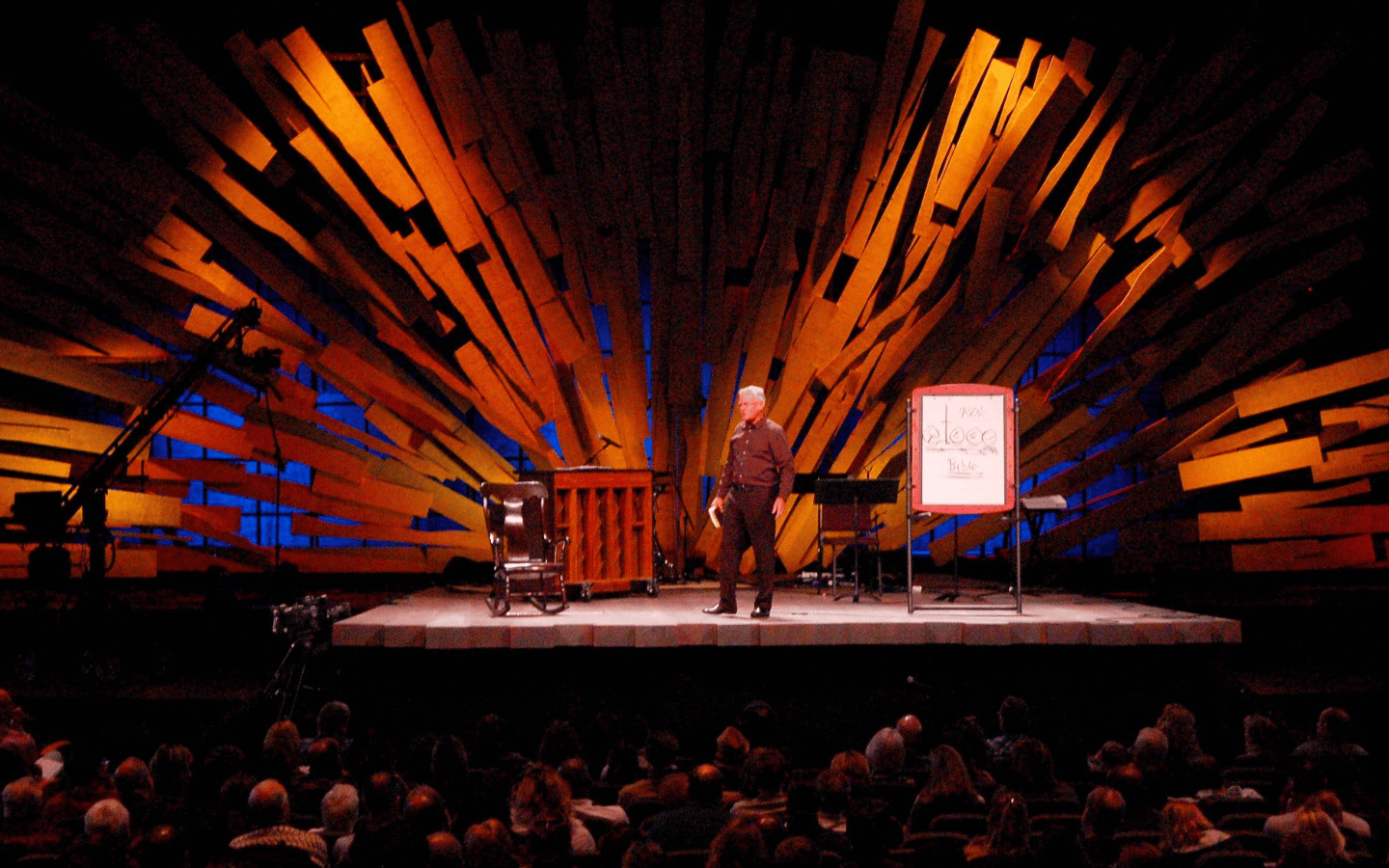
The fiftieth anniversary of Willow Creek Community Church provides an occasion to consider the impact of megachurches on the landscape of American evangelicalism.
In October 1975, Bill Hybels, a former youth pastor and graduate of now-defunct Trinity College in Deerfield, Illinois, convened a gathering at the Willow Creek Theater in Palatine, Illinois. As Bob Smietana recounted in an excellent retrospective for Religion News Service, Hybels wanted to recast evangelical worship and try something different to attract “seekers.”
He succeeded.
The idea was to ditch the stodginess of traditional evangelical services in favor of a lively mix of music (some of it original), drama and a folksy sermon. As Willow Creek caught on, it quickly outgrew the theater, and the congregation moved to larger facilities in South Barrington, where, at the height of its popularity, it attracted 25,000 people every weekend.
In American Protestantism, success inevitably breeds imitators, and so was born the phenomenon of the “megachurch,” which sociologists define (somewhat arbitrarily) as congregations of two thousand or more.
Or was it?
I’ve long argued that America’s first megachurch was not Willow Creek, but Angelus Temple in the Echo Park neighborhood of Los Angeles—although a case could also be made for D.L. Moody’s Chicago Avenue Church in Chicago, now known as Moody Church.
Angelus Temple, which opened on New Year’s Day 1923 with seating for more than 5,000, provides a better precedent for Willow Creek. Aimee Semple McPherson, a Pentecostal preacher and founder of the International Church of the Foursquare Gospel, recognized that to succeed, she needed to compete with Hollywood across town. So Angelus Temple became the site of dramatic sermons.
One Easter Sunday, for example, “Sister Aimee” emerged from a giant plaster of Paris Easter lily. Another time, she rode onto stage astride a police motorcycle.
George Whitefield, the eighteenth-century itinerant trained in the London theater, used dramatic techniques—his stentorian voice and dramatic pauses—to overwhelm colonial audiences. But McPherson took those strategies to another level with elaborate staging at Angelus Temple.
Another parallel between Angelus Temple and Willow Creek is not so benign. Whereas McPherson started her own denomination, Hybels and Willow Creek were resolutely non-denominational (although the Willow Creek Association arguably functions as a de facto denomination).
Denominations are notoriously ineffective institutions, but at their best, they provide a buffer against evangelicalism’s greatest weakness: the cult of personality. Lacking the ballast of tradition, creeds, ritual or hierarchies, evangelicals tend to galvanize around charismatic individuals, who in turn exercise outsized influence over their followers.
As history has proven time and again, such a circumstance is ripe for abuse, whether financial or personal.
In neither case—Angelus Temple nor Willow Creek—were safeguards sufficiently in place to prevent abuse by charismatic individuals who also happened to be the founders. In 1926, McPherson apparently ran off with the head of her radio station and staged her own kidnapping. She died in an Oakland hotel room in 1944 from an overdose of sleeping pills.
Hybels was forced to move up the date of his retirement amid accusations of sexual misconduct, which were later deemed credible by a task force of evangelical leaders.
Despite this checkered history, there is no doubt that megachurches have reshaped American evangelicalism, if only because so many congregations have sought to imitate their techniques. Have they compromised the gospel in so doing?
That’s a difficult question that I don’t feel qualified to adjudicate. When we were filming the PBS version of Mine Eyes Have Seen the Glory in the early 1990s, an associate pastor was adamant that Willow Creek remained true to biblical teachings even as it trimmed its sails to appeal to Chicago suburbanites.
Throughout American history, evangelicals have demonstrated their ability to speak the idiom of the culture, from the open-air preaching of Whitefield and other itinerants in the eighteenth century to the circuit riders and colporteurs of the nineteenth century to the urban revivalism of Billy Sunday and Billy Graham in the twentieth century.
The suburban-style megachurch, with its entertainment and food court, was simply a more recent example of evangelicalism speaking the idiom of the culture. Without a doubt, these “big box” churches altered the landscape of American evangelicalism.
- About the Author
- Latest Posts

An Episcopal priest, Balmer is John Phillips Professor in Religion at Dartmouth College and the author of more than a dozen books, with commentaries appearing in newspapers across the country. He is a contributing correspondent at Good Faith Media.