
Editor’s Note: The following is the cover story for the January-March issue of Good Faith Magazine, which is a complementary resource for all Good Faith Advocates.
In Matthew 16, Jesus, curious about what the crowds are saying about him, does a bit of crowdsourcing among his disciples to get a feel for what is in the air. Like reports from a public research firm, they tick off all the answers floating around: John the Baptist, Elijah, Jeremiah, and the ubiquitous “other.” Then he asked them to forget about what others were saying; he wanted to know what they thought. “You are the Messiah, the Son of the living God,” Peter boldly declared.
Jesus’ response to Peter is a source of debate among scholars for all the potential implications it could be pointing to: “Blessed are you, Simon son of Jonah, for this was not revealed to you by flesh and blood, but by my Father in heaven. And I tell you that you are Peter, and on this rock I will build my church, and the gates of Hades will not overcome it.”
The contention lies in what Jesus meant by “this rock.”
For Catholics, “this rock” refers to Peter himself. There is a good reason for this, as the name “Peter” (Greek: Petros) literally means “rock.” Roman Catholics have built their entire church system on this declaration of Jesus, seeing each pope as the successor of Peter.
Orthodox and most Protestant believers hold a different view. For them, Peter’s confession that Jesus is the Messiah, God’s Son, is the rock upon which the church will be built. Peter, though essential to the grand story of the Church, is simply a messenger of the core tenet of Christianity: that Jesus is Lord.
For some early church fathers and Reformed Christians (Calvinists and many Lutherans), it is neither Peter nor his confession that is the foundation upon which the Church is built. Instead, they believe Christ was pointing to himself as the cornerstone. Although this may seem to some like a thin distinction from the belief that Peter’s confession of “Christ is Lord” is the rock, Reformed teachers will insist that it is completely different, as it removes the human element altogether from the equation.
Regardless of how one interprets the meaning of “the rock,” there is much wider agreement on Jesus declaring that the “gates of Hades” (or “hell” in many translations) “will not overcome it.” Though there have been numerous variations of this interpretation, Christians across time have taken Jesus’ words here as an enduring promise that the “body of Christ,” or “the Church,” or whatever you may call the gathered community of those who follow Jesus, will last into eternity.
For Jesus’ disciples, this promise was challenged almost immediately by Jesus himself. Matthew situates the story of Peter’s confession and Jesus’ teaching on the endurance of the church just before Jesus tells the disciples that he will go to Jerusalem and die. Peter, perhaps emboldened by Jesus’ recent praise of his declaration of faith, rebuked Jesus. “Never, Lord,” he said. “This shall never happen to you” (Matthew 16:22).
Jesus quickly shifts his attitude toward Peter, demanding, “Get behind me, Satan! You are a stumbling block to me.” He then teaches the disciples that the way to true life is through death.
Are the Gates of Hell Prevailing?
The faith of Christians in the Church’s eternal status was put to the test almost immediately. At first, the gatherings of those who followed the resurrected Christ flew under the radar of the powers that be. But as their numbers began to spread beyond a small movement in Jerusalem and into Europe and North Africa, Rome took notice. The empire tolerated any number of religious teachings, as long as those teachings left room for its subjects to declare, “Caesar is Lord.” This, of course, was a problem for Christians.
Beginning with a few localized, targeted persecutions in the first century CE and eventually spreading throughout the empire, it seemed to many that the Jesus movement was destined to be short-lived. (On top of external challenges from Rome, internal theological disputes also threatened the unity of the fledgling Church.) Fears of the Church’s extermination led early Christian writers to defend the faith against “the gates of hell.” The early persecutions of Christians led to Tertullian’s famous line: “The blood of the martyrs is the seed of the Church.”
The line proved to be true, as the Jesus movement continued to grow despite attacks against it. It eventually merged with the power of Rome, becoming the empire’s official religion. But this new status didn’t end the anxieties over the potential death of the Church. In fact, it heightened them by tying the Church’s survival to that of the state.
After Rome was sacked in the early fifth century, pagans blamed the Christians for its defeat. It was from this that Augustine reframed the crisis, drawing clear dividing lines between the sacred and the secular. He argued that regardless of the state of the “earthly city,” the “City of God” would endure any momentary setback. This set the stage for a long period of confidence in the endurance of the Church.
The anxieties didn’t end, though; they just shifted to focus on purity rather than survival. The schisms of the Middle Ages that produced the Eastern/Western divide, the Protestant Reformations of the sixteenth century, and the modern controversies over faith versus reason were mostly struggles over what constituted the “true Church” and whether it would survive among “false believers.”
Recent years, however, have seen a revival of the enduring question: “Will the Church survive?” But after two millennia of growth — whether by confession or coercion — and with our more fully developed awareness of what is going on in the world than early believers had, the question is now a more regional one.
At the beginning of the twentieth century, almost 80 percent of the world’s Christians lived in Europe or North America. By the turn of the twenty-first century, over two-thirds (69 percent) lived south of the equator, marking the most dramatic geographic shift in the history of the Church. The implication of this is that the “average Christian” in the world today is no longer a European-descended man but a woman in sub-Saharan Africa or Latin America.
The causes of this massive reconfiguration of global Christianity are complex and intricately tied to colonialism. But the Jesus movement still endures, with the Church taking on more charismatic and indigenous forms, far removed from the centers of empire that aided (or forced) its spread throughout the rest of the world.
Our Context
The question, then, is no longer, “Will the Church survive?” It is instead, “Will the North American church survive?” To this question, there is no shortage of reading material.
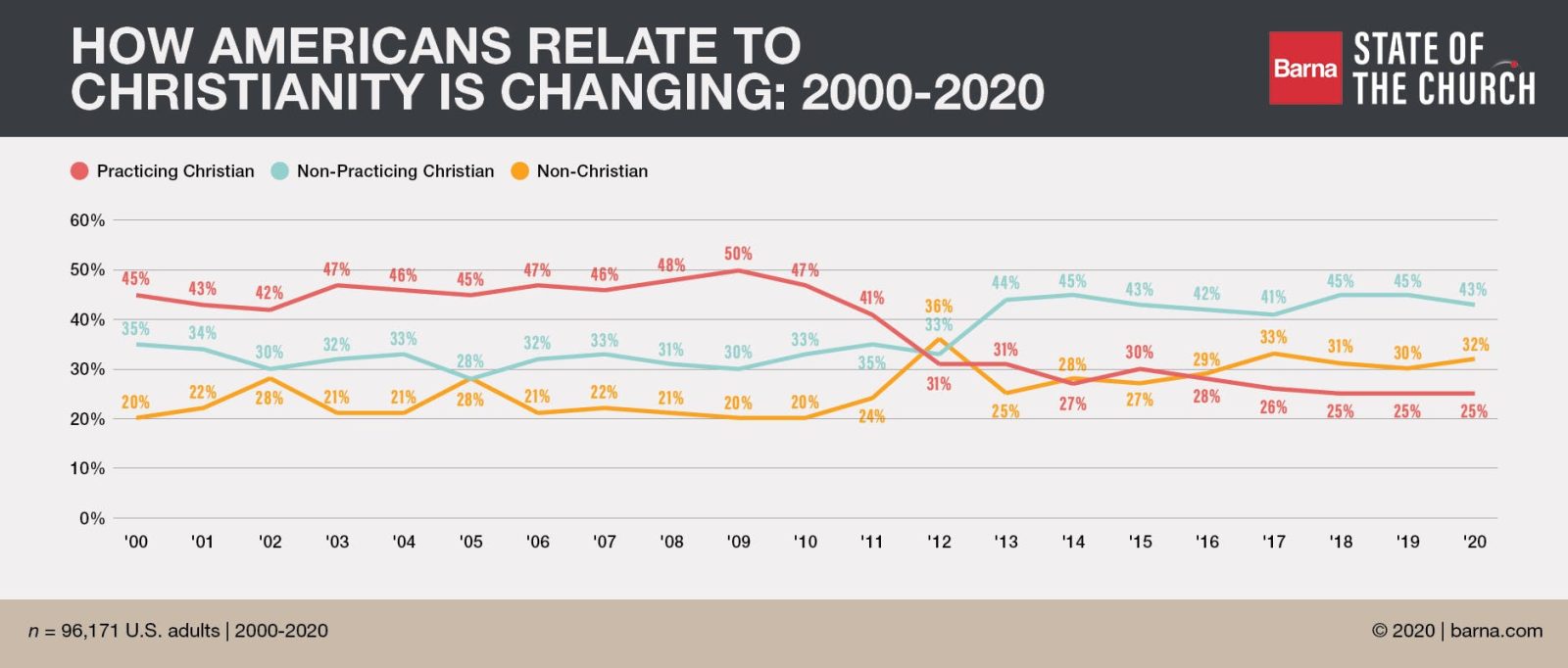
The Barna Group has followed congregational and cultural trends for over four decades. One of its longitudinal studies addresses how U.S. adults relate to Christianity — whether they are “practicing Christians,” “non-practicing Christians,” or “non-Christians.” Though each data point is helpful for understanding the relationship of Americans to Christianity, those who identify as “practicing Christians” tell a more accurate story of the health of U.S. churches, as church attendance and membership are components of “practicing.”
In 2000, 45 percent of survey participants labeled themselves “practicing Christians.” By 2020, that had fallen to just a quarter (25 percent) of respondents — a 20-point decline.
It should be noted that the term “practicing” isn’t all-encompassing. There are various gradations of what that means to people. As many pastors will testify, post-pandemic church attendance (in person) has fallen much faster than the rate of people who have dropped out of church altogether. In other words, it’s not that a lot of people are necessarily leaving; they just aren’t showing up as often.
A 2024 Pew Research study bears this out. It found that among U.S. adults who say they attend a religious service in person, only 25 percent attend weekly, with 8 percent saying they attend once or twice a month. Almost half (49 percent) say they attend seldom or never, with 18 percent attending a few times a year.
So what are people doing on Sunday mornings?
Realignment
It would be irresponsible to dismiss the reality that the number of people who identify as Christian is declining rapidly, causing a massive shift in the lifespan of local congregations. Since there is no national registry of churches, there is no easy way to accurately measure how many churches close their doors each year. Even so, a 2019 Lifeway Research report revealed that 4,500 Protestant churches in the U.S. closed that year. They were replaced by only 3,000 new church starts.
Despite this, all is not lost. In the years since the COVID-19 pandemic, many researchers and practitioners have told the stories of a corporate faith that hasn’t vanished, but reorganized. Church involvement has morphed from a core aspect of believers’ identity to a component of a more complex mosaic of practices and community life.
Shifting Mediums
The changing landscape of how church involvement is defined can trip up many congregations and church leaders. If attendance is no longer the primary indicator of church health, then what is?
The same Pew Research study that found only 16 percent of Americans attended religious services in person weekly also found that around 10 percent watch church services online or on television each week.

Dr. Heidi Campbell
Dr. Heidi Campbell, a communications professor at Texas A&M University, has studied religious life in the U.S. as it has progressed through various technological advances, including radio, television, the internet, and now artificial intelligence (AI). She has researched the data and concludes that shifting technology doesn’t just carry ideas about church to the masses — it also reconfigures what we understand church to be.
Campbell is sober about the state of the institutional church in the U.S. “From a sociological standpoint, the church is sick, and it is dying,” she said. “I know that is being blunt.” She notes, however, that the church is thriving in more charismatic and Pentecostal expressions, as well as in churches that have navigated the new technological landscape.
Campbell encourages church leaders to approach emerging technologies with both courage and a healthy dose of skepticism. “With every new medium, some say, ‘This will save us,’ while others cry, ‘This will destroy us,’” she says. “Churches need to see technology for the problems and the opportunities they create.”
Her research suggests that congregations that viewed the church as “a group of believers who met at a particular place and time” before COVID-19 are the ones that have struggled most since the pandemic. Conversely, those who have embraced relational and hybrid models of congregational life have fared better.
Reflecting on which churches have the better chance of survival, she says, “If ‘church’ remains a place in time, it dies. But if it is relational and hybrid, it breathes.”
A Breathing Church

Rev. Jacqui Lewis
Among those churches that “breathe” are some that, on paper, should have folded years ago but have found ways to lean into new expressions of ancient faith. One such congregation is the Middle Collegiate Church, located in the East Village of New York City. The church, which is part of the United Church of Christ, reflects the multicultural, multigenerational mosaic that defines the city it serves.
Middle Church’s pastor, the Rev. Jacqui Lewis, acknowledged that her congregation is a bit of a unicorn. “We grew during COVID and after a fire,” she said, referring to the December 2020 blaze that destroyed the interior of the church’s historic Manhattan building. “Today, about 4,100 claim Middle as home.” The church draws its members from the New York boroughs as well as from the suburbs of New Jersey and Connecticut.
Middle Church utilizes the hybrid, relational model that Dr. Campbell insists is necessary for a thriving congregation. Rev. Lewis embraces all the new technological aspects of the church, but confesses that the church’s physical presence in the city matters. “I need the church — God alive in people,” she says. “Hands, feet, and heartbeat.”
Lewis also acknowledges that Middle Church’s centuries-long, “justice-forward” mission isn’t a template for every church in the United States. Still, the principles of the congregation are relevant everywhere. They include a courageous clarity of mission, a nurturing multicultural/multiclass ethos, and an embrace of digital ministry that can expand belonging beyond just one zip code.
Beyond all the strategies, though — and despite her public-facing multi-faith embrace of ministry — Lewis believes the church’s future depends on whether it can return to Jesus. “What we might need to do,” she says, “if we want the church to have a future, is to let go of what we think it must be and remember what it was: Rabbi Jesus picking people up and saying, ‘Have you thought about it this way?’ If we return to Jesus, we just might live.”
A Fork in the Road

Rev. Dr. Justin Sabia-Tanis
For the Rev. Dr. Justin Sabia-Tanis, the choice between in-person and hybrid models of church is just one of the decisions churches must make when considering their future survival. Sabia-Tanis is the McVay Associate Professor of Christian Ethics and Social Transformation at United Theological Seminary of the Twin Cities in St. Paul, Minnesota. He sees a moral fork in the road: whether churches will embrace Christian nationalism or compassionate community in their life together.
On the two potential paths for the Church, Sabia-Tanis says, “I think we’re really at a significant crossroads in the Christian church. I think there is a possibility that the church becomes 100 percent complicit with the government, transforming into nothing more than an instrument of the state.” The other option, he says, is that “it could be the voice that pays attention to the spiritual needs of people right now, not to doctrine.”
For him, the decision is whether to become a chaplain to power or a companion to the wounded.
Sabia-Tanis sees numerous rays of hope in his seminary students, who come from diverse backgrounds and life experiences. Many of them struggle with belief and the institutional church, but they haven’t given up. They have also moved beyond the shame-based religion that may draw numbers to megachurches. “Shame can coerce behavior,” he says, “but it can’t transform hearts.”
Practices for Hope
Regardless of a church’s current state of health, Campbell, Lewis, and Sabia-Tanis all see hope in churches returning to the way of Jesus, which is both mission-driven and relational. They encourage congregations to both know and name why they exist and to measure what matters — relationships over attendance.
The Church has survived, though often in ways that surprised its members. After the conversion of the Roman emperor Constantine to Christianity in the fourth century CE, the practice of faith became intertwined with imperial power and wealth. This could have signaled the death of the Church, but instead it gave rise to the countercultural practices of monasticism, which sought purity and service outside the religious establishment. The result was the preservation of Scripture, new educational systems, and a means for true Christian witness after the fall of the empire.
By the thirteenth century, rapid urbanization and the unequal concentration of wealth gave rise to the Franciscan and Dominican orders, who took vows of poverty and preached the gospel away from the centers of power. This helped re-center the church on the poor and reenergize its compassion for the masses.
The Protestant Reformation utilized new technologies to fight against the corruption and centralized power of the Catholic Church. The movement redefined “church” itself as a local, breathing gathering of believers rather than a highly structured hierarchical system.
The Church has always found new ways to be itself, whether through monks in the desert, reformers at the printing press, or activists in the public square. Each new turn felt like a loss to some and a fresh breath of air to others. Each time, Jesus found new ways to embody his message of compassion, hope, and care within those who follow him.
Maybe that’s what he meant when he said, “The gates of hell will not prevail.” Not that the Church would remain unchanged, but that the Spirit would always find new ways to move and transform the world.
- About the Author
- Latest Posts

Senior Editor at Good Faith Media.