
Although the initial trial is over, I still know very little about the Lindsay Clancy case. Amid covering a number of unsettling stories—from Trump’s dehumanizing deportation policy to wondering whether AI will lead to the downfall of civilization—I have tried to tune out as much as possible.
But it is impossible to have logged on to a computer in the past week and know nothing about it. I am aware Clancy murdered her children and also attempted to take her own life, though I don’t know how. I know her defense included postpartum psychosis and that one of the jurors had an issue with, well, something, which resulted in a mistrial.
What’s been harder to avoid than the details of the case, though, is how people who have followed it feel about it. Everyone believes the killings were horrible, but there are mixed emotions about how to hold Clancy, who admitted to carrying them out, accountable.
Some believe mental illness, however temporary, is reason enough for a lifetime of guilt and grief to be the only consequence for her actions. Others believe no defense justified what she did, and she should receive the maximum sentence. From what I’ve seen on social media, most people are conflicted.
I imagine some are only interested in what the law requires of the jury in this particular trial.
But as is the case with all acts of violence, our fascination with these stories speaks to deeper questions beyond legality that we are trying to answer in our individual and collective souls: Even if violence against others is never justified, are there circumstances where we should treat those who commit it with some level of understanding and compassion? When is living with what they did punishment enough, and when should they be removed from society altogether, either through a lifetime of incarceration or through death?
Having swum in the cesspool of social media for over two decades, I’ve noticed other questions that linger in the recesses of many of our subconscious minds. For some, these are right out in the open.
Which acts of unthinkable violence get their perpetrators labeled as “animals,” and which get them labeled as “people who did a horrible thing”? Or, more to the point, is it the act of violence that earns someone the label of “animal,” or something about the person who committed the act?
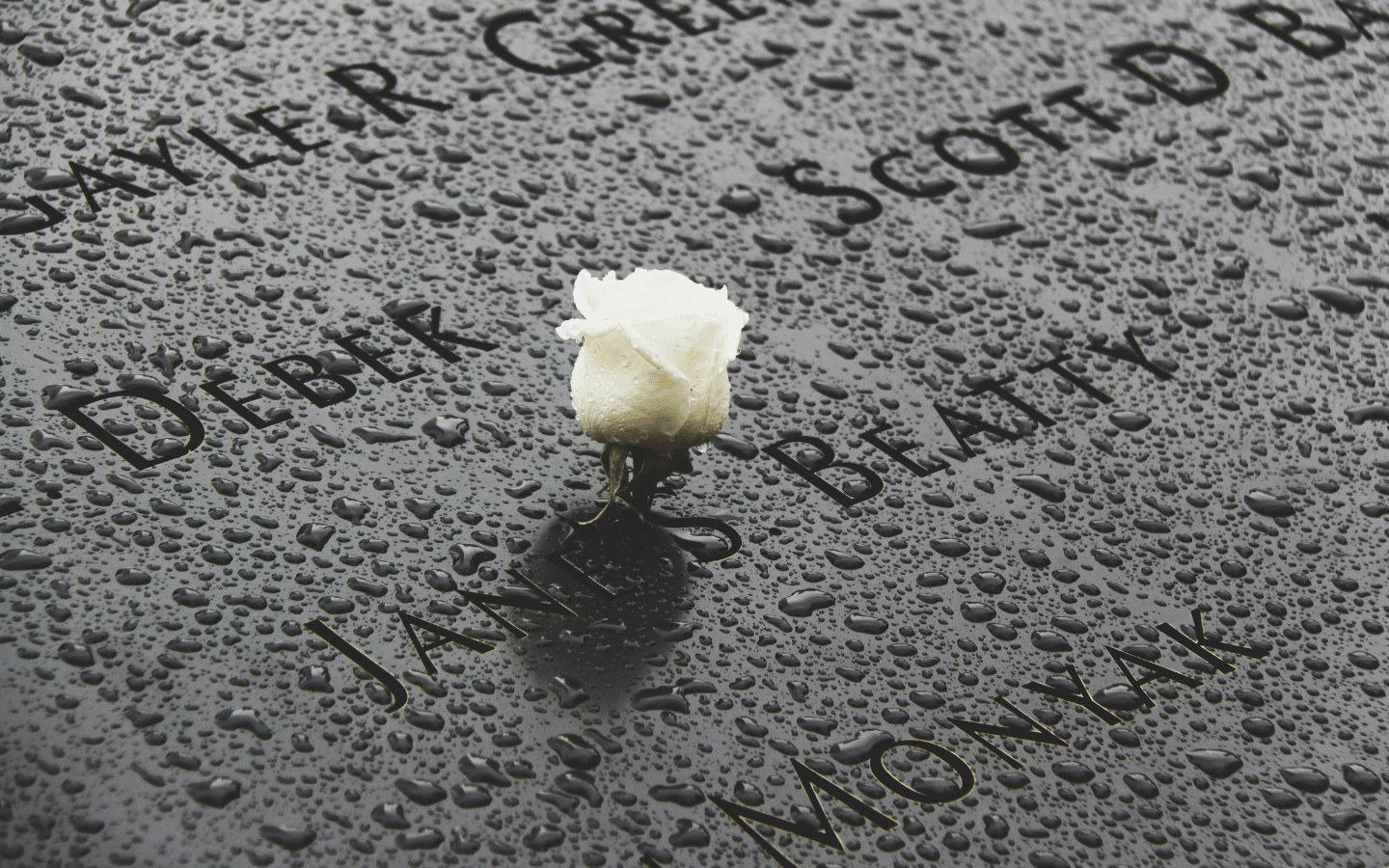
Because of the title of this column and the date it is being published, I imagine the necks of some readers are beginning to tense up. I get it. I’ve had my own emotional and physical discomfort as I’ve contemplated whether to “go there” on this day, or to share a more benign message of “remembering”.
We would all do well to notice and sit with our discomfort before we respond to (and from) it.
Good News?
Several years after the September 11 terrorist attacks, my pastor preached a sermon on forgiveness and the radical nature of God’s love. In it, he shared an image from a painting by Lars Justinin. The artwork depicted Jesus kneeling with a basin of water, washing the feet of world leaders seated in a row. The group included George W. Bush, Tony Blair, and Angela Merkel.
It also included Osama Bin Laden.
A group known as “Heavenly Sanctuary” commissioned the artwork for a poster advertising “Good News Tour” events they held around the country. The events explored the themes of violence in the Old Testament and Jesus’ scandalous message of grace.
According to Greg Boyd, Heavenly Sanctuary contracted with several malls to carry the posters in their public spaces. They removed the posters after receiving angry phone calls from customers, many of whom were self-professed Christians. A Christian college that was to host one of the events canceled its contract.
Even my pastor at our relatively progressive (by 2008 standards) Baptist church received a good amount of admonition after his sermon depicting the painting.
Whether we knew it or not, we were contending with the same questions the Lindsay Clancy case poses, but on a much larger scale.
Who gets grace?
What about Peter?
What about Judas?
In light of the revolutionary love of Jesus, who am I allowed to call an “animal”?
A Mark of Protection
An upcoming lesson in Good Faith Bible Studies (GFBS) deals with the Cain and Abel story—the first act of violence in Scripture. After reading Tyler Tankersley’s excellent commentary on the passage and discussing it on the GFBS podcast with Dr. Sameer Yadav, I’ve been reminded that God’s scandalous grace goes back much further than when it was incarnated by Jesus.
Like many white Christians, I grew up being told all sorts of horrible and horribly untrue things about the mark God placed on Cain after he killed his brother. But contrary to what we were taught, the “mark of Cain” wasn’t a curse. The curse was that Cain was destined to wander the earth for the rest of his life.
The mark of Cain was a blessing. “Anyone who kills Cain will suffer vengeance seven times over,” the story reads. “Then the Lord put a mark on Cain so that no one who found him would kill him” (Genesis 4:15).
This would be a good time to return to our discomfort.
The inevitable accusation will come that bringing up grace in light of violence, whether localized or on a mass scale, is an attempt to excuse or absolve those who perpetrate it. That accusation shows how small our moral imaginations are, and how little we understand grace.
We must never excuse violence. Whether it is a mother who strangles her children, a group of religious fanatics who hijack planes and run them into buildings full of people, or a nation that “mistakenly” drops a bomb on a schoolhouse full of children in a war it didn’t have to wage, all acts of violence are an affront to God and must be accounted for.
But for those of us who follow the enemy-loving Jesus who doles out grace in ways we sometimes find a bit too reckless, we must never forget that we are all created in God’s image. The question of who we get to call “animal” was settled a long time ago. The answer—through our pain, anger, tears, and anguish—is “no one.”

- About the Author
- Latest Posts

Senior Editor at Good Faith Media.