
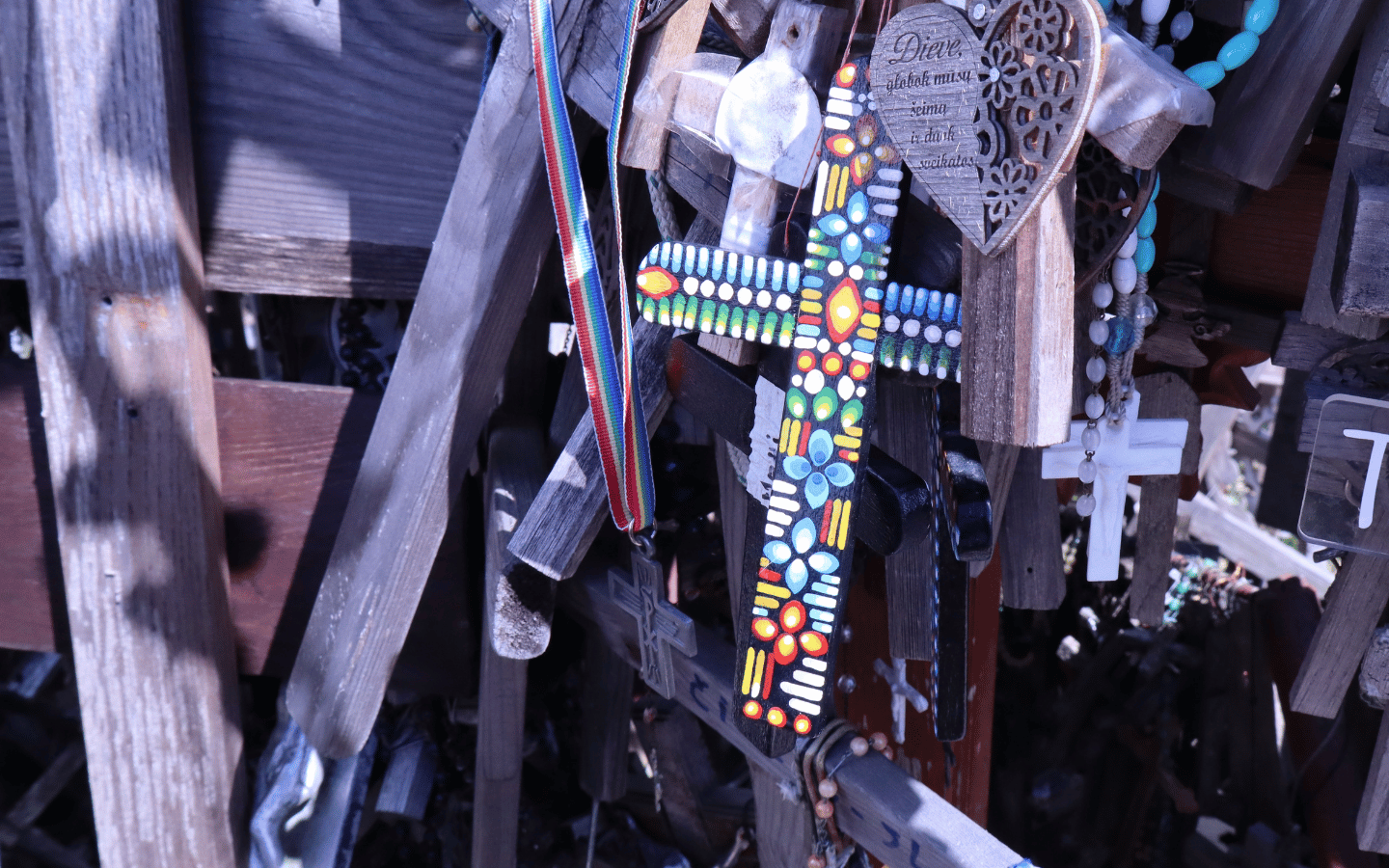
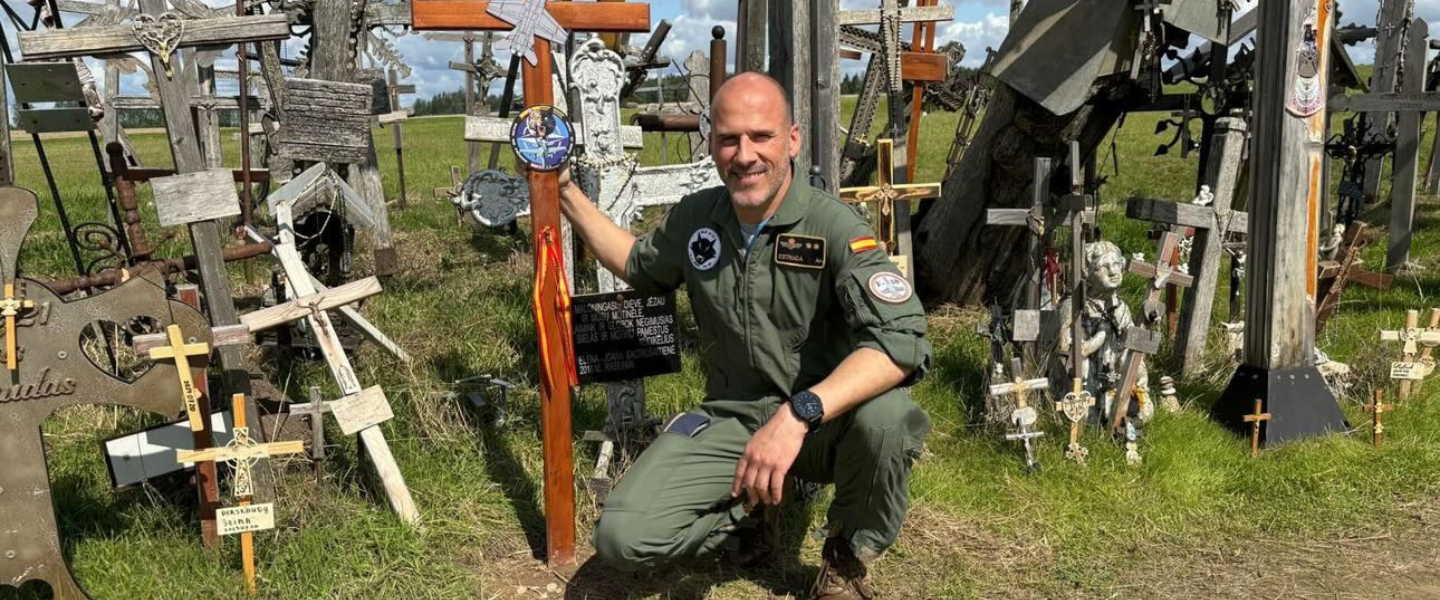
At the end of his 2024 mission in the area, Pablo Estrada Martín planted a cross at the foot of a hill near Šiauliai, in the Lithuanian countryside.
The air base in Šiauliai (pronounced: show-lay) is a hub for NATO’s defense of the Baltic region, and it is a tradition for NATO units to place a cross on the hill after completing a training mission. They do it to remember their work and to honor the resilience of the Lithuanian people throughout centuries of occupation and oppression.
While Estrada was stationed in Šiauliai, leading Spain’s participation in NATO’s Baltic Air Policing mission amid increased Russian activity in the region, his smile and charisma illuminated every room he entered. Everyone loved him, from the hotel staff to his fellow airmen to the foodservice team at the air base.
After the mission, he returned home to Spain. He continued his work with the Spanish Air Force and often spoke fondly of his time in Šiauliai and of the experience of placing the cross at the foot of that hill.
A few months after his return, on Friday, October 4, Lieutenant Colonel Estrada was flying a training mission in an F-18 fighter jet that crashed in the mountains near Teruel, in eastern Spain. He was unable to eject and died on the scene. Investigators believe a large vulture collided with the canopy of his aircraft, causing the crash.
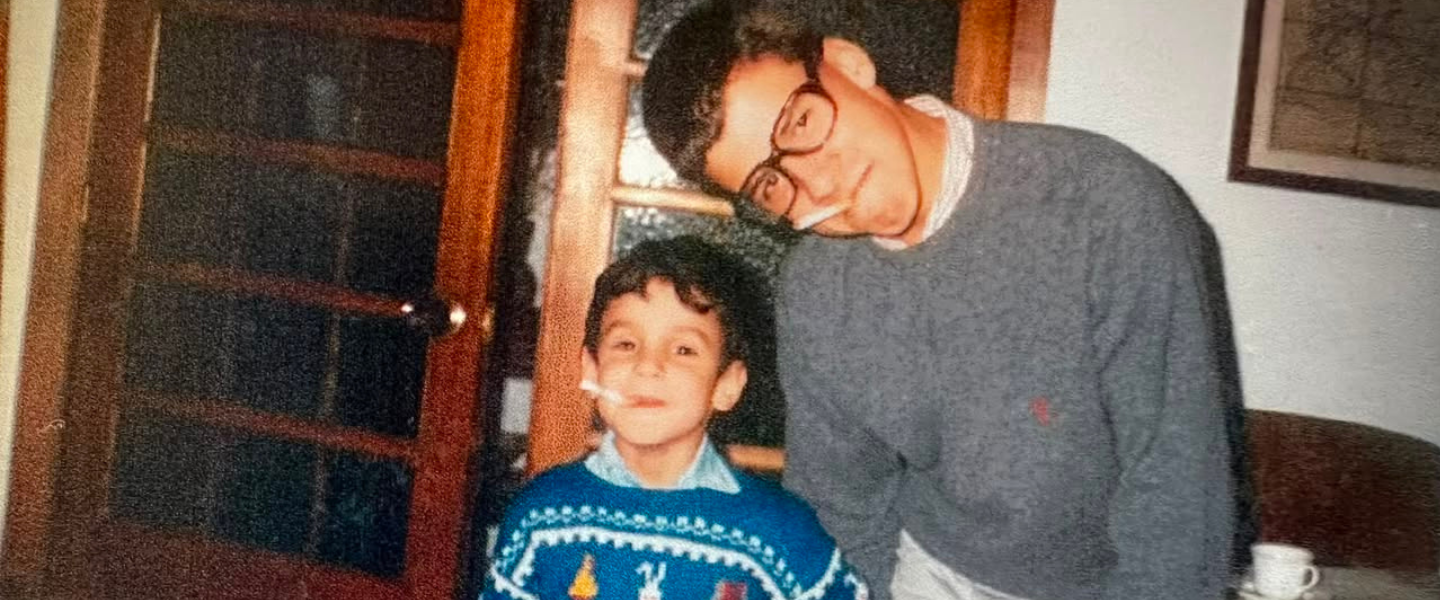
Estrada left behind his wife Gema and their four children, Pablo, Nacho, María and Carlota, as well as a sister with whom he shared a special bond, and his father Pablo, who had also been a military pilot. His mother, Mati, preceded him in death. On July 13 of this year, Pablo and Gema would have been married for 25 years. His family and friends grieved deeply the loss of the man who warmed their worlds with his light.
On the first anniversary of his death, Spanish military personnel gathered at the cross he had planted to pray and honor his life.
On a Hill, Faraway
No one knows who first laid a cross on that hill in a remote field in northern Lithuania, a three-hour drive from the capital of Vilnius. But after an 1831 uprising against Russian colonization, the crosses began to appear en masse. The hill served as a fort, and historians believe that the families of fallen soldiers whose bodies could not be found used it to honor their memory. Another uprising in 1863 expanded the hill’s significance and increased the number of crosses appearing.
After the world wars of the 20th century, the Hill of Crosses took on deeper meaning during Soviet control, as the largely Catholic nation of Lithuania struggled against religious oppression. The site became a national symbol of resistance.
On at least three occasions, Soviet forces bulldozed the hill, burned the wooden crosses and crushed the stone ones. In the late 1970s, they tried to flood the plain surrounding the hill, hoping it would deter the faithful from making pilgrimage there.
After each attempt to destroy Kryžių kalnas, the crosses kept coming. In the dark of night, Lithuanians evaded KGB agents guarding the area to rebuild this emblem of their faith.
The hill gained worldwide prominence in 1993 with a visit from Pope John Paul II, where he remembered those who were condemned to prison, deported, or sentenced to death for their faith by the Soviet Union.
“Innocent people were being condemned,” he declared in a mass celebrated on the hill. “A terrible system of totalitarian violence was raging in your homeland at the time. A system that trampled and humiliated humanity.”
He went on to speak about the “drama of the cross,” which has “given meaning and value to suffering, illness, and pain.”
“Love surpasses murderous hatred, which has also spread violently throughout our European continent,” he said. “It is the love with which God loved the world, in Christ crucified and risen. The Cross is a sign of this Love. The Cross is a sign of eternal life in God.”
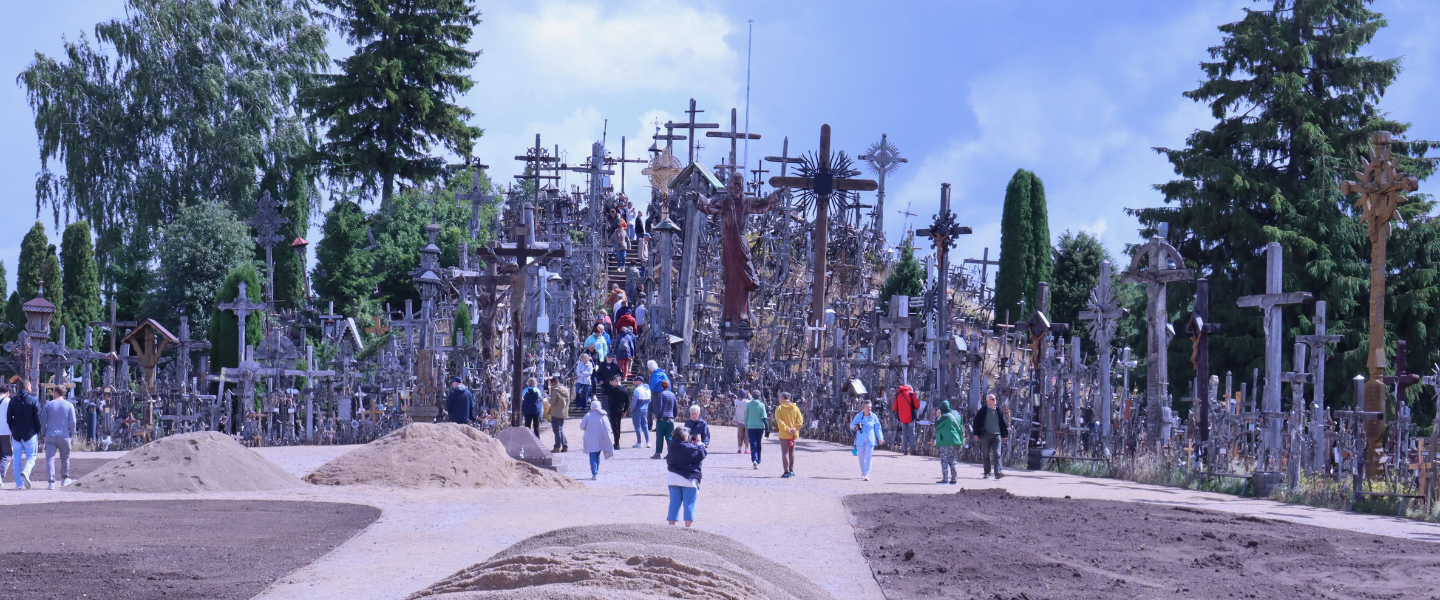
It is estimated that there are currently over 100,000 crosses on Kryžių kalnas. On a recent trip to the site, however, I couldn’t help but suspect the number is at least double that. The stories represented there could fill at least as many libraries.
The Old Rugged Cross(es)
I walked the pathway toward the Hill of Crosses on a chilly, rainy summer day. I carried more than curiosity about this pilgrim site in the Lithuanian countryside. I also brought my own religious identity as a Christian whose life has been shaped by the meanings and stories of the cross.
As a child who grew up steeped in evangelicalism, the cross had a singular meaning. It was on a cross, I was taught, that the savior of the world died to atone for my sins. We would fashion crosses from wooden popsicle sticks for the refrigerator, or from leather and beads to hang around our necks as a sign that we were forgiven.
Later, I would learn there were other, more layered and nuanced ways to see what happened on the cross where a Palestinian Jew named Jesus died. It was the ultimate victory over death, the key that opened the doors to new life. It was a model of suffering those who chose to follow Jesus were to emulate, and it was a renewal of a covenant made to the ancient Israelites.
Despite the insistence of some of my elders that the cross meant only one thing, I gradually came to understand that it could not be contained within a single doctrine. Its power extended beyond what happened at one time on one cross.
Many of the crosses at Kryžių kalnas were crucifixes, with a representation of Jesus still hanging on them. Others were more of the Protestant variety, and I heard echoes of fire-and-brimstone (and mildly anti-Catholic) pastors yelling, “He’s not there!” Some of the crosses were as tall as two stories, while others were trinkets by the thousands hanging onto other crosses.
More than a few had names and dates on them, or flags. Wood, stone, silver and gold fashioned into crosses peppered the countryside.
I could tell the sky was about to open, so I dashed to the Franciscan monastery building about a hundred yards from the hill, my cheap convenience-store umbrella fighting against the cold wind. Thankfully, the door was open, and I sat in the chapel, contemplating a small cross on an altar, looking across at the hill. Outside the window, a wood carving of St. Francis peered in.
I tried to feel something, reflecting on how five decades of familiarity with the cross can desensitize you to the symbol of the event that Christians believe is the penultimate act in our redemption story.

The Story of a Life
When the rain began to subside, I walked back to my car along a path that led me back to the hill. Rather than walking back up and over, I encircled the hill to get one last look at some of the crosses at its base. Near the entrance, I noticed a lanky, olive-skinned man fastening a ribbon to a plate bearing a cross and other symbols, including military patches.
It was placed next to a cross that held a NATO patch and a medallion of an F-18 fighter jet.
I decided to linger, hoping I could hear his story. After a few moments, I approached and asked if he minded telling me about the cross he was planting. In the coming moments and days, Jaime Aguayo was extremely generous in sharing with me the life of his cousin and hero, Colonel Pablo Estrada Martín. (Estrada was posthumously promoted to Colonel.)
“Pablo was one of those rare people you always hoped to have sitting next to you at dinner,” Jaime said. “He made everyone around him feel valued. He taught you, looked after you, and had a remarkable ability to make you feel you were the most important person in the room.”
Pablo’s death has been grievous for all his family and friends, including his large collection of cousins.

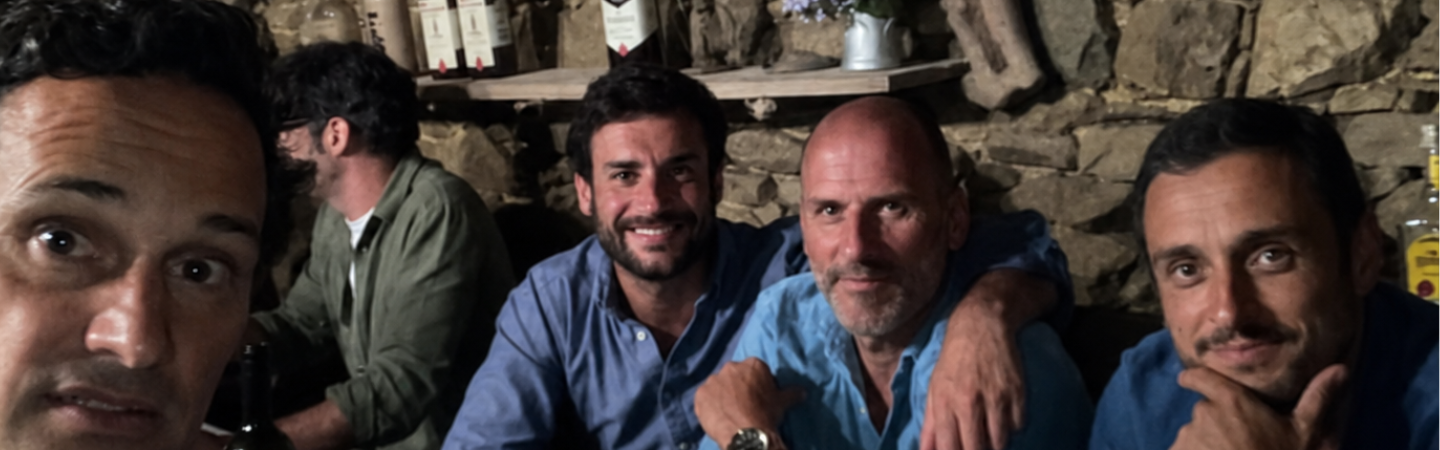
Jaime Aguayo
After seeing photos of Pablo’s fellow airmen visiting the Hill of Crosses on the anniversary of his death, Jaime became interested in the site. He mentioned to his friend Alvaro that he would love to visit the site one day to place a cross next to Pablo’s. That Christmas, Alvaro received Jaime’s name in their friends’ secret Santa drawing, and purchased them tickets to Lithuania.
Jaime commissioned a blacksmith to create an altar fashioned in the form of the Cross of Victory, which has its origins in the region where Jaime’s family is from.
Jaime wore a Penn State Nittany Lions cap as he placed the cross next to Pablo’s. The hat had belonged to Pablo, who purchased it when he was a high school exchange student in San Antonio, Texas, just down I-35 from where I live. Penn State holds no significance for Jaime, other than that the hat belonged to Pablo.
In our conversation and messages, Jaime fondly remembered visiting Pablo at the air base, playing video games, eating homemade Cocido madrileño, and keeping him company while he performed his duties beside the F-18. He also tells of the cycling routes they would ride on together, large family celebrations, and summers spent together in Asturias.
“For me personally, Pablo meant everything from the time I was very, very young,” Jaime said. “I always wanted to be by his side.”
Death and Life
Some may find aspects of the site and the crosses placed there problematic, and for legitimate reasons. As is the case with any religious symbols, the temptation is always to use them in an attempt to baptize our personal and national identities, without participating in the very act of sacrifice the cross represents. In this respect, we must always be on guard against idolatry.
But we should never dismiss the power of the cross to teach us something about our loves and affections, and of the enduring power of light over darkness.
Jaime’s tears as he placed his cross beside Pablo’s bore witness to the depth of his love for his cousin. They reminded me that some lives, like Pablo’s, are so otherworldly that there must be another world.
Love is stronger than death, and death is not the final story. That is the message of the cross.
- About the Author
- Latest Posts

Senior Editor at Good Faith Media.