

Editor’s Note: The following first appeared in the October-December 2025 issue of Good Faith Magazine, which is a free resource for all Good Faith Advocates.
I’ve had the pleasure of experiencing the Q Christian Fellowship Annual Conference for the past two years. It’s an amazing event because LGBTQ+ Christians and allies from all walks of life come together for one main goal: to worship God together without the threat of harm.
Because there are so few spaces where people can bring all of their queerness and all of their faith, they don’t squabble about the particularities of what it means to be a queer Christian. That is to say, they cast a wide theological net. Every worship service is inspired by a different worship tradition: gospel, Pentecostal, contemporary, and always culminating in a high-church Communion service. The workshops are just as diverse, maybe even more so. It’s perfectly normal to see a celibacy workshop happening right next door to a workshop on ethical nonmonogamy, happening across the hall from a seminar on Bible interpretation. Even though those gathered don’t always agree on what it means to be queer and Christian, they all agree that it’s crucial for us to have spaces where we can bring both identities together without shame.
In both years I have attended, I have heard innumerable people express gratitude for a space where they can bring their full selves – their queerness and their faith – to the table. The narrative I kept hearing repeatedly was some version of this sentiment: I’m too queer for Christians and too Christian for queer folk.
I’ve experienced this phenomenon myself. While my Facebook and Instagram pages get homophobic comments from time to time, my (short-lived) TikTok page only received one. Instead, most of the negative comments I received on TikTok were from queer people who felt I had betrayed the LGBTQ+ community by being a pastor – that I had aligned myself with the institution that causes my people the most harm.
Am I too Christian for my queer community? Too queer for Christianity?
I can’t say with confidence if queer people of other faiths experience similar struggles (maybe I can say that a little more confidently about the Abrahamic traditions, as we share a lot of scripture), but I’m willing to bet Christianity isn’t the only religion with this problem.
Regardless of whether it’s exclusively a problem in Christian spaces, one thing that surprises me about queer people’s discussion of this issue is the insistence on thinking about this problem within a binary – thinking that insists things can only exist on a spectrum of “this” or “that,” and if a thing isn’t “this,” then it must be “that.”
Take temperature, for example. Binary thinking would insist that if water is not cold, then it must be hot. However, our lived experience tells us that if water is not cold, it could be tepid, lukewarm, boiling, room temperature, or a wide range of other temperatures. You can probably name even more variations than those. When we test binary thinking against our lived reality, the theory falls apart.
The same is true of the false binary insisting that someone or some place can only be queer or Christian. That false binary breaks down in my own lived experience as I hold firmly to both my faith and my queerness as an openly queer pastor at a Baptist church. (In the South, no less.) Additionally, I have queer ministry colleagues serving in churches in Georgia, Texas, Florida, Washington, Kentucky, Tennessee, and elsewhere. Not only that, many of those churches celebrate queerness as part of God’s creative design. They put up rainbow vestments for Pride. They observe Trans Day of Remembrance as a holy day of lament. They even occasionally host Drag Gospel Brunches during worship – as their Sunday morning worship service.
I don’t say this in an attempt to discredit the experiences of those who shared their stories with me at QCF; there are absolutely queer places that find our faith “too much” and faith communities that can’t tolerate our queerness. But those extreme “you have to be this or that” communities aren’t the only spaces that exist. If we occupy spaces that insist the binary is the only way of being, perhaps it’s time for us to step away from the gap between that one specific rock and that one specific hard place.
The problem isn’t that there aren’t institutions that create room for both queerness and faith to exist; the problem is that we don’t know about them.
LGBTQ+ affirming congregations may not have quite the volume that nonaffirming congregations have (Lord knows when I was looking for a new church to serve, my options were minimal). Still, these spaces are certainly more common than unicorns. Why don’t more people know about these faith communities?
A network of welcoming and affirming faith communities isn’t seen as an enticing story, so mainstream media doesn’t report on them. Generally, they opt to cover the angry faith-based folks protesting Pride parades and Drag Brunch. Anger gets views, so the data tells us. The angrier, the “better.”
All these challenges make our work with the Faithful Pride Initiative (FPI) necessary. We want it to be not only a space where we make GFM’s content easily accessible. We also want FPI to be a place that nourishes the souls of LGBTQ+ people of faith because we know that our lives are not boiled down to simple “this” or “that” falsities. As such, we are working diligently to create resources, cultivate relationships, and share experiences that will help queer people of faith do precisely that.
In that vein, I’d love to hear from you! Are you a queer clergy person serving in a faith community? A queer person of faith doing some excellent nonprofit work? We want to hear your story. By sharing our stories, we can not only highlight that there are spaces beyond that small gap between a rock and a hard place, but we can create more of them. I don’t know about you, but more places where we have room to stretch our arms, give ourselves space to breathe, and be comfortable in the skin God gave us sounds like God’s kin-dom on earth to me.
I’m optimistic (maybe naively so) that we don’t have to accept that a life between a rock and a hard place is the best we can hope for when it comes to embracing both our queerness and our faith. Maybe you’re not there yet, and that’s okay. We have a lot of work to do before affirming faith spaces are the norm. But the good news is people are already doing that work. People have been doing that work for a long time. People will continue to do that work, and you can be part of it, too.
- About the Author
- Latest Posts
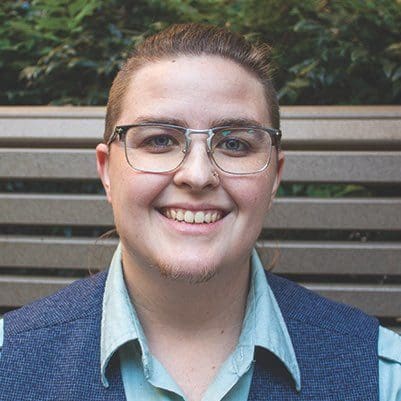
A bivocational pastor, writer and spiritual director based in Williamsburg, Virginia, she currently works as a Spiritual Director at Reclamation Theology. Cawthon-Freels is the author of Reclamation: A Queer Pastor’s Guide to Finding Spiritual Growth in the Passages Used to Harm Us (Nurturing Faith Books), and a contributing correspondent at Good Faith Media.