
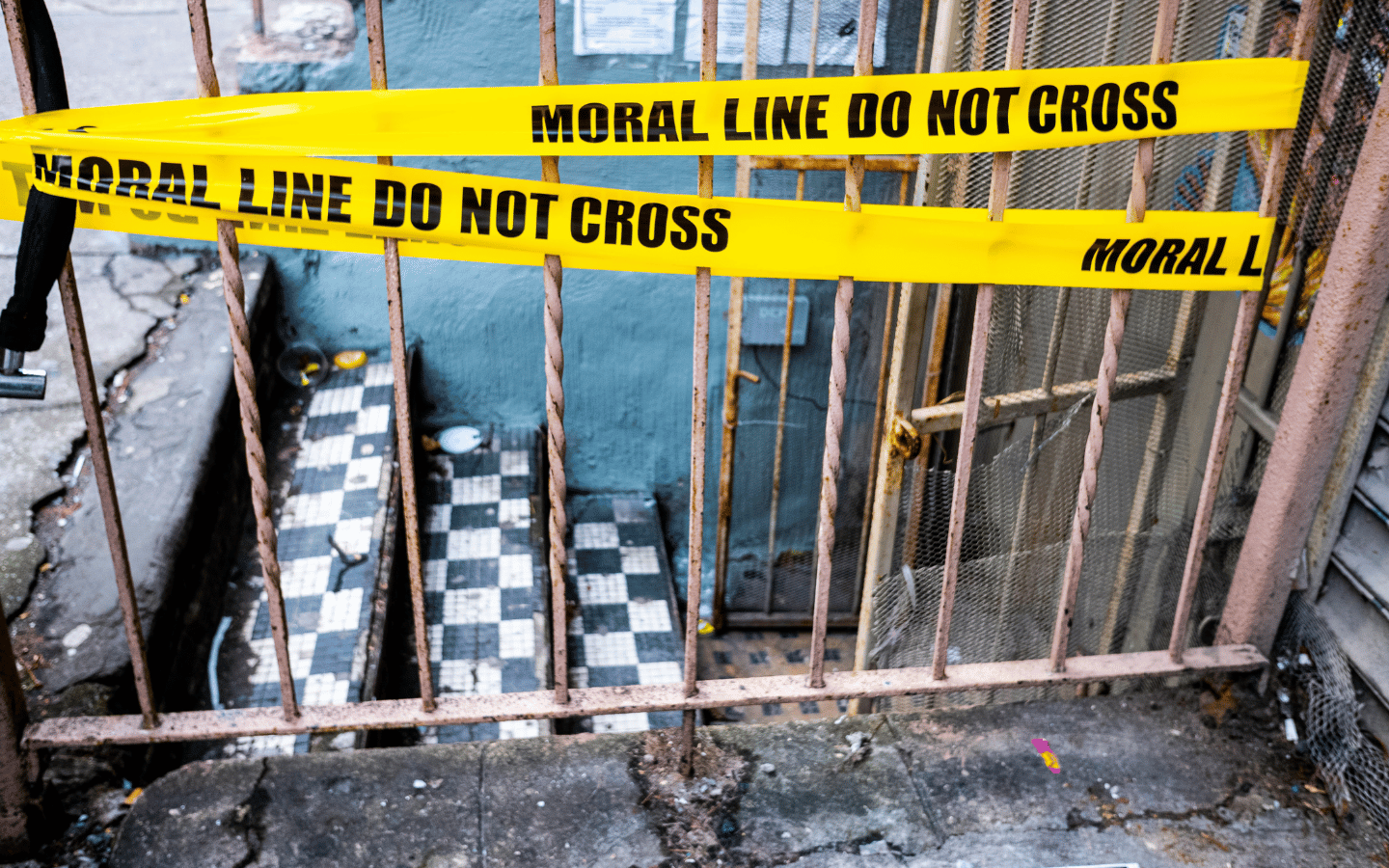
I am a Christian, retired military officer who commanded units in Iraq and Afghanistan, and for much of my adult life, I was a registered Republican.
Over the past 12 years, a question has kept returning: For Christians, is there a line below which a candidate’s character and conduct become disqualifying? And if there is, where is it?
Donald Trump has been convicted of 34 felonies. He has been found by a jury to have committed sexual abuse, and was caught on tape describing serial predatory behavior toward women. And he instigated the events of January 6th, telling those assembled that they needed to “fight like hell” because reclaiming power could not wait for the next election.
Yet approximately 80 percent of white evangelicals—those who describe themselves as born-again or evangelical Christians—voted for him.
His white evangelical supporters consistently give one justification: abortion. They say the real moral issue is to protect the life of the unborn, leaving the candidate’s moral conduct largely irrelevant.
But the actions of most evangelicals don’t match their stated conviction. Have they adopted or fostered a child? Volunteered at a crisis pregnancy center? Donated to organizations that support mothers in need? For most, the honest answer is “no,” and that gap matters. A moral conviction that shapes your vote but nothing else in your life begins to look less like a desire to honor God and more like a convenient justification.
I am not arguing that Christians should vote for any particular party or candidate, or even vote at all. It is narrower and more urgent: at some point, a candidate’s moral character must become disqualifying. And if Donald Trump’s consistent depravity does not cross that threshold, what would?
A Lesson from Battle
The U.S. military I served in has long wrestled with similar questions—not about elections, but about conduct in war. We were taught St. Augustine’s just war theory, which rests on a foundational premise: the ends do not justify the means. How you fight matters. Your cause, however righteous, does not excuse the methods (or leaders) used.
I saw this principle put to the test in Afghanistan. A suicide bomber dressed in a woman’s burqa killed several Afghan civilians, a number of Afghan police officers, and two members of our team. Despite the enormous grief, anger, and fear, our team continued to treat Afghan civilians with dignity and respect, even when doing so made our work harder and the risk greater. We understood that abandoning our standards would violate the oath we had all taken and would set us down a slippery moral path.
I think about the team often when I hear evangelicals explain their support for Trump in transactional terms—pro-life judges, lower taxes, culture war victories. The logic of evangelicals, reduced to its essence, is that the outcomes justify their choice. Making a moral reprobate the world’s most powerful person is acceptable as long as their goals are achieved.
But that reasoning has never been acceptable in the Christian tradition. It was not acceptable to Augustine. It was not acceptable to the men and women I served with in a remote Afghan district. And it should not be acceptable at the voting booth.
A Lesson from the Bible
The New Testament offers a haunting parallel. When Pontius Pilate offered the crowd a choice between Jesus and Barabbas, a moral reprobate of his time, the religious leaders and the crowd chose Barabbas.
Though the analogy is imperfect, as Jesus never ran for office, the warped logic resonates across the centuries. The crowd was angry, fed up, and hungry for power. Unwilling to endure any longer, they made a choice that stands as one of the most sobering examples of a religious community allowing its desires to override its deepest convictions.
Two thousand years later, most of us read that passage and are certain we would have chosen differently. But if a convicted felon, a man found civilly liable for sexual abuse, and a man who inspired a violent attack on the seat of American democracy does not represent a bridge too far, what does?
- About the Author
- Latest Posts

Retired colonel from the U.S. Air Force.