
“Your turn now: show us what you have in your gut.” — Mohamed Mbougar Sarr
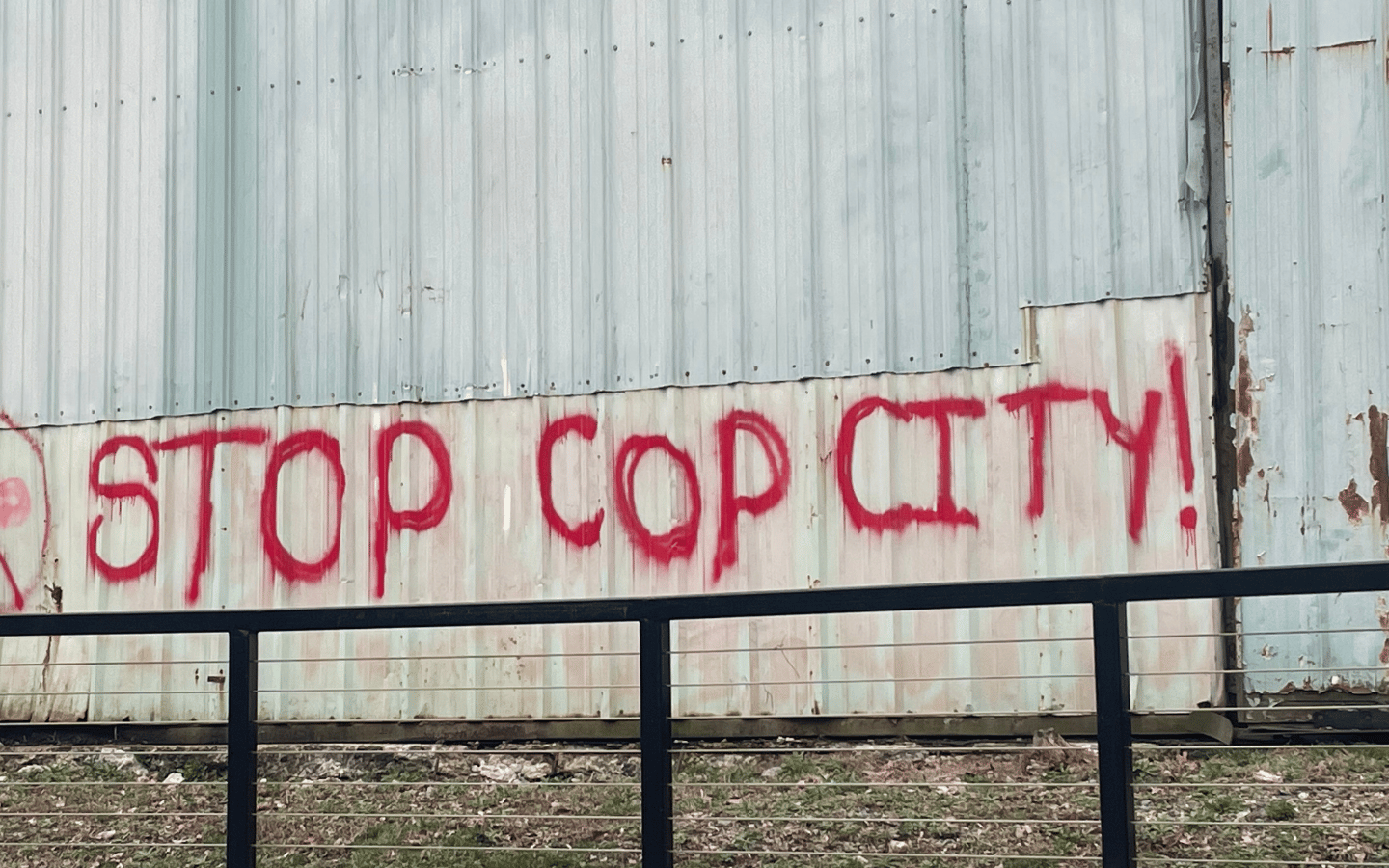
In 2021, activists and organizers were ready to resist the moment Atlanta’s then-mayor, Keisha Lance Bottoms, announced plans for Atlanta’s “Cop City.” The project would wipe out hundreds of acres of undeveloped land in southeast Atlanta, just outside the city limits but in an otherwise densely populated area.
It would disturb ecologically sensitive lands. The shooting range would degrade life in nearby neighborhoods.
The allocation of $90 million in taxpayer funds to police training facilities occurred amid a global pandemic and a nationwide movement against police brutality. This meant further injury to the communities hit hardest by pandemic health disparities and epidemic police violence.
The “Stop Cop City” movement that followed gathered national attention. Protesters and organizers used a variety of tactics to derail the development, sending thousands of emails and phone calls to Atlanta City Hall. They packed local forums, town halls, and council meetings.
Activists moved into the forest, calling themselves “forest defenders” and bravely putting their bodies on the line. One of them, Manuel “Tortuguita” Paez Terán, was eventually killed by a Georgia State Bureau of Investigation SWAT team.
Some activists tried to raise the cost to developers and builders by damaging construction equipment at the Cop City site, and at others around the city. Other funders and associated businesses faced episodes of property destruction. When protesters were arrested, the Atlanta Solidarity Fund was ready to bail them out of jail.
Facing a well-organized and committed resistance, state and local authorities countered with the only tactic violent state actors know: increased repression.
Officials couldn’t be convinced not to build Cop City, which opened in early 2025. Instead of listening to their constituents, the politicos worked to punish dissent even more harshly.
The state charged three bail fund activists with money laundering. In March 2023, police arrested and charged at least 23 people with domestic terrorism charges.
Charging documents revealed no evidence directly connecting those arrested to alleged property destruction. Instead, cops made flimsy arguments for probable cause, like the common protest strategy of having bail fund numbers written on one’s arm in case it is needed. Yet in September 2023, sixty-one people arrested in the demonstrations had their charges upgraded under Georgia’s Racketeering Influenced and Corrupt Organizations (RICO) laws.
Faced with court scrutiny, nearly all of the most serious charges against Cop City activists were dropped. But much damage was done in the process, as organizers struggled to get jobs or to hire attorneys, thanks to the way their lives had been turned upside-down by angry prosecutors and vengeful cops.
New Headlines, Old Story
The prosecutorial strategy of chilling dissent by overcharging dissenters is in the news once again. The federal government is increasingly using federal conspiracy charges to try to rein in protests against its violent nationwide immigration raids.
Federal prosecutors managed to secure domestic terrorism convictions against demonstrators at the Prairielan ICE facility in Texas for “crimes” that included being a member of a leftist book club and owning a printing press used to print anarchist publications. The convicted are facing sentences of at least 30 years for their resistance.
Increasing state repression in response to organized resistance is not a new strategy. It is a well-worn path employed, not to mention taught, in and by the United States and around the world. It can sometimes indicate that a regime is losing its grip on power.
Although a political system under the consent of the governed can tolerate or even incorporate dissent, a truly powerful ruling class has little to fear. Cracking, weak regimes over-rely on state violence to stave off their inevitable downfall.
Authoritarian tactics like those the Trump Administration is implementing are attempts to consolidate power, make the state appear impenetrable and its totalitarian rule inevitable. The same methods, however, tend to plant the seeds of their own demise.
Power is never permanent and the world is filled with decent people who, though they sometimes move too slowly, eventually tire of indecency—or find themselves the target of it.
Fortunes quickly change. Those who live by the sword die by the sword.
However, state repression is effective, at least in the short term. Raising the cost of disobedience will buy the authoritarians a little more time while the timid decide what, and whom, to risk.
Costly Resistance
A half-century ago, the brutality of the United States was aimed not only at minorities and working-class people at home, but also at Vietnam rather than Iran. Some things never change; others do, however slightly.
The Civil Rights Movement had won many victories, but progress had stalled out for the progressive movement, as well as for the peace movement. Weary of cascading oppressions, a radical group called The Weather Underground took up more ferocious protest tactics, including building explosives for the purpose of property destruction. (The compelling podcast Mother Country Radicals, produced and narrated by one of the children raised in the underground, is a good primer of their history.)
They shocked the consciences of the nation. Black radicalism was unpopular, but expected. The country knew of both its guilt and its intransigence, even if it vowed never to repent.
But the Weatherfolks were white. They rejected the brutish social contract of American life altogether. They could have been its silent beneficiaries or its irritating but harmless wave of endless incremental reformers.
They made a choice, however, that the rest of polite society assumed did not exist. It was that choice and confrontation with reality it provoked that terrified Americans about the Weatherpeople more than bombing empty buildings did.
The fugitive priest Daniel Berrigan sent word to them in August 1970. He was underground himself at the time, on the run from the FBI following his sentencing for burning draft cards in Catonsville, Maryland. Berrigan differed from them a bit on tactics and the use of explosives. He stood in solidarity with them, however, on the analysis of what time it was, and what the times demanded.
“It’s best to meet troubling times with risk-taking love,” he told them. “This is why we accept trouble, ostracism, and fear of jail and death as the normal condition under which decent men and women are called upon to function today.”
I should prefer that the ranks of the decent, those of goodwill and committed to neighbor-love, rise up a bit more quickly. We have seen enough already to know what the times demand of us: Conspiracy, everywhere and all at once, is not crime, merely culture.
- About the Author
- Latest Posts
Greg Jarrell is a cultural organizer with QC Family Tree in the Enderly Park neighborhood of Charlotte, North Carolina. He is the author of Our Trespasses: White Churches and the Taking of American Neighborhoods.