
Editor’s Note: The following first appeared in the November-December issue of Nurturing Faith Journal. In 2025, NFJ became Good Faith Magazine, which is available as a free resource to all Good Faith Advocates. More information on becoming an advocate can be found here.
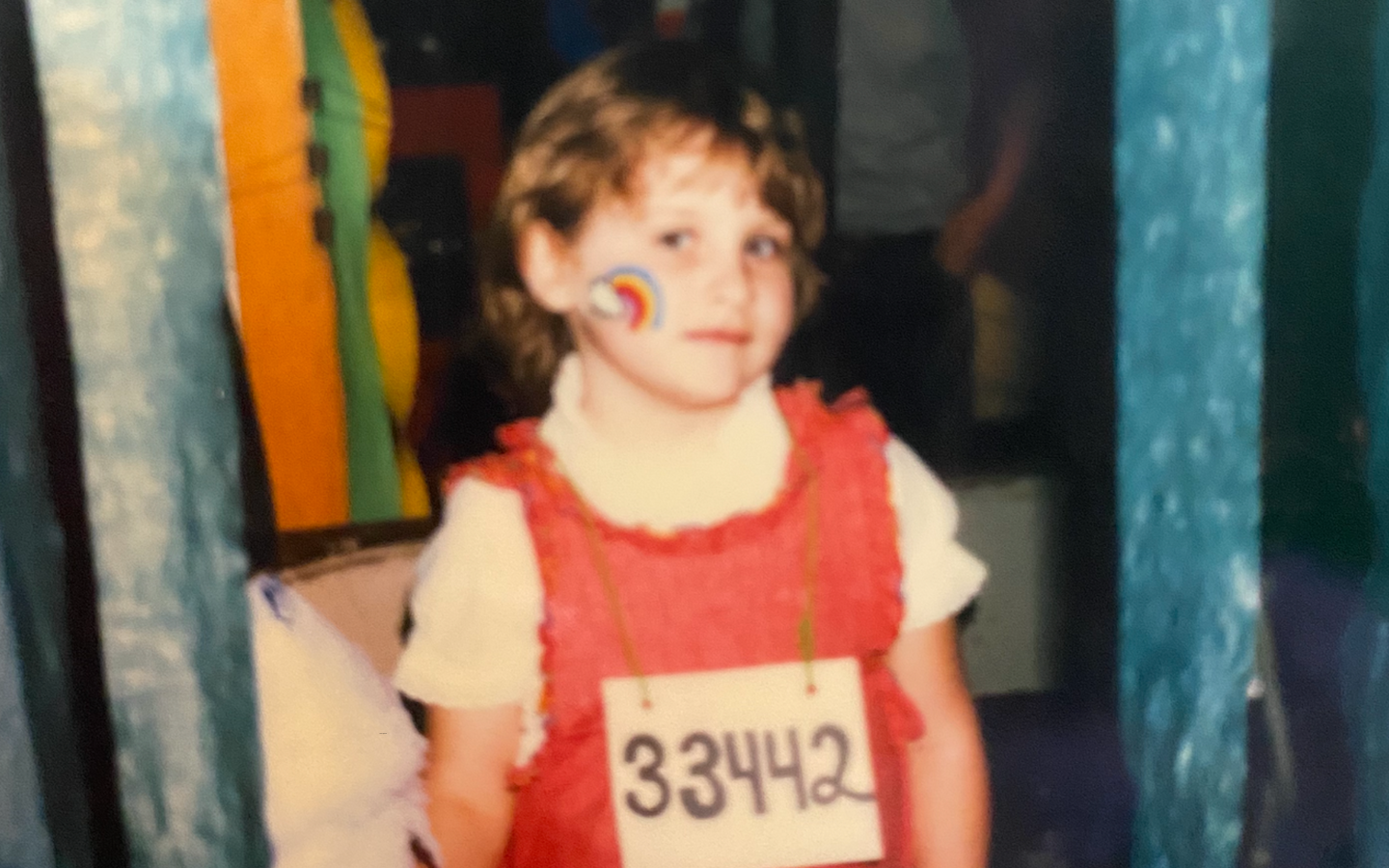
As I sorted through old boxes, preparing for a move, my jaw dropped upon finding a deeply symbolic photo. In this image, I am about five years old, “imprisoned” in the indoor gymnasium of our church festival.
St. Brendan Parish on the west side of Youngstown, Ohio, was one of the two churches where I spent my formative years. The church operated the makeshift “jail” as a festival game. Parents or guardians could place their kids in this prison while they walked around the festival. Parents would then be required to “post bail” (i.e., donate money to the parish cause to get their kid out).
I’m sure that at the time, I was all for this. After all, it was a fun game that all the kids were playing. What Catholic school kid doesn’t want to fit in?
Looking at the photo, my adult jaw-drop turned into a smile when I beheld the rainbow painted on my face, a treat from earlier that evening at the festival. The evidence of where my journey began stared me in the face from that photo. As a young, free-spirited person who would start to figure out she was queer at that same church’s elementary school in the coming years, the church was not just a pretend jail; it was my actual prison.
In the Christian tradition, the church can be a building, an institution, or an assembly of individuals. The English word traces back to Greek, where church meant the Lord’s house.
I grew up in not one but two rather conservative Christian denominations. Around the same time as the incarcerated rainbow photo, my father left Catholicism and became active in the Assemblies of God, a Pentecostal, charismatic branch of the Evangelical movement.
Converted largely through the influence of televangelists Jim Bakker and Jimmy Swaggart during the heart of the AIDS crisis in the 1980s, Dad dove in all the way. He vocally expressed his beliefs about queer people being an abomination. He would later teach me the word Feminazi, coined by his idol Rush Limbaugh.
Such teachings were two of the many that struck down and further locked up any of my blossoming queer, feminist, and free-spirited natures as a child. My mother, who remained fervent in her Catholic faith, suddenly became the enemy he pressured to convert. And I, the eldest, became a pawn in their unholy war as they fought for my religious allegiance.
I remember being pulled into arguments about theology as early as eight years old. During one such dinner, they debated the doctrine of the Immaculate Conception — the Catholic teaching that Mary, the mother of Jesus, was born without sin. Considering my father, who was more temperamental than my mom, routinely referred to the Catholic Church as the Whore of Babylon, siding with his version of warden felt like the safer bet.
Arguments like these over church and doctrine littered my childhood, as I went to both churches every Sunday morning. I would go to 9 a.m. Mass with Mom, who insisted her kids still be raised Catholics as a condition of staying with my dad. Then, my father would pick me up in his minivan from the side of the Catholic church and take me to the Evangelical program at 10:30 a.m. Many of the messages at his church were anti-Catholic and thus anti-my-mother, who, despite some of her beliefs, was still the gentler parent.
As I aged, I discovered that their at-odds denominations did agree on some things – namely, that women should not have the autonomy to choose what to do with their own bodies and that being queer was both an embarrassment and a sin. Mom, who had a gay friend, was a bit more tolerant. Dad was just clear that being queer or trans would earn you a life sentence in the fiery pits of hell. Yet, living with him and dealing with his temper and theology felt like hell, as I already knew as early as nine that I liked girls and boys.
As a queer person who still keeps one foot in their Christian identity, church is not an inherently charged word for me today. I know God, as I understand God, lives everywhere. I also know that God’s houses exist within all our hearts.
Inspired by the growing movement of LGBTQIA+ affirming churches across a variety of Christian denominations, I have learned that church doesn’t have to be a horrible place for people like me.
Neither of the churches in which I was raised accepted me. What stung even further is that, while they disagreed on much regarding Christian theology, they agreed on one thing – that people like me should never freely exist as ourselves within the confines of the church prison or the larger society. And I had to stay in church to be “saved” or to live their version of a normal life.
To be told that “God’s love for you is unconditional – but only if you do exactly what the Bible/the church expects of you” was the ultimate mixed message. And like any institutionalized person, I believed it for so long without daring to find out who I really was. Doing so would have been dangerous if I wanted to keep my family and my salvation.
Escaping prison and getting to where I am today was a process.
After one of my parents’ notorious arguments about religion and their fears of “losing me,” I plopped my teenage self onto the bed and said to myself, “I’m not sure if spiritual abuse is a real thing, but what they’re doing has to be it.” While I was in graduate school for clinical counseling at an extremely conservative Catholic institution (2003-2005), I looked up “spiritual abuse” to explore as a topic for a class and realized that others had indeed written about it.
I have gone on to become a trauma therapist and now educate others on spiritual abuse and religious trauma.
Spiritual abuse is whenever an idea of God or any religious or spiritual construct is used as a weapon by others to control and demean others who are often on the downside of power. The most common examples of this phenomenon that the general public recognizes as spiritual abuse would be in the kind of cults that show up in documentaries on just about every streaming service.
My goal is to get people to see where spiritual abuse can happen in churches, congregations, and houses of worship in all denominations, right in the middle of Main Street. The “spiritual but not religious” containers, like yoga studios, meditation groups, or communities that form around spiritual teachers who peddle their services online, are also ripe for spiritual wounding. Wherever there is a power differential coupled with something spiritual (e.g., involving the things that we cannot explain by the simple laws of nature), spiritual abuse can happen.
Even with this expanded definition, we tend to highlight those experiences that are more obviously harmful. For instance, a parent who professes Christian devotion while kicking their teenage child out of the house and condemning them to Hell is a more obvious example of spiritual abuse. A pastor, priest, or other clergy member who exploits their congregants financially or commits sexual assault clearly meets the profile for abuse. A nation-state that passes laws governing the bodies and the life choices of its citizens, fueled by religious indignation, we are thankfully starting to call that out as state-sanctioned spiritual abuse.
Now, think of the person who sits in the pews of their house of worship week after week – maybe even in the same seats that generations of family members occupied before them. Some of these folks may not have any memoir-worthy, traumatic tales to share with a therapist. On the surface, they might look like a model citizen, living an apparently normal life, with their participation in church regarded as a sign of their civic involvement and commitment to their community. Have they been in prison, too?
Expectations are confining; they can be their own prison: expectations that you will not explore your feelings for people of the same gender or even be curious about your own gender expression and experience; expectations that you will have certain views and vote for only certain people based on those views; or expectations that you won’t ask questions about whether there are others ways to experience God in one’s life. You go through the motions because no one ever told you there was another way to experience life.
Perhaps the real tragedy is that the people in church prisons may never know what they could have been or how they could have lived more authentically. That reality could have been mine if I had not learned to trust my gut and ask questions.
My escape from this prison did not occur overnight. I left the Evangelical movement shortly after coming out to myself at nineteen. After a few years of descent into addiction, the familiar confines of church called me back as the only viable option for working on myself.
Like many an institutionalized mind, I assumed that my problems were the result of turning away from my previously understood version of God. So, I became a rather devout Catholic for a few years until my body and soul revealed the truth that I could never fully be myself in that version of prison, either.
I am still a spiritual person who loves God. Being a seeker almost caught me up in another spiritual prison, this time a yoga ashram, as I feared that I might be missing something if I didn’t have more direction. This was simply more institutionalized thinking that took more therapy to unravel and unlock.
Today, I am grateful for the opportunity to access quality trauma therapy for myself. This has allowed me to deeply confront the thinking that all those years of prison instilled. I am grateful to meet other people of faith, especially faith leaders, who fully affirm me and my LGBTQIA+ family and support the values of feminism and bodily autonomy.
All these healing practices and influences have taught me that I don’t have to remain locked up in a cage to connect with the Divine. For this soul who still holds that little girl with the rainbow painted on her face in her heart, God, spirit, the Divine, and all things spiritual are much more accessible when we’re flying freely, without the chains of judgment and shame.
- About the Author
- Latest Posts
Dr. Marich is the founder of the Institute for Creative Mindfulness. A clinical trauma specialist and educator, she is the author of over a dozen books and manuals on trauma and addiction recovery. She is the author of, You Lied to Me About God: A Memoir,