
As the Trump era enters its waning years, the practice of intentional family estrangement initiated by adult children is gaining attention in conservative spaces. Parents who have taken religious and political exclusion to their natural conclusions are looking around and wondering why their kids have gone “no contact” with them.
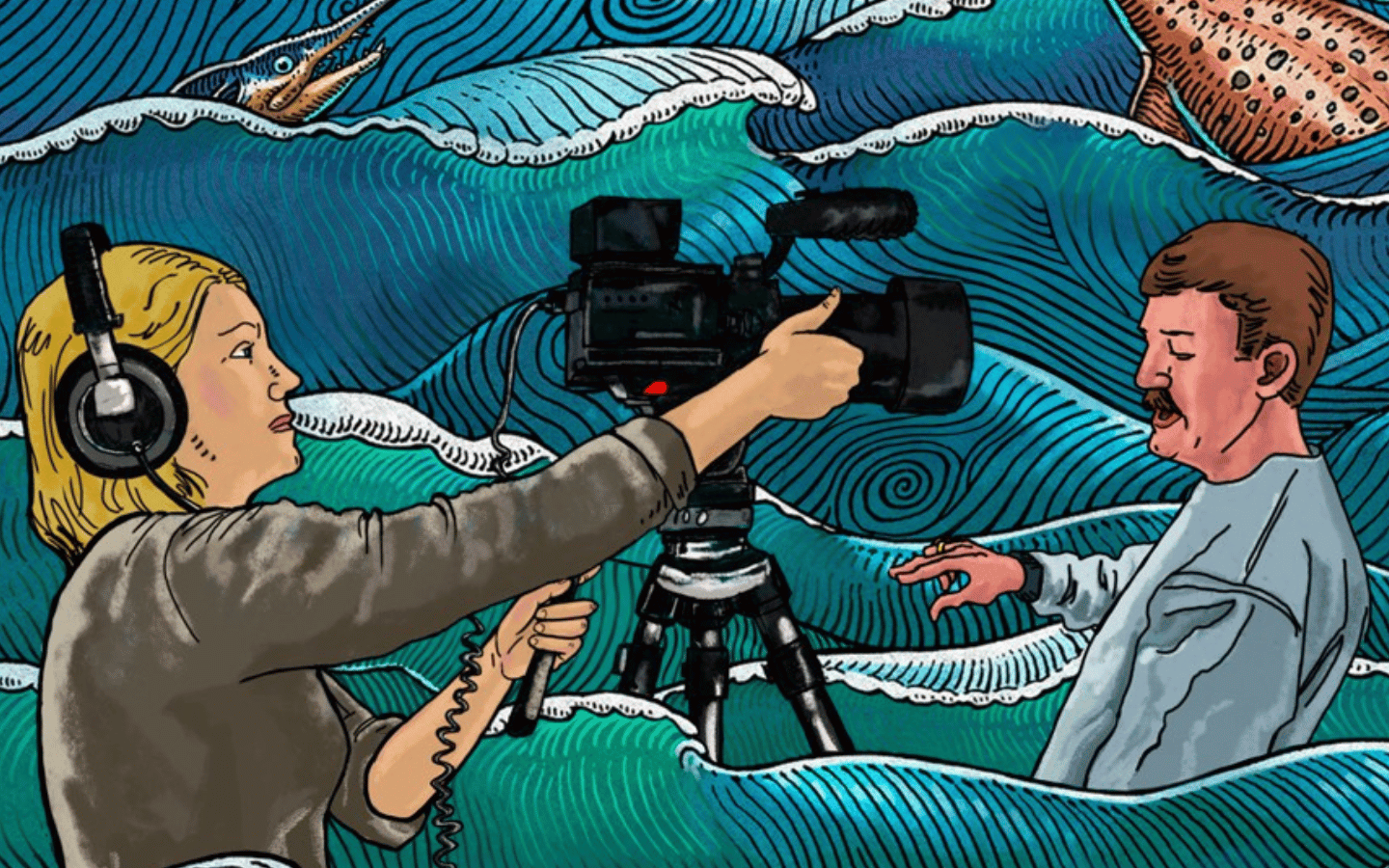
In her recent documentary Flood, filmmaker Katie Scoggin chronicles an alternate path she chose after years of disconnect from her fundamentalist Christian father: tenuous embrace.
Scoggin grew up in Southern California’s Inland Empire, near the longtime headquarters of Campus Crusade for Christ, now known simply as “Cru.” Her parents, Marvin and Peggy, had spiritual awakenings in the early 1970s at the height of the “Jesus People” movement. Peggy attended “Explo ‘72,” Campus Crusade’s historic mass evangelism event at the Cotton Bowl in Dallas, and both she and Marvin were heavily influenced by the evangelical ecosystem Cru helped create.
For Marvin, that meant a fervent embrace of young-earth creationism—the belief that the Genesis accounts of creation are literal, the earth is only around 6,000 years old, dinosaurs roamed the planet alongside humans, and the placement of their fossils is a result of Noah’s flood. For the Scoggin children, this meant growing up in a world of cartoons and children’s literature that told a wildly different story about the origins of the universe than their peers.
As is the case with many children of Christian fundamentalists, this house of cards came tumbling down in college when Katie took an anthropology course on evolution. “It blew my mind wide open,” she says in Flood. “I woke up with one set of beliefs, and I went to bed one night with a world-crumbling realization: The flood could never have happened.”
Over time, this divergence from her family’s faith led to near-total estrangement from her father. The film opens with Katie discussing this with a group of fossil hunters she is filming for another project. One of them encourages her to reconnect with her dad, which she begins tepidly over the phone before moving on to filming the documentary.
Many who grew up in fundamentalist Christianity will recognize someone they know in Marvin Scoggins. As a soon-to-be-retired elementary science teacher, he is thoughtful and outwardly warm toward his students. At home, that warmth turns into annoyed frustration with a family whose beliefs have strayed from his.
Peggy is still a believer, but has joined a church with a less strident theology than that of Campus Crusade. Katie’s sister, Kelly, seems ambivalent toward any conversations about faith. Andrew, Kelly’s teenage son, is an intelligent student navigating a world between the fundamentalism of his grandfather and the atheism of his father.
Although Flood centers on Katie’s attempts to reconcile with her father, the rest of her family shines in how they portray the complexities of relationships among loved ones with different religious beliefs.
The story is set against the backdrop of Marvin and Peggy packing up their San Bernardino home in preparation for a cross-country move to Virginia to be near Kelly’s family. Boxes of books, papers, letters, and decades of accumulated junk litter the house as arguments and negotiations over what to keep and what to throw away dominate the move. This provides a compelling metaphor for a story about belief and relationships.
The film doesn’t dwell on politics, but it is a helpful exploration of how old relationships can be reimagined, if not restored, in a post-Trump world.
Flood is airing as part of the PBS Independent Lens documentary channel until October 11.
- About the Author
- Latest Posts

Senior Editor at Good Faith Media.