

“In any other place we’d be tokens. Here we’re community.”
This simple statement echoed through my mind as Pride Month progressed from rainbow enthusiasm to Department of Defense (DOD) rulings to the Southern Baptist Convention (SBC) making yet another antiquated statement about whether women are called to preach. Church and state both have a way of putting a damper on my otherwise cheerful rainbow glitter collection.
In the wake of the SBC’s latest reaffirmation of its opposition to women serving as pastors, alongside recent DOD actions removing or disaffiliating several religious traditions from official recognition, many queer, BIPOC, and/or women spiritual leaders are once again receiving the message that we do not fully belong. During Pride Month, however, I find myself less interested in exclusion and more interested in what comes after it.
Whether it’s the DOD or the SBC, those of us who live at the margins of acceptability—in both church and society—are already adept at navigating exclusion. These new and overt statements of disassociation and opposition are not shocking. They’re simply more of the same.
We’re used to not being allowed, so we’ve created subversive pathways to continue our spiritual leadership. We’re accustomed to the so-called affirming institutions that like to hang their hats on our inclusion. Meanwhile, they continue to pay us less, tokenize us, or plaster our faces all over their promotional materials as a symbolic badge of allyship. They relegate our lives and ministries to the category of “this church believes in XYZ, but they’re just not quite ready for a XYZ pastor.”
The question isn’t about who is included and who is excluded. The more interesting question is what we build anyway.
Centering the Margins
“In any other place we’d be tokens. Here we’re community.”
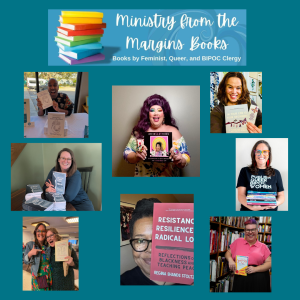
These words were spoken after our first cohort of over twenty queer, BIPOC, women, and disabled spiritual ministers gathered for Ministry from the Margins Books in summer 2024. It started as a wild idea to honor my twentieth ordination anniversary. Since I was no longer pastoring churches or teaching in seminaries, I wanted to mark the occasion while honoring the ways my vocation had shifted prophetically and profoundly over the decades. Since I’m an author who owns a nonprofit press, I decided I’d celebrate my “ordiversary” by gathering ministers from the margins who wanted to write books that would change the church and world.
What began as an effort to gather excluded spiritual leaders became something much larger.
Amid distinct differences, all of us have experienced the constant sting of exclusion, of having our lives legislated, our bodies policed, our identities dubbed “hot button issues” by preacher and politician alike. Within those differences, we found belonging.
The one-time cohort became a movement toward beloved community. Nine cohorts. Two and a half years. And over one hundred graduates.
As each gathering closes, I have the privilege of bearing witness to increasingly more ministers from the margins uttering similar words: “In any other place we’d be tokens. Here we’re community.” We see each other in our writing and in the ways our manuscripts transform into movements for social change.
Otherwise excluded, we see a nonbinary pastor reimagine the very text used to damn them by queering the Psalms—and becoming a bestseller.
Otherwise excluded, we see one of our Unitarian Universalist authors arrested in the freezing snow of Minneapolis as she protests ICE because she knows her calling is to turn poetry into prophetic protest.
Otherwise excluded, we see a queer, nonbinary Hindu officiant ascend the TEDx stage to speak of belonging, only for their book to sell out in the TED Store.
Otherwise excluded, we see a Black queer woman radically reclaim peace as a teaching method at a Mennonite college.
From participating in each other’s book launch teams to preaching in each other’s pulpits, meeting for 6 a.m. co-writing Zoom sessions to proofreading drafts, gathering on retreat to writing reviews, these revolutionary writers and subversive spiritual leaders created community beyond the written and bound words of the official cohort.
Not as tokens, but as community.
Joining the Community
What I did not anticipate was that the books would become only part of the story. The deeper transformation was that people who had spent years searching for belonging found reflections of themselves in one another. They found colleagues, collaborators, cheerleaders, friends and fellow troublemakers. They found a community that did not require them to shrink, explain, defend or justify their existence.
Registration remains open until July 6 for our final summer gathering before we move to a slower rhythm of just two cohorts each year. Yet the significance of this work has never been limited to the cohort itself. The significance is what happens when people who have been excluded find belonging in each other.
So, when the Southern Baptist Convention or the Department of Defense decides who should be excluded, a radical gaggle of spiritual leaders knows that life and meaning and community exist outside the bounds of exclusion. We know that belonging—not merely representation—may be one of the most powerful forms of faithful resistance available to religious leaders marginalized by the very institutions we serve.
We know this because we’ve built it together.
In any other place we’d be tokens. Here we’re community.
If you’re a queer, BIPOC, woman, and/or disabled minister interested in Ministry from the Margins Books, or if your organization would like to sponsor the participation of one of these revolutionary writers, learn more here.
- About the Author
- Latest Posts

Award-winning author of ten books, including The Authorpreneur Handbook. Founder and CEO of Tehom Center Publishing, a nonprofit press publishing feminist and queer authors, with a commitment to elevate BIPOC writers. Rev. Dr. Yarber’s work has been featured in Forbes, HuffPo, NPR, The Advocate, Ms. Magazine, the television show Tiny House Nation, and more. She travels the world speaking, preaching, publishing, and writing, but she can always be found at www.tehomcenter.org