
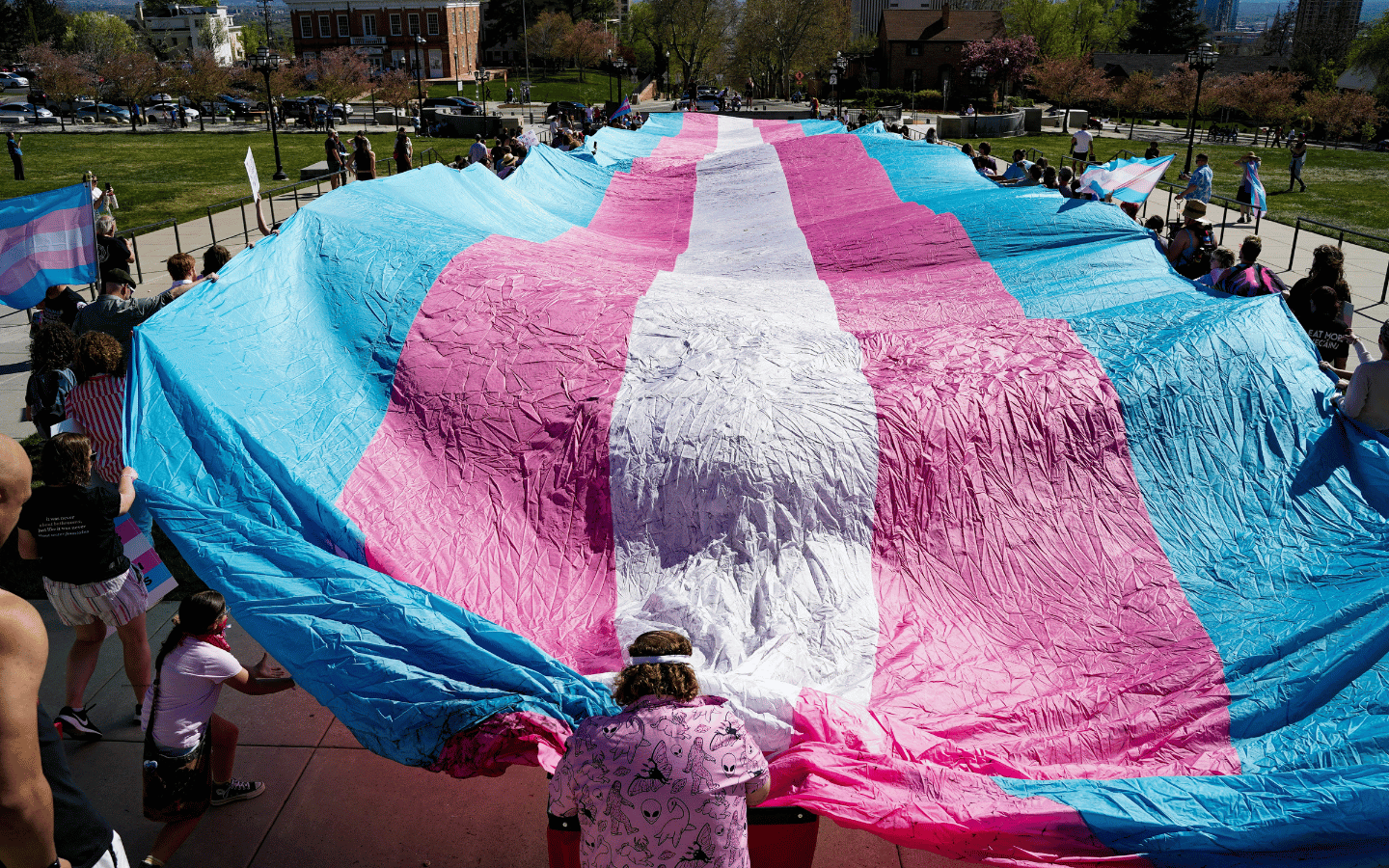
Today, November 20, is Transgender Day of Remembrance. The commemoration began in 1999 as a vigil for Rita Hester, a Black trans woman murdered in Massachusetts the year before.
Since then, communities around the world have gathered on this day to read aloud the names of transgender people killed in the past year. The list is always too long, and a disproportionate share of the names belong to Black trans women.
As I reflect on this day, I keep returning to a story I’ve preached: the transfiguration.
Up On the Mountain
Peter has always been one of my favorite characters in the Bible. He is so deeply human.
There he is on a mountaintop, witnessing something extraordinary. Jesus is transfigured before him, talking with Moses and Elijah, and the cloud of God’s presence descends.
Peter’s first instinct is to start building: “Lord, it is good for us to be here; if you wish, I will make three dwellings here, one for you, one for Moses, and one for Elijah.”
In other words, let’s stay. Let’s make this permanent.
I understand that impulse. When we’ve touched something holy, we want to hold on to it and build something around it so it never fades. (Just look at the photos on your phone.)
But even while Peter is still speaking, the cloud overshadows them and God interrupts: “This is my Son, the Beloved; with him I am well pleased; listen to him!”
Before thinking about leaving the mountain, we should pay attention to what happens on it. The transfiguration isn’t just Jesus having a spiritual experience. It is Jesus being revealed in his truest form and the disciples finally seeing him as he really is.
Matthew’s Greek word is metamorphoō, the root of our word metamorphosis. It means transformation, but more than that, an unveiling. Jesus’ glory, which was there all along, becomes visible. The disciples are given the grace to see what was always real.
I can’t read this text without thinking of our transgender siblings. I’m grateful to Rev. Dr. Susan Shaw, whose lecture for the Association of Welcoming and Affirming Baptists (AWAB) first opened my eyes to this reading. When a trans person comes out or transitions, they are not becoming someone else.
They are becoming more fully themselves, letting their outward life align with who they have always been. They are saying, “This is who I really am. See me. Know me.”
If we believe every person is made in God’s image, then when our trans siblings live in their authentic identity, they reveal something of God’s image more fully. They are transfigured and the rest of us are given the grace to see them.
Notice that the voice from the cloud doesn’t say, “This is who I’m making you become.” It says, “This is my Beloved.” Present tense.
This is who you are. This is who you have always been. And God is well pleased.
Transgender Day of Remembrance exists because too many people have refused that grace, refused to see trans people as beloved, and chosen violence instead.
Testify
So on this day of names, let me lift up one more: Frances Thompson.
In May 1866, white mobs in Memphis spent three days rampaging through Black neighborhoods. They murdered at least 46 Black people, raped Black women, and burned churches and schools. It was terrorism, plain and simple.
Frances Thompson was a formerly enslaved Black trans woman who earned her living as a washerwoman. She survived the violence, barely. Then she did something remarkable: She testified before the congressional committee investigating it.
Imagine that moment. A Black trans woman, just out of slavery, sitting before white congressmen and telling the truth about the rape and brutalization of Black women and the organized racial violence she had witnessed and survived.
Years later, when her trans identity became public, the white supremacist press mocked her, misgendered her, and tried to use who she was to discredit what she had said. But she had already spoken. She had stood in her full identity and told the truth.
When Jesus and the disciples come down the mountain, they immediately meet a father whose son is suffering from seizures. The mountain is glorious. The valley is where the work is.
We are still in the valley Frances Thompson walked into. Black communities continue to face police violence, economic inequality, and the steady dismantling of hard-won civil rights protections. At the same time, trans people, especially trans kids and trans people of color, are being targeted by legislation designed to deny them health care and erase their existence.
These struggles are not separate. Black trans women like Frances Thompson have always understood that liberation is intersectional.
You can’t free only some people. Justice for one requires justice for all.
Down from the Mountain
The mountaintop isn’t the destination. It’s the equipping. We go up the mountain to be transformed so that we can come down to be transformative.
That means keeping the practices that connect us to the holy (worship, prayer, silence, time in creation) not as an escape from the world but as preparation for engaging it. It means refusing the false choice between spiritual depth and social action.
Dorothy Day went to Mass daily while running houses of hospitality. Martin Luther King Jr.’s vision from the mountaintop propelled him into dangerous work.
A queer friend once told me, “We don’t need more allies. We need accomplices.” We need people who are there with us, doing the work.
When our trans siblings are under attack, and especially Black trans women living at the intersection of transphobia and racism, we cannot stay silent. We use our voices, our votes, our resources, and our presence. And we build congregations where people are seen and celebrated as their full, authentic selves.
Matthew tells us that when the disciples heard God’s voice, they fell on their faces in terror. But Jesus came and touched them: “Get up and do not be afraid.”
Today, we pause and remember. We say the names. Remembrance is its own kind of testimony, a refusal to let anyone be erased.
But the story doesn’t end on the mountain. It ends with Jesus and his friends going down, back to the crowds, back to the complicated, back to the work.
Back to where trans kids need adults who will protect them, where trans people need churches that will stand with them at the most dangerous intersections, and where every person, every single one, deserves to be seen as God sees them: beloved.
Frances Thompson refused to be erased. May we be people who climb the mountain to be renewed in God’s presence, and people brave enough, faithful enough, and stubborn enough to come back down, again and again, to build the beloved community.
Listen to the voice. Get up. Go down the mountain. You are beloved.
- About the Author
- Latest Posts