
Between 1798 and 1825, the French scientist Pierre-Simon Laplace published the five volumes of his “Treatise of Celestial Mechanics.” Legend is that Napoleon Bonaparte asked Laplace why his work on the solar system included no mention of God the Creator.
Laplace reportedly responded, “I had no need of that hypothesis.” He believed the mysteries of the universe could be calculated solely through mathematical and scientific means.
At the end of the 19th century, Nietzsche wrote of religious leaders, “Into every defect had they put their illusion, their stop-gap, which they called God.”
In 1944, Bonhoeffer wrote, “how wrong it is to use God as a stop-gap for the incompleteness of our knowledge. If, in fact, the frontiers of knowledge are being pushed further and further back (and that is bound to be the case), then God is being pushed back with them, and is therefore continually in retreat.”
If we perceive God as present primarily in things we do not understand, the expansion of scientific understanding makes God obsolete. Even in the 20th century, however, it was common for Christians to reach for God as an explanation for the mysterious.
In the 19th-century “God of the gaps” understanding, the believer fearfully assumes God is threatened by learning. This god motivates us to close our eyes to new information, to embrace confirmation bias and reject the evidence in front of us in favor of what makes us feel comfortable, safe and right.
This god eagerly polices purity and draws battle lines of us vs. them. It thrives in ignorance but shrivels and shrinks in the clear light of day. This god falls short of the God revealed in Christ.
Digital Divine
In 2023, Andrew Ross Sorkin interviewed Elon Musk amid legal disputes over whether OpenAI was using copyrighted data to train its artificial intelligence chatbot, ChatGPT. Musk dismissed the situation, contending that “by the time these lawsuits are decided, we’ll have digital God.”
Musk’s prediction may not have come to pass. However, it is emblematic of broader streams of thought swirling around new artificial intelligence technologies and the human individuals involved in that industry.
Any conversation around AI requires us to understand a distinction between several of the many narratives at play:
- The story of AI as a tool that raises ethical questions about its capabilities and use, its implications for the formation of humans who engage with it, and the economic, ecological and social impacts of AI elements such as data centers.
- The story of AI as a future (or present) intelligence that raises philosophical and moral questions about its own being and about the nature of consciousness and personhood.
- The story of AI as told by the people most directly shaping it through their mythological, ideological and economic imaginations.
This third point is my focus. I am not pronouncing a moral stance on a particular technology or its use per se. Rather, I am attempting to highlight conflicting visions of “gods” I perceive in our historical moment and invite us to follow a God who calls us to compassion.
Transhumanism and its Friends
The belief that humanity is on the verge of creating or discovering “digital God” is a salient idea. It captures our attention in a media environment designed to manipulate and monetize our anxieties, fears and hopes. It is also a compelling script to feed to potential investors.
This vision conjures possibilities of human civilization escaping this planet, of human consciousness transcending mortal embodiment, of human limitations eliminated by exponential scientific discovery. Such a worldview brings a flavor of Gnosticism, a thrilling invitation to secret knowledge that only the initiated few realize can allow them liberation from the drudgery of this physical plane.
Technofuturist transhumanism frightfully proposes human sacrifices to a god they believe will be created by technological advancement—an Artificial General Intelligence (AGI). This is a hypothesized form of artificial intelligence that has surpassed human cognition in all kinds of tasks. The casualties along the path toward this god are necessary collateral damage to be accepted in pursuit of a greater, perhaps even ultimate “good.”
The gap is to be crossed by any means necessary, filled up with the bodies of the most vulnerable thrown into the chasm. This is a god that devalues, escapes, and erases human bodies. A god that claims to solve every problem, creatureliness being the primary one, is a god that can’t wait to stop being human.
What Good is god?
Humans tend to place God in whatever phenomena we do not yet understand. We borrow explanatory power and justification for our actions from what we perceive as transcendent divine mystery or imagined future possibility.
We use a heaven somewhere “out there” to assuage our guilt and anxiety at the bone-deep knowledge we are harming our shared home and all who share it with us, especially the most vulnerable. We use an AGI sometime in the future to justify objectifying and harming humans in pursuit of power and wealth.
But what are the consequences of believing in a god that hides behind the holes in our scientific mastery? Of limiting the divine to the yet-unsolved equation? Is God’s truth threatened by exploration, critical thought, or even us changing our minds?
If we believe in a 19th-century god of the gaps, we’d better not look too closely at what we don’t yet know, lest our god become smaller. When we operate from this frame, we are biased toward confirmation rather than curiosity. Conversely, the 21st-century story of technological expansion creates a “god” that makes humanity and human intelligence obsolete.
This god is pursued as technological advancement, regardless of human cost. This god is to be sought in the gap of what technology has not yet achieved.
The ends justify the means, which is seen in philosophies such as transhumanism, effective altruism and longtermism. But anyone paying attention to the power brokers of AI can see that what truly concerns them is accumulating corrosive amounts of money and influence.
This lie that the love of money is the root of all kinds of good degrades the fabric of our life together.
What God is Good?
God is not stuck in the past, which would compel us to reject change or forward progress. Nor is God waiting in the future, which would encourage us to claw after imagined advancement no matter the cost.
God is with us in the present, to be encountered and loved; our Savior who gave us the two Great Commandments and said “Behold, I am with you always,” and “The poor you will always have with you.”
We are faced with the paths of closed-minded self-protection or of rationalizing self-promotion. Christ invites us instead to follow a path shaped by the cross. Jesus of Nazareth reveals a God who is present, not in the unsolved equation or a future superintelligence, but in the unloved neighbor and the exploited Creation.
This God moves toward humanity in love. This God is Creator and Sustainer of the miraculously complex universe, in all its knowable and unknowable wonder.
This God is Redeemer and Restorer, not escape artist. This is a God who gets in the mess of humanity with us and invites us to join the divine work.
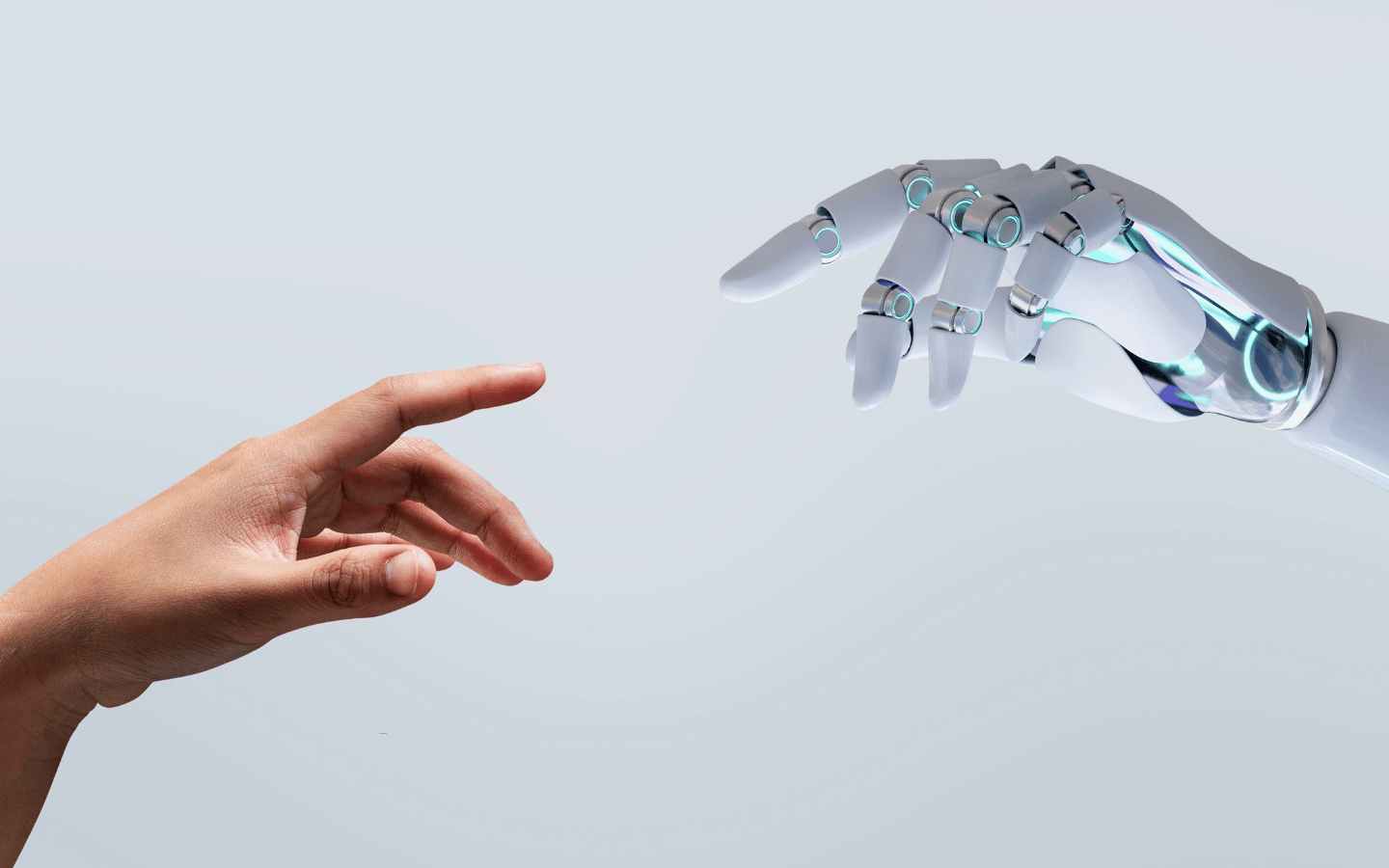
The God who goes to the cross is the vulnerable and is constantly pointing with nail-pierced hands to the places where we do not love, all the while loving us.
The gaps where we will find God are the holes in our compassion, the rifts torn by our violent empires and exploitative economies, the tender places of our own broken relationships. The God of this cruciform path is not a fragile theological structure, a house of cards that could fall at the slightest turbulence.
The God revealed in Christ is the furthest thing from Peter Thiel’s fantasies of domination or Sam Altman’s dreams of AGI and superintelligence. Not an exploitable power that exploits others, God is a vulnerable love that loves the vulnerable.
If we do not find God in the gaps in our knowledge or the gaps in our technological advancement, what then?
What if, instead, God is to be found in the gaps of our compassion, our goodness, our justice, our love? What if, when we look at the bleak world and wonder what any of this might mean, if beauty and care could possibly prevail, God is there in that gap, calling us onward?
If we believe in a God who spans these gaps with outstretched arms, we are called to fill the vacuums of our shared harms with more and more love. And there will always be more of this God to discover.
God’s mystery is not, first and foremost, our lack of comprehension of the mechanics of reality. God’s presence is not to be invoked by human sacrifice on the altar of greed and advancement.
The mystery revealed in Christ is that God is present even and especially in the suffering of God’s creatures and our response to that suffering. The first place we should look for God’s presence, though it is often the last, is in those whom we dehumanize and harm, whether through bigotry, blindness, or business as usual.
I am still haunted by Laplace’s words: “I have no need of that hypothesis.”
If that hypothesis is a god who is mostly present in the unsolved equation, perhaps we don’t need it. If that hypothesis is a god that we will create as we barrel towards ever-greater greed, alienation and objectification, we must reject it.
But if that hypothesis is that the divine can be seen and loved in every person and every part of the Creation, especially the marginalized, forgotten, and vulnerable…well, then that’s a hypothesis we desperately need. And the gap between that hypothesis and the fully realized experiment…
…of loving all people
…of caring for our shared home
…of building justice and peace
…that gap is precisely where we will meet God.
- About the Author
- Latest Posts
Michael Huerter is currently serving as Pastor of Worship & Engagement at Holmeswood Baptist Church in Kansas City, Missouri. He attended seminary and completed a PhD in Church Music at Baylor University. Michael loves dogs, hiking, cooking, and gaming. He is the author of The Hybrid Congregation: A Practical Theology of Worship for an Online Era, published in 2025 by IVP.