
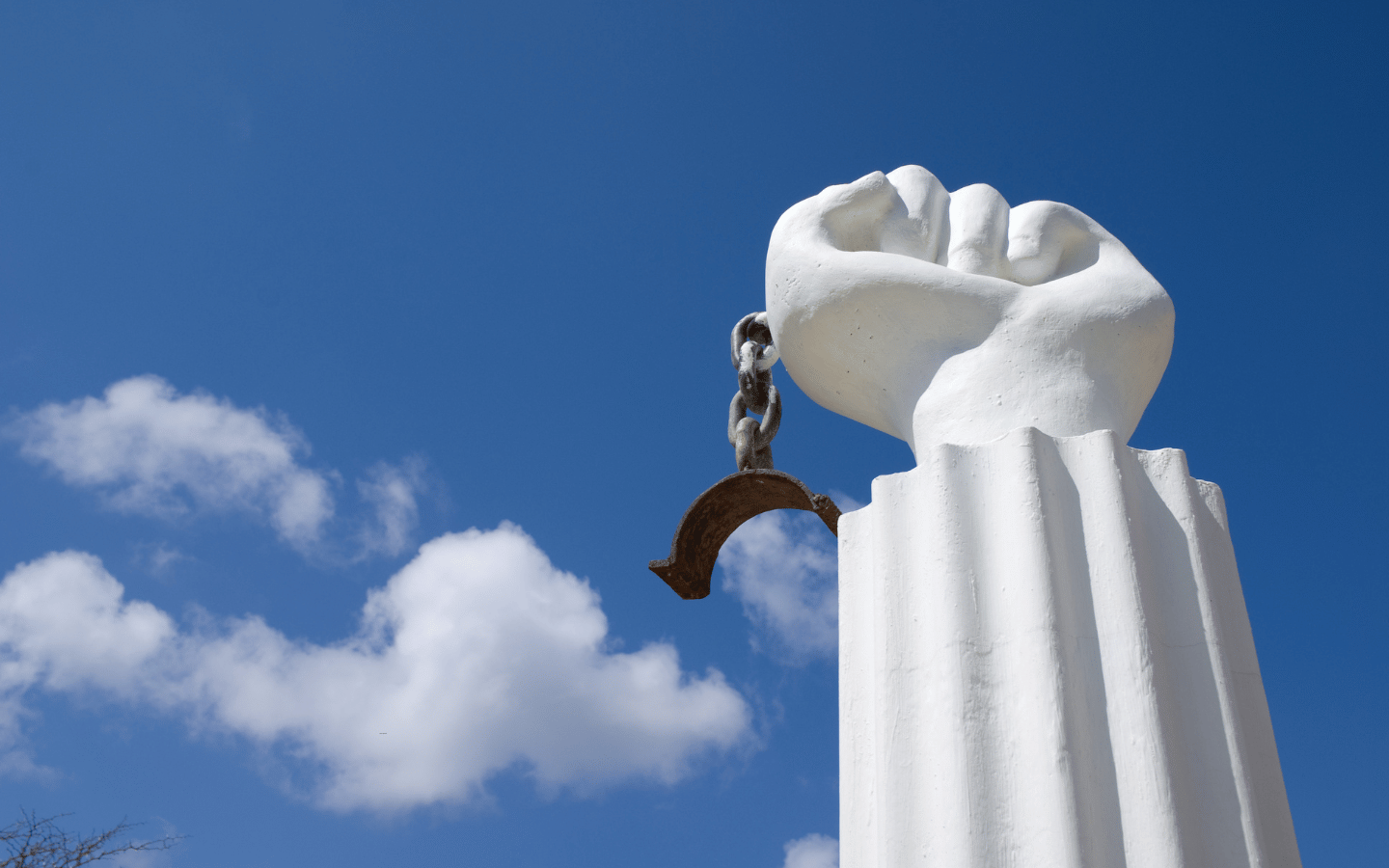
I hate, I despise your religious festivals. Your assemblies are a stench to me (Amos 5:21).
Fifty years ago, on the bicentennial of the signing of the Declaration of Independence, my mother was not in the mood to celebrate. A graduate student at the University of Virginia, steeped in the Black intellectual tradition, she told my father—then her boyfriend—that she would not join the jingoistic pageantry of parades and fireworks. Instead of celebrating two hundred years of freedom for white male landowners, they agreed to see Aerosmith, Bob Seger, and Jeff Beck, and get high.
The apple doesn’t fall far from the tree.
Like my parents, I’m in no mood to celebrate the semi-quincentennial of American independence, and I have no interest in the white nationalist propaganda festival masquerading as “Freedom 250.” There was no semblance of true freedom in this country until Juneteenth 1865—and even that was partial and temporary. What “freedom” are we celebrating?
Whose Freedom?
There is a massive contradiction at the heart of the American experiment: What America calls freedom was built on, and continues to be dependent upon, the unfreedom of others. Freedom for white people was built on the enslavement of Africans, the genocide of Indigenous nations, Jim Crow apartheid, mass incarceration, mass deportation—and the beat goes on.
The Founding Fathers were capitalist landholding colonizers who declared independence chiefly from any constraint on their accumulation of wealth and power. They had no intention of extending freedom to women, to Indigenous nations, or to enslaved Africans. Their pseudo-enlightenment understanding of freedom was severely limited by a white colonial imagination.
Why would we celebrate the genocidal settler-colonialist enslavers who founded this nation?
Scholar Saidiya Hartman claims the end of slavery should be considered “the nonevent of emancipation” because the freedom received arrived burdened and hollowed out. In Scenes of Subjection, she shows how emancipation transferred the formerly enslaved into a new architecture of subjection: the debt of the sharecropper, the binding labor contract, the “burdened individuality” of a liberty that conferred blame without land, power or protection. Liberty became one more instrument of domination.
According to Eddie Glaude Jr., American freedom is white freedom—an imposter freedom, treated as the white man’s possession and a revocable gift he can grant or withdraw at will. Every advancement toward freedom for non-white Americans meets a season of white backlash, like the one we are living through now, which serves as a horrific reminder that American freedom has always been for whites only.
Whose Democracy?
I am also in no mood to indulge attempts by “moderate” or “progressive” Christians to redeem the semi-quincentennial as proof of a sacred bond between Christianity and American democracy. What Christianity are we talking about? What democracy?
In an age of extreme White Christian Nationalism, it is disingenuous to speak of that bond without specifying which Christianity we mean. There are many different versions of Christianity and democracy in America. Most of them are fraudulent.
Over the last 250 years, Christianity has most often been an enemy of democracy and a partner in oligarchy, patriarchy, colonialism, capitalism and white supremacy, blaspheming their support for these evils in the name of Jesus. The only reason we have anything resembling a democracy in this country today is because of the resistance by the people to whom white freedom was never intended to extend.
What would Indigenous Americans, the descendants of enslaved Africans, women, LGBTQIA+ people, immigrants, and AAPI communities make of our 250 festivities and think pieces? These are not rhetorical questions. They force us to ask whether the word freedom means anything when Americans say it.
Honesty requires us to confess that true freedom has never been handed down by this nation. It has always had to be seized, repeatedly, by the very people the nation was built to own and oppress.
Freedom is not a gift an oppressor can give because oppressors can only offer the freedom they possess, one built on the slavery of others, which is not freedom at all but domination in disguise. As Ursula Le Guin’s “The Ones Who Walk Away from Omelas” reminds us, real freedom cannot be based on oppression, and we must walk away from false white freedom to pursue a liberty that is not dependent on anyone’s bondage.
Frederick Douglass tore off that mask on July 5, 1852– not July the Fourth, but the day after.
He faced a hall of white abolitionists expecting an Independence Day oration and delivered an indictment: “What, to the American slave, is your Fourth of July?…To him, your celebration is a sham.” And: “This Fourth of July is yours, not mine. You may rejoice, I must mourn.”
He was not refusing to love freedom; he refused to let a complicit Christianity counterfeit the word.
Personally, I am not satisfied, as my mother had to be, in refusing the counterfeit alone. Sacred memory is among the holiest practices of any spiritual tradition.
A More Worthy Celebration
I reject the 4th of July as a day of independence, but that does not leave me without celebration—only free to keep a truer and more liberative one that took place 500 years ago.
Two hundred and fifty years before the founding enslavers and colonizers signed their declaration, in July 1526, the Spanish colonizer Lucas Vázquez de Ayllón set out on a journey with 700 people (100 of whom were enslaved Africans) and founded the first European colony on the North American coast of what is now Georgia. The Spanish called it San Miguel de Gualdape, but within months, it lay in ruins, as the enslaved Africans rose up, killed their enslavers, burned the settlement, and walked into the woods to live free with the Guale people.
Scholars now believe the descendants of the 1526 revolt also played a critical role in the massive Guale Revolt of 1597, a coordinated attack on various islands that nearly dismantled the Spanish colonial system across Georgia’s Sea Islands.
These brave revolutionaries signed no parchment. Their names have been lost to history.
Yet they engaged in the first in a long history of slave revolts on the North American continent. They also formed the first maroon community on this soil, gave birth to Afro-Indigenous solidarity, and established a true multi-racial international community of freedom that is 250 years older than America itself.
This is what I intend to celebrate this year: the anniversary of the first enslaved rebellion, the first resistance to settler-colonialism, the first maroon community, the first birth of true freedom.
It is an anniversary I invite you to join me in celebrating with the Resistance 500 Project, a twenty-week spiritual formation curriculum, devotional, and public counter-witness, running every Sunday from July 5 to Advent in 2026. Each week is anchored to an important rebellion and guided by the maroons’ own sixfold practice: gather, remember, examine, lament, celebrate, and act.
For Christians, Resistance 500 is an opportunity to practice anti-racist decolonization, to pry the gospel loose from the empire that wielded it as a property deed. Resistance to slavery and settler-colonialism is a sacred practice, and it deserves to be commemorated and emulated, especially in the midst of today’s fascist authoritarianism.
While the United States throws itself the most expensive birthday party in the history of empires, you are invited to celebrate the anniversary of resistance to settler-colonialism and slavery.
Freedom did not begin in 1776. It began in 1526, in the woods of coastal Georgia, in the hearts of the enslaved, in the hospitality of the Guale people, and in the courage of those who resisted. Now is the time for us to join them.
- About the Author
- Latest Posts
