
In the fourth pew on the right, from the pulpit’s perspective, I sat quietly. Afraid to move, afraid to breathe, for the better part of an hour.
My attendance in such settings was fickle most of the year. My parents, never the Bible-thumping type, took little issue when Great Aunt Emmie offered to carry my younger sister and me to Sunday worship at her small Baptist church.
Great Aunt “Em” wasn’t a Baptist. She just sang in the choir.
A fallout with the Methodists decades before had left her looking for a new flock. The Baptists were as good and judgmental as any.
The man in the blue dress jacket, striped tie, and white shirt started out sweet enough. He spoke directly, his voice easily reaching the back-row faithful.
I remember he smiled a lot at the beginning. His words were warm, like a pot of soup beans on a stove eye.
And then, he changed. His demeanor shifted.
He seemed to grow taller. His face reddened. Spittle escaped his mouth as he spoke.
His words came fast, like a serpent’s strike. The gentleness that once was underwent a metamorphosis. Dr. Jekyll had become Mister Hyde.
When he said the name above all names—Jesus—there was nothing sweet about it. He yelled, attempting to scare the hell into us.
I remained still, lest his gaze fall upon me. My sister crawled under the pew.
Long before I knew the verse, I learned then that not everyone who invoked the name of Jesus was about his kin-dom.
American Redemption Stories
Which is why, when Jelly Roll took the microphone last week at the Grammys and spoke about Jesus during his acceptance speech, I thought about that fourth pew.
Jelly Roll is the kind of artist America loves. They see his story as testimony.
He is a man who has owned his rough past. Yet, he presents himself as reformed and clean, someone safe enough to be celebrated.
He spits stories of jail time and Jesus, addiction and redemption, with ease. Americans know this script: fall hard, find faith, work hard, and rise again. Grace and success can look the same if you squint long enough.
I’ve heard enough prosperity preachers to know where this was going. For me, religious performance is easy to spot.
Christianity has its fair share. Elmer Gantry ain’t a household name for nothing.
I’ve known plenty of folks who know how to say the name of Jesus loudly when a microphone is placed in front of them. The entertainment industry seems to be in no short supply of preachy voices that grow strangely quiet when uncomfortable topics enter the chat. Topics such as people in cages, gun reform, food scarcity, DEI, and murdering people in the street.
Saying Jesus’ name is easy. Standing where Jesus stood has always been costly.
Standing Where Jesus Stood
There is a difference between discipleship and performative piety, between following Jesus and spiritual tourism.
Tourists like to visit exotic places. They’ll book a trip to the Maldives, Bangkok, or Costa Rica and never leave the resort.
This is a comfortable alternative to experiencing another way of life, but it doesn’t offer full immersion. Sampling the jerk chicken at the Hilton hotel in Jamaica is not the same as grabbing it on the streets of Kingston.
Likewise, shouting Jesus’ name at an award show isn’t the same as invoking his name while advocating for the least of these. The former is devoid of credibility, but will grant you applause. The latter doesn’t guarantee you the same standing ovation, but it does bear the weight of faithfulness even when the crowds ain’t around.
The problem isn’t that the name of Jesus is spoken publicly. It’s that it’s spoken without any willingness to stand where Jesus stood—among the harmed and excluded.
Your Jesus can’t be loud in the limelight and mute in the street. You can’t holler, “Look what Jesus done for me!” and not be willing to do the same for someone else.
Jelly Roll has no problem telling folks about Jesus. Yet when questioned about issues and policies that impact the people Jesus has called his followers to love and support, he downplays his voice and influence.
‘Dumb Rednecks’ and Grifters
After winning the award for Best Contemporary Country Album, reporters asked Jelly Roll if he would weigh in on the state of politics here in the United States.
“I hate to be the artist that sounds aloof, but I just feel so disconnected from what’s happening. I didn’t know politics were real until I was in my mid-20s in jail. That’s how disconnected you are when you grow up in a drug-addicted household.”
There’s an expression on the internet: “Rick-rolled.” You click a link expecting one thing, only to discover you’ve been redirected to Rick Astley singing “Never Gonna Give You Up.”
It’s a classic misdirection. A bait and switch. I think a lot of people are getting “Jelly-rolled” too.
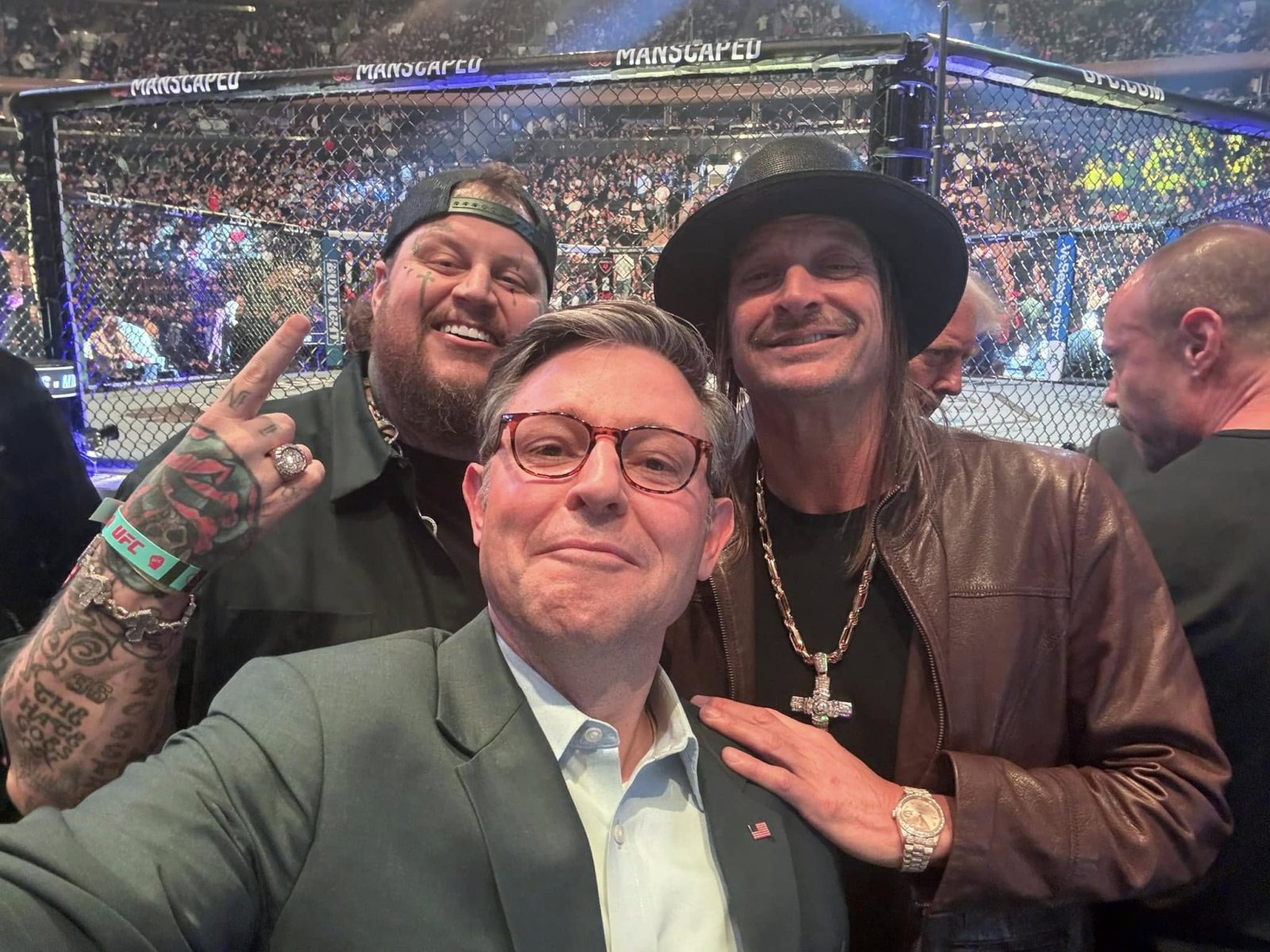
For someone aloof from politics, he has no problem posing in a photo with Republican House Speaker Mike Johnson and MAGA-supporting Kid Rock at an Ultimate Fighting Championship event. Similar images show the artist smiling with U.S. Secretary of Homeland Security Kristi Noem. Last week, images of Jelly Roll and Donald Trump began resurfacing.
Jelly Roll also stated at the Grammys: “People shouldn’t care to hear my opinion. I’m a dumb redneck.”
Jelly Roll is wrong in both statements.
First, people do care what he thinks. They do want to know his opinion.
He has almost 10 million followers on TikTok and almost 6 million on Instagram. Almost 5 million on YouTube, with his biggest hit fetching 352 million views. When Jelly Roll talks, people listen, as evidenced by the chatter coming from his Grammy comments.
And second, I don’t think Jelly is a dumb redneck at all.
He knows his audience. He knows the things they like. He knows the things they don’t.
He knows they respond to his raw and honest lyrics about real-life struggles. He touches a chord with those who are working-class, come from a small town, or identify strongly with their rural roots.
Jelly Roll appeals to these people and he also appeals to their faith.
The shouting of Jesus’ name, the Pentecostal-like fever laced in his words, and the assurance that he’s blessed because he refused to give up, is a gospel that fans of Jelly Roll know.
The word grifter means to take part in small-scale acts of swindling and because of this, I don’t think Jelly Roll is a grifter. Nor do I think he’s a charlatan or a con-artist.
What he is, however, is something far more familiar and consequential.
He’s a politician.
- About the Author
- Latest Posts

Justin Cox received his theological education from Campbell University, Wake Forest University School of Divinity, and McAfee School of Theology where he earned his Doctor of Ministry. He is an ordained minister holding standing in the Cooperative Baptist Fellowship and American Baptist Churches USA. When not spending time with his spouse and daughters, he can be found writing and baking late into the night. His thoughts and reflections are his own.