

It is a hot July afternoon. Folks have arrived from different places, carrying different stories, experiences, hopes and burdens.
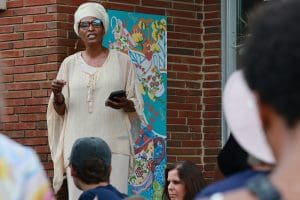
A Black woman, an elder and leader in the activist community, welcomes participants to a journey. She invites them into the history of the maroon people of the Great Dismal Swamp.
She asks them to consider becoming maroon people in our time: people who survive, resist, reimagine and rebuild. She shares stories of those who sought freedom in the swamps: the communities they created, the dangers they faced and how they resisted systems of control.
Crowned in beautifully wrapped cloth, a poet emerges as an invitation-bearer. Her voice calls us toward the water and into a shared journey of solidarity with the maroon people.
She proclaims, “Take me to the sacred waters where treacherous treaties never spoke of forever chemicals or plastic in our guts: (Un)Natural, (Un)Breakable, (Un)Seen, and (Un)Regulated, (Un)less, we choose differently!”
Before taking the first step, participants receive pieces of a quilt and are invited to find the three people whose pieces complete their own. They discover their traveling companions.
They learn a song: “Wade in the water, children. The tide’s gonna turn our way.” As they sing, artists give them seeds to carry for survival and walking sticks to test the depths, clear obstacles, find balance and remember the strength of those who came before.
The path leads beneath the tree canopy. A humble guide, wearing a kufi and carrying a staff, welcomes them to the next step of the journey.
He points to a barrier of crepe-paper streamers stretched across the path. Written into the barrier are the whispers that strengthen the empire: fear, isolation, cynicism, hopelessness, consumerism, division, silence, comfort, indifference, scarcity and the voices that say, “Someone else will fix it” or “I’m only one person.”
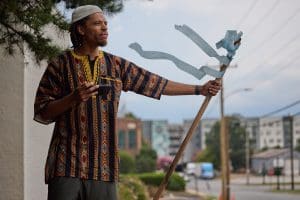
The guide invites each person to choose one of the whispers they know and to name what they will embrace instead—courage, community, solidarity or another source of strength. Together, using their walking sticks, they clear the path. The barrier gives way and the travelers continue.
They move with song toward the water. Here, a wise guide greets them and introduces the water as their companion: a source of life, renewal, power, adaptation, movement, peace and protection.Participants receive water to refresh themselves.
They step further on the path and encounter rocks marked by the evils of empire—exploitation, greed, scarcity, violence, extraction and harm. Working together, they wash the rocks clean. Beneath the stains, they reveal the qualities that can replace empire: community care, wellness, abundance, love and joy.
Having cleared the obstacles and destroyed the symbols of empire, the travelers are guided by a healer toward an altar of remembrance. They lay down what they have been carrying and allow themselves to become unburdened and unrestrained. They give thanks for what it took to arrive here, cleanse and anoint one another, and make room for goodness, peace and joy.
“Wade in the water, children. The tide has turned our way.”
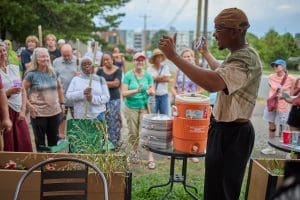
At the final station, the travelers gather in a circle and look at one another, taking in the beauty of a people freed from the oppressor and unburdened. They are reminded that freedom is not an individual accomplishment but a shared condition. They are now a community of freed people, empowered to work together to loosen others’ chains.
The seeds they have carried are revealed as gifts: offerings to adorn, honor, resource, thank and bless their neighbors. One by one, they bestow these gifts upon one another.
Together they sing the final refrain: “Be like the water, children. Move with power and freedom.”
There is food, music, fellowship, laughter and celebration. People are invited to carry their seeds home and plant them so that something new can grow.
The day that began beneath the hot July sun ends not simply with the destruction of empire, but with a community gathered to celebrate its freedom—and to imagine what it means to survive, thrive and make freedom possible for others.
Funeral for the Empire
The opening story depicts the fifth annual Funeral for the Empire, held around Independence Day each year. This public ritual hosted by QC Family Tree and Beloved Community Charlotte is an act of collective imagination that invites people to grieve and release the systems that harm us and to practice the world we want to build instead.
Funeral for the Empire is an example of communal resistance. Through storytelling, music, movement, art-making and shared ceremony, participants use collective imagination and material conditions to journey together from lament to liberation, honoring resilience, community, wellness and hope. We craft practices that teach us how to refuse cooperation with the Empire’s demands and behaviors.
Faith communities have a unique role to play in movements of resistance and noncooperation. Rooted in particular places and relationships, we can help cultivate moral protest and persuasion and practice strategic noncooperation.
Perhaps our greatest superpower is our spiritual and symbolic power, expressed through ritual, story, prayer and collective practice. This helps us nurture courage, disrupt harmful systems and embody the world we are working to create.
Liturgical direct action is a form of nonviolent resistance that uses the rituals, symbols, embodied practices, sacred spaces and communal traditions of faith as tools for public action. It brings together two things that are often treated separately:
- Liturgy: the embodied practices through which a community expresses its deepest commitments—prayer, communion, song, procession, blessing, lament, confession, anointing and testimony and
- Direct action: collective action intended to publicly confront, interrupt, challenge or transform an unjust condition.
Rather than simply talking about justice in worship, liturgical direct action asks: “How can the practices of our faith become practices of resistance?”
Liturgical direct action can raise public awareness, persuade participants to act and undermine an unjust system’s authority by disrupting it, refusing to cooperate with it or making it harder to sustain. It can challenge old habits and systems while demonstrating alternatives.
Systems of political violence and repression work by concealing injustice, devaluing the target, reframing what happened to serve those in power, manipulating official channels to create a false sense of due process and intimidating or coercing people into supporting their tactics. Liturgical direct action can counter these tactics by exposing injustice, restoring dignity, reframing the narrative, mobilizing solidarity and disrupting repression.
One way to craft liturgical direct action is to take a familiar religious practice or sacrament beyond the sanctuary and into public space. For example, a community might hold an altar call outside an ICE detention facility or a “Remember Your Baptism” service at a police training facility.
Another approach is to bring liturgical seasons into public space. As we turn toward All Saints’ Day and Advent, consider how your community of faith might use these seasons to confront political violence and repression. What might it look like to embody hope, remembrance, lament and expectation as public acts of resistance and solidarity?
Here are some questions to consider as your group plans its next liturgical direct action:
Name what you are confronting.
What systems, beliefs or ways of being are causing harm? What does “empire” mean in our communities? Who is harmed by these systems, and whose humanity is diminished?
Imagine what comes after.
What kind of world are we trying to make possible? What values do we want to carry forward? What would liberation look and feel like in our actual community?
Ask what your faith community can uniquely offer.
What can your faith community do that other organizations cannot? What spiritual, symbolic, relational or material resources do we have? What sacred practices could help us publicly name what is happening?
Identify the function of the action.
What do we want people to understand, feel or do?
Who needs to hear this? Who needs to be centered? What needs to become visible?
How can we expose injustice? How can we restore dignity to people who have been targeted?
How can we interrupt the narratives that justify harm? What alternatives can we demonstrate rather than simply describe?
Turn theology into embodied action.
What would we mourn? What would we confess? What would we refuse to carry forward? What would we bury? What would we remember? Who would speak? What would we bless?
Design the ritual collectively.
What should happen first, next and last? What symbols or objects tell the story?
What role should music, movement, art, scripture, poetry or silence play? Where should the action happen?
Who needs to participate? What should participants be invited to do? How do we make the ritual accessible across different faith traditions and levels of religious commitment?
Move from ritual to organizing.
What happens after the event? What relationships do we want to strengthen?
What action should participants be prepared to take? What systems or practices do we want to stop cooperating with? What alternatives can we begin building together?
- About the Author
- Latest Posts

Helms Jarrell is the pastor of Beloved Community Charlotte in Charlotte, North Carolina.