
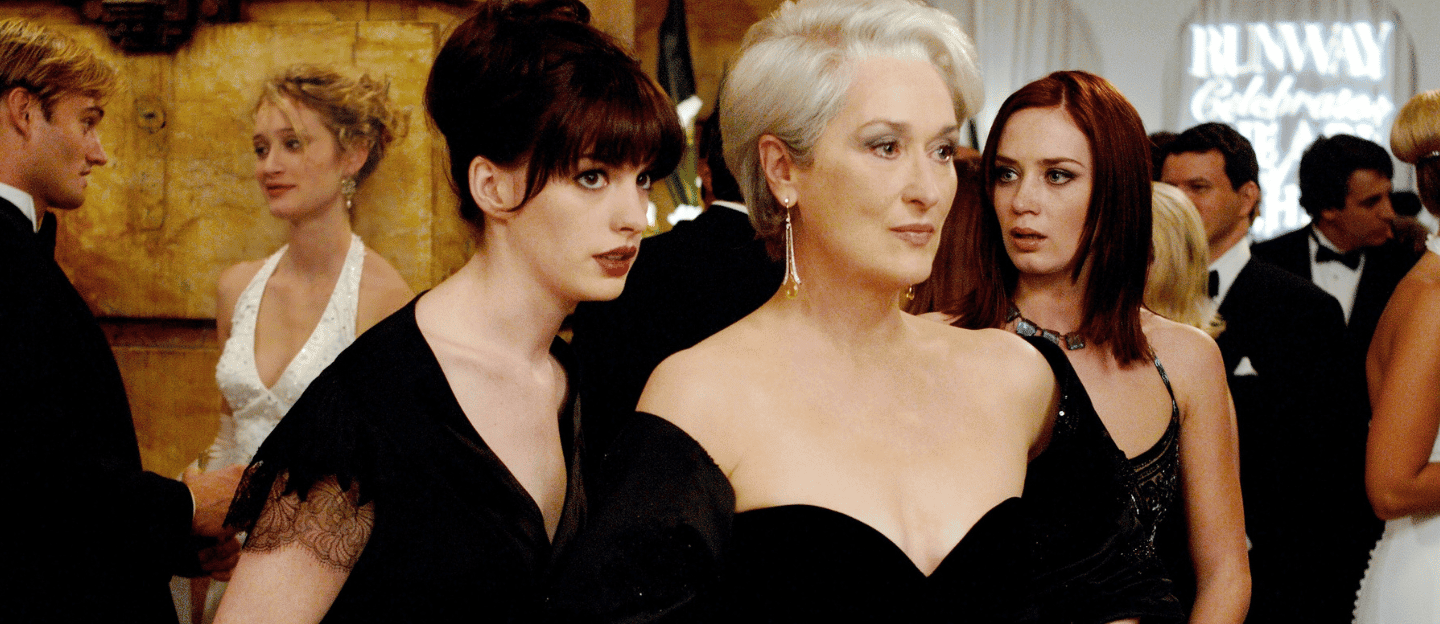
In a recent episode of the Sunday School Rejects podcast, I spoke about the cerulean monologue from the movie The Devil Wears Prada. Which, if you haven’t seen it yet, what are you doing? There’s already a second one out! (And it’s pretty good.)
In the iconic discourse, Miranda Priestly, played by Meryl Streep, the editor-in-chief of a high-end fashion magazine, takes the aloof and brainy Andy Sachs, played by Anne Hathaway, to task over Andy’s expressed contempt for the fashion industry.
In the scene, an assistant runs over to Miranda with two slightly different blue belts. She points out that it will be difficult to choose because they are “just so different.” In response, Andy snickers, causing the hearts of everyone in the room to stop. She then apologizes, stating that she’s still “learning about this stuff.” The monologue begins:
This… “stuff”? Oh, okay. I see, you think this has nothing to do with you.
You go to your closet and you select that lumpy blue sweater, for instance, because you’re trying to tell the world that you take yourself too seriously to care about what you put on your back.
But what you don’t know is that that sweater is not just blue. It’s not turquoise. It’s not lapis. It’s actually cerulean.
And you’re also blithely unaware of the fact that in 2002, Oscar de la Renta did a collection of cerulean gowns. And then I think it was Yves Saint Laurent who showed cerulean military jackets? And then cerulean quickly showed up in the collections of eight different designers. And then it filtered down through the department stores and then trickled on down into it some tragic Casual Corner…where you, no doubt, fished it out of some clearance bin.
However, that blue represents millions of dollars and countless jobs.
And it’s sort of comical how you think that you’ve made a choice that exempts you from the fashion industry when, in fact… you’re wearing a sweater that was selected for you by the people in this room…from a pile of “stuff.”
You can see why everyone’s heart stopped.
But what does any of that have to do with evangelicals and Christian history?
Illusions of Exemption
The Pentecostal denomination I grew up in was founded by a man named Charles Parham at the turn of the 20th century.
By Parham’s own account of his upbringing, he does not emphasize any denominational doctrines or loyalty. He asserts that he was able to read the bible “with no preconceived ideas, with no knowledge of what creeds and doctrines meant, not having any traditional spectacles upon the eyes to see through…entirely unbiased.”
Later biographies reveal that Parham was raised as a Quaker and a Methodist, and attended Methodist churches as a child. He even served as a Methodist preacher until he began pursuing Pentecostal ministry in the late 19th century.
Methodism affirms the Apostles’ Creed, the Nicene Creed, and an orthodox view of the Trinity, among other doctrines. While these are often not explicitly stated in Methodist church services, they influence how its clergy and membership approach the bible and understand their faith.
While I believe Parham did not think any of his early childhood interactions with the church affected his ability to interpret the Bible purely, he was nevertheless influenced by those interactions. And yet, Charles Parham genuinely believed he had an unadulterated relationship with the bible and approach to understanding it. He believed his interpretations were directly from the Holy Spirit, exempt from the hoopla and silliness of Christian orthodoxy, tradition, and scholarship.
Unfiltered Faith Doesn’t Exist
This is indicative of a modern American evangelical mindset. It is shockingly common for non-denominational and Pentecostal ministers to have no formal training or bible education. In many cases, this is even seen as a good thing.
My own family referred to seminary as “cemetery,” because they believed that’s where your faith would go to die. Too much book learning, too much knowledge of Christian history and tradition would cloud your connection to the Holy Spirit. The Spirit was meant to help us understand scripture in its pure, unadulterated, King James English translation.
I will not go down the translation rabbit hole because we simply don’t have the time. But please note the issue of translation would throw a thousand cerulean wrenches into the conversation on biblical interpretation.
This is where the final line in the cerulean monologue feels most relevant. Priestly says, “It’s sort of comical how you think that you’ve made a choice that exempts you from the fashion industry when, in fact… you’re wearing a sweater that was selected for you by the people in this room…from a pile of ‘stuff.’”
I find it comical that modern evangelical Christians think they’ve made theological choices that exempt them from the whole of Christian history and tradition, when, in fact, they’re touting beliefs and interpretations that have been hand-selected for them by people in various rooms throughout history.
The creeds, doctrines, and traditional spectacles that Charles Parham so disdained ultimately influenced him despite his inability to see that. It wouldn’t be difficult to trace any one of his beliefs back to various Christian historical figures or church creeds. We lose depth, connection, and accountability when we falsely presume we can circumvent history via the Holy Spirit.
None of this is to say we must be shackled by our histories and traditions. There is certainly much evil to contend with in Christian history.
We should not keep baptizing old evils for the sake of tradition. And, there are plenty of scholars doing beautiful work in translation and interpretation that take us to new places and reveal the spark of creative imagination within our faith tradition.
I don’t know that Miranda Priestly would have much to say about the Council of Nicaea or the Edict of Milan. I think if she saw what they were wearing during the Crusades, she might have some input.
What she did understand is the interconnectedness of seemingly unrelated things and the collective impact of that interconnectedness. We are not separate from our past, and our faith is not separate from its past. We grapple with it, we acknowledge its harms, we embrace its goodness, and we press on with reverent creativity.
And that’s how we avoid the subtle arrogance that comes from assuming we have greater spiritual insight than our predecessors in the faith.
- About the Author
- Latest Posts

Annie Wilde is a graphic designer, seminary graduate, and co-host of the Sunday School Rejects podcast.