
My career began with a cup of tea served on a gold platter.
Maybe, like me, you have always wanted your life to matter. I read Mother Teresa as a teenager, and that settled it: My life would be about helping people through service and hard work.
I was, of course, thrilled to land my first job fresh out of college doing just that at a church in Cambridge, Massachusetts, full of smart-sounding plans.
End poverty!
Eradicate homelessness!
Close the racial wealth gap!
I felt so much pressure to prove I could help.
My mentor, Val, stopped me. “Whatever you do, don’t move forward with these plans you guys made,” she said. “Go talk to your neighbors.”
This sounded like the opposite of helping people. But on my first walk, I met Zuleika, an Indian who immigrated to Zimbabwe before coming to the United States shortly after the attacks of September 11, 2001. She invited me for tea.
Zuleika’s apartment was a small unit in a massive government-subsidized complex and she had made it an oasis, filled with real and fake plants. Every inch of the walls was covered with drawings and pictures of Mecca.
She brought out tea on a gold platter. The entire scene was beautiful.
Zuleika introduced me to her neighbors. Almost all of them were Muslim immigrants and refugees from South Asia and East Africa. For a year, I had nothing to show for myself unless you counted success by cups of tea.
But over tea, neighbors shared their dreams for the community. They never once mentioned our church’s smart-sounding plans. They wanted a henna night, a summer barbecue and a soccer tournament.
We started with soccer, hoping maybe 12 kids would come. Ninety-six came and people from 30 countries filled that field every night that week.
That week and in the 18 summers the program has run since, I started to see the thread. The joy on that soccer field grew from a year of relationships that started when a Muslim immigrant invited me into her home and served me tea on a gold platter. It was all just beautiful and for the first time I felt that what we were doing mattered, that I mattered.
It still took me a dozen years or so, working on refugee policy and research, to finally understand how much beauty matters.
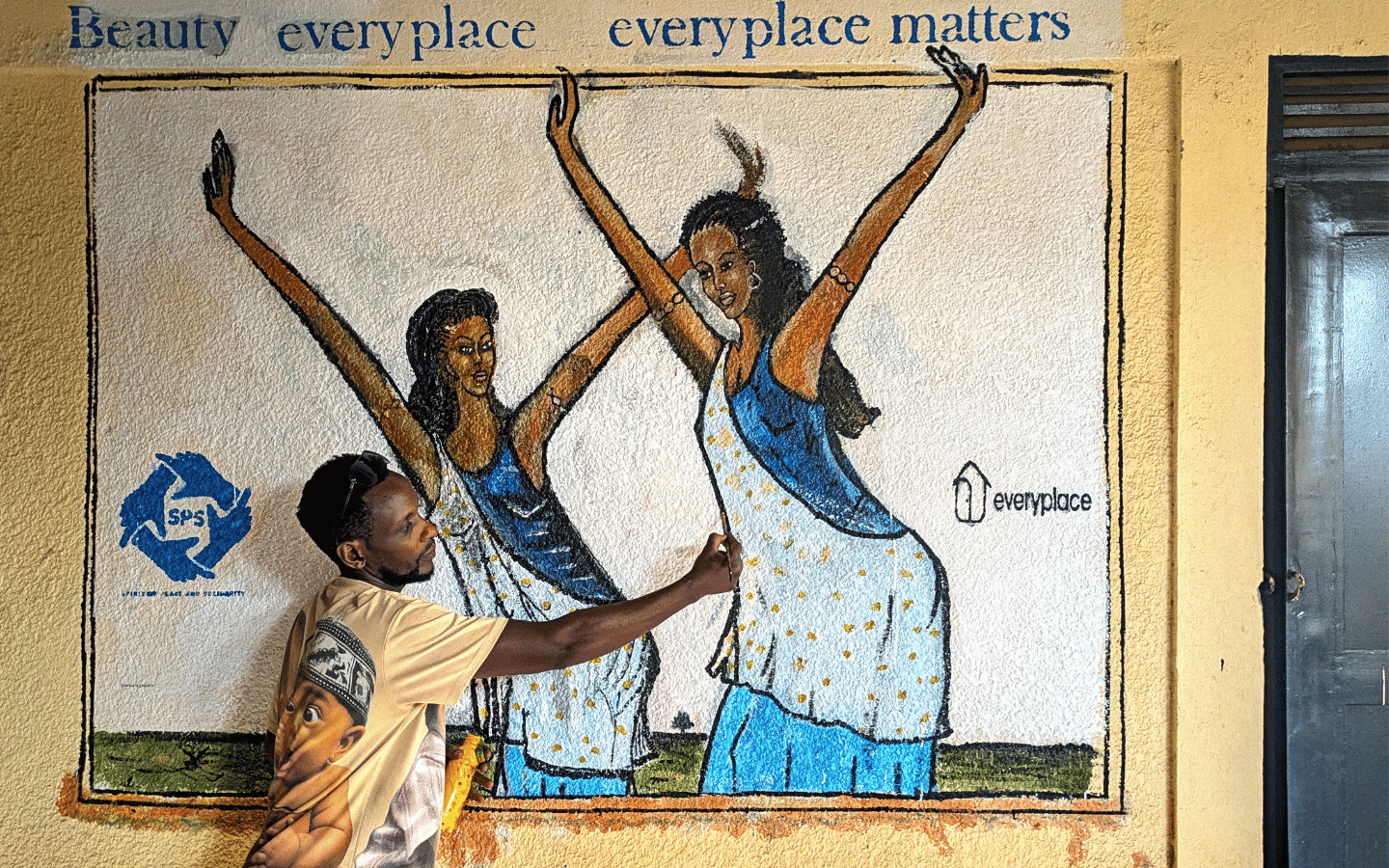
Today I lead Everyplace, a nonprofit organization that partners with refugee leaders in camps and communities around the world. All our work begins with beauty. One example comes from the Mahama refugee camp in Rwanda.
Searching for Beauty
Desideratte is 28, a mom of three and an elected representative of Mahama’s villages. In March, our partners at Spirit of Peace and Solidarity, a refugee-run nonprofit in the camp, gathered those representatives to ask a question they had never been asked: Where is beauty here?
Desideratte answered by remembering what it was like when she arrived. “In the past, we felt that the camp was not truly a place to live,” she said. “Being here felt like isolation, forgetting ourselves, and losing hope for the future.” For years, life in Mahama had meant waiting for a return home or for a resettlement that comes to very few.
“But we have come to realize that this is our home,” she said, “and it is up to us to make it like our own home, because we don’t know how long we will be here.” So she and her neighbors got to work, cleaning up the roads, planting trees and creating gardens.
As the conversation continued, other representatives spoke about where they saw beauty in the camp now: “in our diversity” and “in our youth.” Then they started dreaming about what would create more of it. “We need a sign at the front of the camp that reflects who we are.”
That is what they are building now. What an incredible way to remember who you are and declare that you matter, by literally staking it in the ground.
The refugees transformed the camp into a place that felt more like home by using beauty. They dreamed about the future through beauty. They rallied their neighbors through beauty.
And today Desiderata says, “We have begun to love this place.”
Lessons from Beauty
So what could this mean for how you love your refugee neighbor?
Maybe you want to welcome the stranger the way Zuleika welcomed me and the bad news feels like it outweighs the good and you wonder what you could possibly offer that would matter. Here is what I have learned from Zuleika, from Desideratte, and from hundreds of refugees since: Start where beauty already is, because beauty changes how you see, how you act and what you build.
How you see.
To see beauty, you have to slow down, notice and pay attention. If beauty comes from God, then every person is made in God’s image and already reflects that beauty. When you meet a refugee family at church or down the street, look for their talents, dreams, humor and creativity. Suddenly, “refugee” is just one part of their life story.
How you act.
Come as a neighbor, the person who lives next door, says “hi” throughout the day and pitches in. Refugees are asked constantly about their trauma, so ask your neighbor something else: where she sees beauty, what she loved about home, what she is good at.
Then find the people already leading in your community, and back them, so your help goes to leaders who are already doing the work. In Mahama, a 26-year-old youth leader named Ange put it plainly: “We are willing and able to work together. What we lack are supporters.”
What you build.
When you start from where beauty already is, what you make together has life in it. Asking what would make a place more beautiful turns your attention to what is working and makes room for joy.
In Uganda, women who weave baskets from banana bark designed their own creative center, choosing its colors, layout and materials. One of them, Esther, told us, “It is more than a creative space; it is a healing space for us.”
Receiving Beauty Before ‘Serving’
This past year, more than 750 refugees across 10 sites in nine countries shared what beauty means to them, designed plans to create more of it, and are now carrying those plans out: renovated playgrounds, art workshops, a cultural training center, shade stations and gardens.
Small things that say, in a loud and tangible way, “you matter.” When you start with beauty, you can say that to your neighbor, too.
Zuleika offered me beauty before I had offered her anything. So the next time you wonder how to be a good neighbor to a refugee, remember the words the Rev. Dr. Sam Wells turns to in times of grief, as he wrote in The Christian Century: “If it can’t be happy, make it beautiful.”
Ask where beauty already is and see where it takes you. For me, it started with a cup of tea.
- About the Author
- Latest Posts
Founder of Everyplace, a nonprofit organization that works alongside refugee communities to make the places they live feel more like home.