
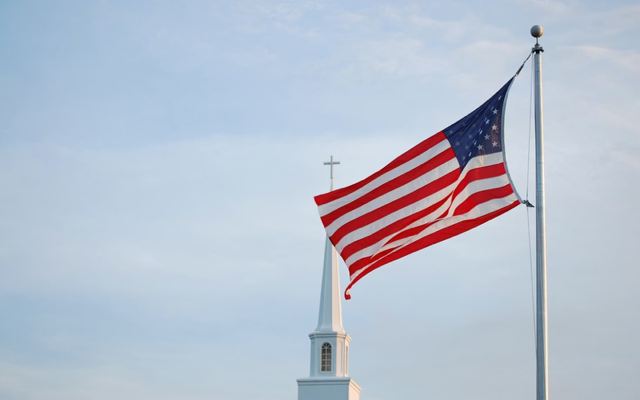
On the 250th anniversary of American Independence, Missy and I attended a concert and fireworks show in North Texas. We expected to see and experience a lot of patriotism and love for the U.S.A. But something else occurred that we did not expect: Christian nationalism was on full display and celebrated.
We saw people wearing shirts professing their love for Jesus and America. Other shirts wanted to make certain everyone knew their church was present and accounted for at the event: First Church loves Jesus, Freedom, and Our Troops.
Darius Rucker, formerly of Hootie and the Blowfish, was the featured artist. Darius sang fan favorites and some new songs.
But the biggest reaction came when he sang Lee Greenwood’s “God Bless the USA.” The crowd stood, singing every word while waving their phones in the night sky. Some people in the crowd even wiped away tears because they were so moved.
However, the biggest shock for me came when I saw a man wearing a shirt with a cross draped in the American flag. I’ve seen it before, but seeing it at the 250th Anniversary hit differently. Looking at the man’s outfit, which donned everything red, white, and blue, there was no doubt that he wanted to communicate his commitment to Jesus and the good ole’ USA.
But here was the problem: The American flag was so prominent that the cross faded to the background. Herein lies the reality of Christian nationalism, both overt and ingrained: Faith will always get lost behind the objectives of empire.
Generosity fades behind greed. Empathy fades behind selfishness. Understanding fades behind loyalty.
Inclusion fades behind exclusion. Community fades behind individualism.
Compassion fades behind vengeance. Forgiveness fades behind revenge. Justice fades behind privilege.
Faith fades behind blind certainty. Facts fade behind opinion. And love fades behind hate.
Jesus said it best in Matthew 6:24: “No one can serve two masters. Either you will hate the one and love the other, or you will be devoted to the one and despise the other.”
When people attempt to share their commitment to their faith and country, they are performing a balancing act that will always end with faith falling to the country. Why?
Because faith is built upon an idea: an idea that all are created equal, therefore worthy of love and justice. Country is built on a place: a place that demands conquest and control.
For 250 years (and before that, in all honesty), the tension between an idea and a place persisted. Europeans wanted to live out their faith as their conscience dictated, only to demand adherence to their specific brand of religion once they gained power in the New World. Explorers wanted new economic opportunities, but engaged in the genocide of Native Americans and the enslavement of Africans to secure them. Both practices are surely looked down upon by the Holy Book that Christians proclaim allegiance.
Even when the founders penned the immortal words, “We the People,” the “we” did not include everyone. Women, the landless, and people of color were excluded. Jesus had a lot to say about the harm of exclusion and the pursuit of wealth.
Again, love for faith and country have a hard time coexisting because faith will always take a back seat to country. An idea is much more difficult to defend than a place.
Throughout America’s 250 years, the country has attempted to right our wrongs, but each time, regression follows progress. Even when “more rights for me” does not mean “fewer rights for thee,” the “thee” always seems to figure out a way to reduce rights for the “me.”
America is experiencing a time of regression right now. So, when I see the cross draped with the American flag, I interpret it as a celebration of regression. “Make America Great Again” is an idea and practice of rolling the country back to a time when the privileged set the agenda for everyone else.
What were we celebrating last weekend? For many, I fear, they were celebrating the moment when the faith of Jesus was replaced with a patriotic loyalty to America.
I can no longer stomach the facade that is American Christianity. Walter Shurden once quipped, “For many American Christians, the adjective has become more important than the noun.”
I can no longer stand for the Pledge of Allegiance or the singing of the “Star-Spangled Banner”– not out of disrespect for my fellow citizens but out of the idolization that has become American patriotism. I will, on the other hand, bow my head in reverence to the man named Jesus, who taught me that a commitment to love and justice should always overshadow a commitment to empire. That I will celebrate.
- About the Author
- Latest Posts

CEO of Good Faith Media.