
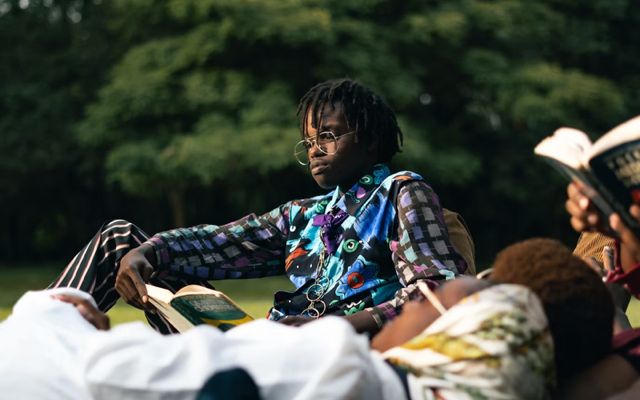
“Martin, don’t let anybody ever tell you you’re not a Somebody.” It’s Martin Luther King Jr.’s foundational childhood story. His grandmother instilled a core belief in his own worth, which remains a critical teaching in the African American community.
Somebodiness was popularized by King but dates to chattel slavery. “The essence of ante-bellum black religion was the emphasis on the somebodiness of black slaves,” James Cone explained in The Spirituals and the Blues. The need to create alternate meanings for human being and belonging as a reminder of one’s sense of worth, purpose, and community is a central part of African American survival.
Somebodiness is the sure and certain understanding that your life is consequential and of profound importance. It is the essential value of your person, your built-in worth, regardless of the fluctuating social and political calculations used to measure identity, citizenship and nationality.
The concept directly challenges the historical conditioning and social structures that treated African Americans as property or second-class citizens. In an interview on the Center for Action and Contemplation podcast, Ruby Sales, a Civil Rights leader and activist, shared how she survived Jim Crow:
“I think that in many ways, the society that I grew up in, in the South . . . if we had learned to hate ourselves the way the official requirements required us to do, then we would’ve never survived, and so I think that out of the Black community in the South, you have a kind of agape [the Greek word for unconditional love] growing up. I loved everybody, and in order to love . . . we had to counter the narrative that we were nobody with the sense that we were somebody, and that meant self-love. And I think many communities who stood on the outside of the gates of power have had to come up with a way of finding themselves worthy and beloved.”
As a part of their racial consciousness, African American children were taught a “racial etiquette” that was demeaning and meant to remind them of their “place” in society.
“Every black child would come to appreciate the terrible unfairness and narrowness of that world—the limited options, the need to curb ambitions, to contain feelings, and to weigh carefully every word, gesture, and movement when in the presence of whites,” Leon F. Litwack explained in Trouble in Mind: Black Southerners in the Age of Jim Crow. But to ensure the child understood that this shrinking and “shucking and jiving” was not natural but a performance for survival of white supremacist violence on a colonized land, they were told of their somebodiness.
“God don’t make no junk” was a common refrain heard on Sunday mornings as a child. Our inherent worth and self-esteem, specifically in defiance of systemic racism and oppression, remain a central principle of our spiritual teachings.
“You are created in God’s image. You are not slaves, you are not ‘n—‘; you are God’s children” is the message Howard Thurman heard from the pulpit. The pastor emphasized Thurman’s belonging not to a color-coded hierarchy, bound by depraved and dehumanizing language, but to God and thus a part of a divine lineage. His body was marked holy and blessed—even as it was being cursed and damned by American society.
King, who was mentored by the mystic and theologian, rooted human dignity in the theology of God’s creative love. Because all individuals are created in the image of God, they possess an inviolable dignity. This belief requires that society act with justice and morality, rejecting actions that seek to treat a “somebody” as a “nobody.”
“At every moment in history, oppression has been met with resistance. In every instance in which the State has consigned the vulnerable to the status of Nobody, the people have asserted that they are, in fact, Somebody,” Marc Lamont Hill explained in Nobody: Casualties of America’s War on the Vulnerable, from Ferguson to Flint and Beyond. “In doing so, they offer hope that another world is indeed possible, that empires eventually fall, and that freedom is closer than we think.”
“I am somebody” is a natural response to attempts to minimize one’s “me-ness,” to deny one’s aliveness through macro and microaggressions and inflictions of systematic pain and suffering. It is the rebuttal to the continued refusal to act with fairness and equality. It is to talk back to all tries, attempts, endeavors, and cracks at one’s self-assertion of intrinsic and permanent value.
This understanding is well worth underlining in a few books and as part of a reading list for a summer of somebodiness, which might include:
- The Mis-Education of the Negro by Carter G. Woodson,
- The Autobiography of Malcolm X by Malcolm X and Alex Haley,
- Lorraine Hansberry’s To Be Young, Gifted and Black,
- Notes on a Native Son by James Baldwin,
- Gwendolyn Brooks’ Family Pictures,
- Toni Morrison’s The Bluest Eye,
- Alice Walker’s The Color Purple,
- Ta-Nehisi Coates’ Between the World and Me,
- You Are Your Best Thing: Vulnerability, Shame Resilience, and the Black Experience, edited by Tarana Burke and Brené Brown, and
- Kellie Carter Jackson’s We Refuse: A Forceful History of Black Resistance.
- About the Author
- Latest Posts
Director of The Raceless Gospel Initiative, an associate editor, host of the Good Faith Media podcast, “The Raceless Gospel” and author of Take Me to the Water: The Raceless Gospel as Baptismal Pedagogy for a Desegregated Church.