
“She Speaks: Black Women Artists and the Power of Historical Memory” is a highly innovative exhibition that explores 250 years of American history through the lens of womanism. The art is on view at the Banneker-Douglass-Tubman Museum in Annapolis, Maryland through January 16, 2027 and it couldn’t have come at a better time.
“As the nation collectively commemorates the 250th anniversary of the signing of the Declaration of Independence through coordinated state and city initiatives, this exhibition enters the conversation by expanding how American history is remembered and told,” the curatorial statement reads. “Through this work, truth is not presented as fixed or singular, but as layered and contested.”
Curated by Martina Dodd, the exhibit centers female expression and rightly begins on the ground level with the words of Maryland native, Harriet Tubman: “I had reasoned this out in my mind; there was one of two things I had a right to, liberty or death; if I could not have one, I would have the other for no man should take me alive. I should fight for my liberty as long as my strength lasted.”
Using mediums like painting, textile, photography and video installation to bear witness to the past, reinterpret the present, and envision Afrofuturist futures, seventeen African American artists blend historical narratives with speculative, intergalactic, or indigenous aesthetics. With works described as “deeply personal and politically charged,” marginalized voices are empowered to shape self-determined and vibrant destinies.
“She Speaks” without interruption, reclaiming agency over technology, land, and cultural continuity without the disruption of a settler state. The exhibition holds space for possible, probable, and preferable futures with African American women as the architects. It introduces characters like Martha Jackson Jarvis’s fourth great-grandfather, Luke Valentine, a militiaman who was free but served during the American Revolution, with his story depicted in rich earth tones rather than the traditional red, white and blue.
Faith Ringgold is masterful in her side-by-side portrayals, contrasting the lofty rhetoric of equality with actual American history, juxtaposing the ideal with the African American reality of chattel slavery, lynching, and the Civil Rights Movement for equality. Her work exposes the hypocrisy of America’s founding documents, highlighting how those original promises of liberty systematically excluded African Americans, Indigenous peoples, and women. The visual effect of the six works from her series “Declaration of Independence and Freedom” is striking, damning even.
The exhibition is to be discussed and asks questions of you: “What does a liberated future look like to you?” Which histories do you feel were missing—or misrepresented—in how you learned American history?”
“What is a lesson passed down to you by a woman in your life?” “The future I imagine is…”
These are the prompts the visitor is invited to engage with at the start of the exhibition titled “Your History, Your Voice.” These questions are a part of an interactive wall, which seeks to empower individuals to name their expectation of and lay claim to the future, which also belongs to them.
This is certainly the case with Ada Pinkston’s “Keep Your Head to the Sky” and “Pointing Towards Justice.” In the digital prints on archival paper, Pinkston embodies a counternarrative where Confederate monuments to white-body supremacy, described as “unresolved sites of memory,” once stood.
By reclaiming speculative spaces and combining them with ancestral knowledge, these mediums dismantle harmful colonial tropes. They empower marginalized communities to actively shape and visualize their own liberated, self-determined destinies.
Zsudayka Nzinga’s “The Art of Storytelling” captures a quilting circle, which serves as a reminder to continue gathering to swap stories and share secrets for survival. How we remember is just as important as what we remember. Collective memories bind communities together by providing a shared origin story, which may include a defining trauma.
It serves as a tool for marginalized groups to challenge dominant and “official” histories. By preserving and elevating untold stories, communities can actively participate in making history rather than just being passive bystanders.
The second level of the exhibition reminds the viewer of this and that we have the eyes to see it, complete with cowry shell decorated sunglasses in “The Aunties,” from a series “The Aunties and The Land.” The couple stewards Mt. Pleasant Acres Farms, a 111-acre historic property in Preston (Caroline County), Maryland, where Harriet Tubman once liberated her family from enslavement.
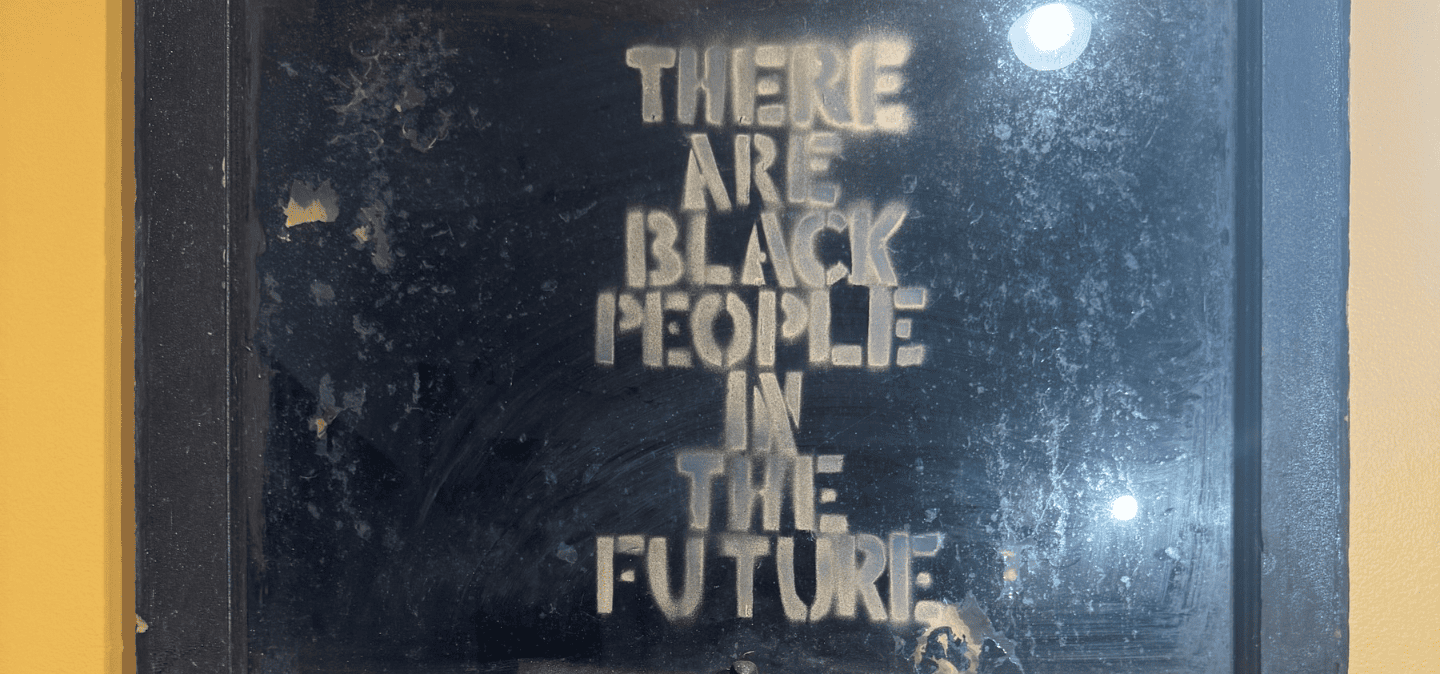
Throughout the exhibition, visitors are reminded: “There are black people in the future.” It is an understanding shared with the reader: African Americans will not only exist but will be active shapers of tomorrow.
Each round goes higher and on the third floor of the exhibition, there is a seating area and a push-dial phone decorated in cowry shells. The exhibit is called “1-800-SANKOFONE or DIAL-AN-ANCESTOR.” With it, Charlyn Griffith dials into the depths of African and African American interiority and spirituality.
Also on the third floor is the centerpiece, “Follow the Drinking Gourd” by Fabiola Jean- Louis, from the series “Rewriting History.” A beautifully dressed African American girl signals for quiet in front of an ornate, colorful dollhouse, with a toy Confederate soldier at the top of the stairs and presumably, the lady of the house at the bottom.
But beneath the stairs are two people, one of whom is also signaling they keep quiet. Named for an African American spiritual and folk song famous for its lore as an escape map for Africans who were forcibly enslaved on the Underground Railroad, the theme of the exhibition comes through loud and clear here.
The incomparable work of Elizabeth Catlett is also featured. Through “My Right is a Future of Equality with other Americans,” “In Sojourner Truth,” and “My Role Has Been Important in the Struggle to Organize the Unorganized,” the sculptor and printmaker captures the resilience and bravery of African American women, who have been a part of struggles for justice and equality from the beginning.
More than conversation pieces, “She Speaks” reminds the visitor “She Was Once Known.” The installation by Khaleelah I.L. Harris suggests there is always a time and a place in the common places of one’s home to discuss and preserve history. Harris asks the visitor to “remember what we already know,” and that spoke to me.
For more information on the exhibition and to visit, go to bdmuseum.maryland.gov/exhibitions.
- About the Author
- Latest Posts
Director of The Raceless Gospel Initiative, an associate editor, host of the Good Faith Media podcast, “The Raceless Gospel” and author of Take Me to the Water: The Raceless Gospel as Baptismal Pedagogy for a Desegregated Church.