

Thirty years ago this summer, I boarded a plane to Estonia with a dozen other college student missionaries from Texas. I was 21 and full of zeal to take the message of Jesus to the newly liberated people of the former Soviet Union. I wanted them to know that just as their country had been freed from the shackles of tyranny, so their souls could be freed from the bondage of sin.
At least that’s what I told myself I was doing.
Time didn’t necessarily reveal my initial motivation as a complete lie. I was, after all, a product of all I had been taught about the gospel and my responsibility to it. But time has drawn the complexities of missions into sharper focus.
Money Matters
One element of the complexity is that I really wanted to travel, and a summer mission trip was one of the few options available to me. Although my family occasionally took in-state summer vacations, we weren’t the traveling kind. Before flying to Estonia, I had only been on an airplane twice and could count on one hand the number of states outside Texas I had visited.
Travel required money I didn’t have. Missions, however, resolved that issue. Many Christians sitting in church pews were taught that if they aren’t in a position to spread the gospel themselves around the world, they can at least fund those who are.
On a macro level, this resulted in church and denominational budgets that swelled during the heyday of Christian missions. The Baptist world I grew up in was the gold standard of the missions industrial complex, funding thousands of full-time missionaries and short-term projects around the globe. Billions of dollars have flowed not just to missionaries themselves, but to a massive infrastructure of logistics, field projects, training and support programs, and, in some cases, retirement accounts.
On the micro level, missionaries raise funds that either fully cover their expenses or subsidize the budgets of the church, denominational, or independent missions agency that facilitates their mission. This requires the interpersonal skills and tricks of a professional development officer who knows how to ask for money without asking for money. (Assuming, of course, the missionary isn’t independently wealthy and can write the check themselves.)
The combination of evangelistic zeal with fundraising tactics has formed a unique culture that sacralizes the financing of mission endeavors. Giving money to someone to travel to a faraway place isn’t just “financial support.” It is “participating in what God is doing.”
In my evangelical college student world, this spiritualization of missions fundraising took some supernatural turns. One of these was some version of the following testimony: A student lacked a very specific amount of money to go on a mission trip. As the deadline approached, they were on the verge of canceling their participation when, miraculously, they stopped by their mailbox and found a check for the exact amount they needed.
The exact amount! God must want me to go!
I was floored when I first heard this story. By the tenth time, I had begun to wonder whether people in these students’ lives—through parents, friends, and church networks—had been made aware of the exact amount the student needed to fulfill their obligations before writing their checks to “participate in what God is doing.”
Transformative Travel
These were the early roots of my cynicism toward missions. Even so, my experience in Estonia that summer was consequential for the rest of my life. I taught English and helped a congregation on a construction project.
Because of language barriers, there wasn’t much one-on-one evangelism. This ended up being a blessing in disguise. Instead of “sharing the gospel,” I got my first introduction to the good news embedded in subtle gestures and the glorious awkwardness of intercultural communication.
One Sunday morning, while waiting for a bus to take me to church, an old, drunk Estonian guy approached me for a conversation. He knew about as much English as I knew Estonian, which led us both to think we understood far more than we actually did. After what I thought was a pleasant conversation about how nice the weather was that morning, he walked away as I told him one of the only Estonian phrases I had learned—Jumal armastab sind! (God loves you.)
As I stood there, proud of myself for “being a light,” a young woman at the bus stop asked me if I knew what he was talking about. When I told her I thought he was talking about the weather, a slight, barely perceptible smile crept across her face. (This is the Estonian equivalent of rolling around the floor laughing hysterically.)
“He told you he has just enough money left for one more bottle of vodka and asked if you’d like to share it with him,” she said. “He’s going to get it now.”
Back then, I was thankful the bus arrived before he did. I would have had a lot to answer for to the missions agency that sent me there to save his soul. (I’ll refrain from sharing what I’d do if the same thing happened today.)

With fellow student missionaries at an abandoned Soviet airfield.
Flipping the Script on the Hippie Trail
I returned home with that story, and many more, to pull out of my back pocket when talking about that summer. I also had this maxim to share, which I quickly learned was as much a staple of missionary mythology as miraculous fundraising stories: “I received far more from the Estonians than I gave.”
In all my years of being in and around mission settings, this is the one truth that remains constant. This leads me to wonder: Why don’t Christians just send young people on trips where their sole (and soul) purpose is to receive the transformative experience of travel?
For many evangelicals, we know the answer to that question is rooted in colonialism and the white savior complex. But there are enough of us out here trying to move away from that, and we could effect real change in young people’s lives.
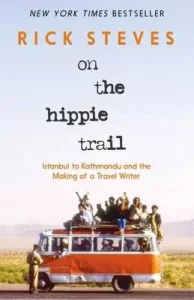 Rick Steves, the famous guide and travel writer for all things Europe, recently released On the Hippie Trail: Istanbul to Kathmandu and the Making of a Travel Writer, which could serve as a guide. The book is the publication of his travel journals from a trip he took when he wasn’t much older than I was when I traveled to Estonia. In it, he chronicled his and a close friend’s journey along an infamous route from Europe to South Asia.
Because of the Soviet invasion of Afghanistan in 1979, the Hippie Trail ceased to exist shortly after Steves took his journey. In the book’s postscript, Steves writes that people lament to him that such a journey could no longer be taken because of globalization. He disagrees.
“The trip was not only Iran, Afghanistan, and India in 1978,” he wrote. “It was 23-year-olds on the verge of adulthood, getting to know the world…That same world and those same 23-year-olds are still out there…And today—with the rise of a fearful Christian Nationalism and an aggressive America-first approach to a world that is ever-smaller, more interconnected, and more complicated—this kind of transformational travel is more valuable than ever.”
Because travel is an economic privilege most people, like me at 21, don’t have, Christians who believe an expansive God is present in an expansive world can play a part. This would require a shift in mindset away from funding missions and toward funding meaningful travel and pilgrimage.
A Real ROI
But what will the return on investment be?
Well, Rick Steves returned from his trip, scrapped his plans to teach piano for the rest of his life, and started a small travel company that has grown into a worldwide phenomenon. As it has grown, he has donated millions of dollars of his wealth to address the global hunger crisis, and his faith is a primary driver for his mission.
I haven’t reaped the same financial rewards from the lessons I learned in Estonia. But I did come home with a deep love for a country that, in 2015, I began returning to regularly. The relationships I have formed there and the lessons I learned continue to form and transform me into the writer, son, brother, church member, and friend that I am today. They have made me more open to the wonders of God and less fearful of my neighbors.
“Travelers learn that fear is for people who don’t get out much, that we’re all equally lovable children of God, and by traveling, we get to know the family,” Steves wrote. “I believe that if more people could have such a transformative experience—especially in their youth—our world would be a more just and stable place. Travelers understand that the big challenges of the future will be blind to borders, and we’ll need to tackle them together—as global citizens and as a family of nations. And most fundamentally, travelers know that the world is a welcoming place filled with joy, love, and good people.”
- About the Author
- Latest Posts

Senior Editor at Good Faith Media.