
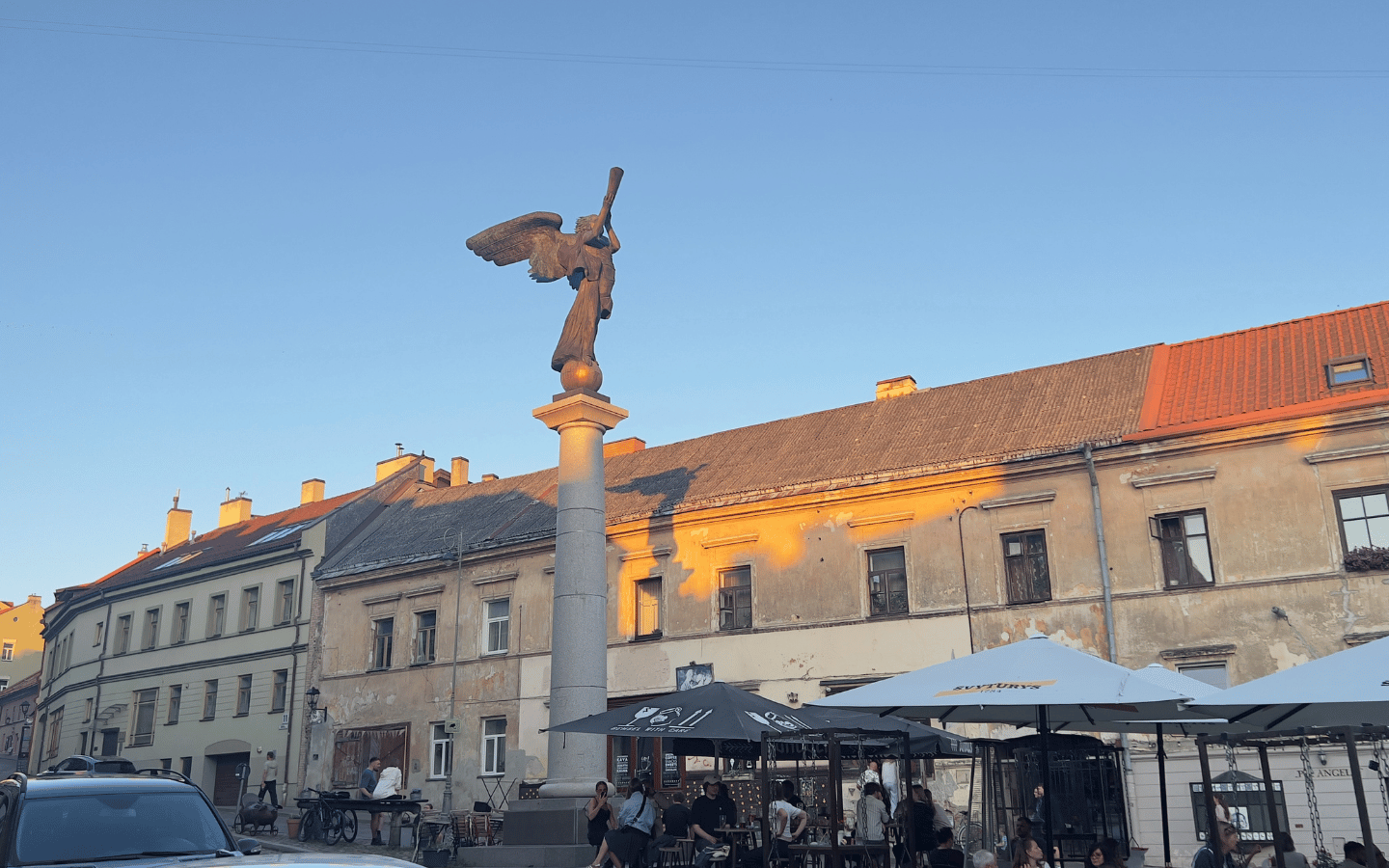
“Everyone wants Vilnius as their own,” the young art student told me at Devinkė, the neighborhood bar. “And who wouldn’t? It’s a heavenly place.”
She was taking a break from giving emotional assistance to an acquaintance who had had about four too many, and was happy to make small talk with this middle-aged American journalist who had just confessed to her that I had only recently learned about her city while researching a story about Belarusian refugees.
Vilnius is the cultural home of many Belarusians, who had their eyes on the city that Poland occupied during the interwar period. And of course, the Soviet Union had the city that lies on the river Vilnia in its grip during the Cold War period.
It’s true. Everyone wants Vilnius as their own, and a recent weekend trip to the city helped me understand why.
Like most Baltic and Scandinavian capital cities, Vilnius’ Old Town is considered its crown jewel. But unlike other Northern European city centers, this UNESCO World Heritage Site has a decidedly Italian feel, influenced in part by a 16th-century marriage between an Italian princess and a Lithuanian duke.
On a cool Friday night of my visit, bracketed by the recent European heat wave and a cold front ushering in heavy rains, I sat in Old Town for hours, watching passersby get sucked into the Portal, the first in a global network of high-resolution video screens connected to various cities around the world. There, children and old people alike engaged with other humans from various places such as Philadelphia, Manila, and Brazil. Some simply waved while others prompted their global neighbors to do the “Macarena” or bounce their palms-up hands in the “6-7” motion.

Old Town Vilnius is a respite from the chaos of the world. But a neighborhood just a few steps away and across the river is a cool breeze blown into a weary soul. There, bohemian locals in bars like Devinkė and at midday picnics on the banks of the river Vilnia discuss their art and world affairs, and, during my visit, expressed wonderment at the existence of an American Christian who is both progressive and even remotely interested in Vilnius.
That neighborhood is Užupis.
Middle Space
Užupis (pronounced OO-zhoo-piece), which means “beyond the river,” is a small community. Before the Holocaust, it was a vibrant Jewish suburb of greater Vilnius. During the Cold War, its abandoned buildings housed squatters and prostitutes. In the post-Soviet years, it developed a reputation as a haven for creatives, weirdos, and revolutionaries.
Today, Užupis occupies the uneasy middle space between anarchy and gentrification that many similar neighborhoods around the world are experiencing. Unemployed, ripe-scented artists paint the comings-and-goings of the neighborhood while sitting on curbs in front of Michelin-recognized restaurants. Tourists and locals alike read books while rocking in a swing hung from a bridge over the river.
If the coming struggle between a colorful, free-spirited community and unrestrained capitalistic blandness has a productive outcome, it will be because Užupis isn’t just any old neighborhood. It is an independent republic, albeit a self-proclaimed one. (A well-informed patron of Devinkė told me that this insistence on independence may be the only thing residents of Užupis and Texans have in common.)
The Free Republic of Užupis was established in April 1998. “It is unclear whether the statehood of the Republic, recognized by no government, is intended to be serious, tongue-in-cheek, or a combination of both,” the Užupis embassy website says. “The decision to place Užupis Day on April 1st (April Fools’ Day) may not be coincidental, emphasizing the importance of humor and non-importance of ‘serious’ political decisions.”

Free Užupis
The Užupis Constitution was written by Romas Lileikis, its first “President,” and Tomas Čepaitis, Užupis’ first “Minister of Foreign Affairs, and sometimes King.” The Constitution reads more like a living witness to dignity and shared humanity than a stodgy, legal document.
It contains 41 articles, mostly a declaration of the rights of every human, although some are mere suggestions while others are geared toward canine and feline neighbors.
According to the Užupis embassy, no one knows which articles were written by Lileikis and which were written by Čepaitis. “The only truth known to history is that [the] President loves dogs, and [the] Foreign Minister loves cats,” the embassy website reads. “So articles about the rights of these citizens can be authorized.”
No world nation has recognized Užupis’ independence. However, in his visit to Vilnius in 2018, Pope Francis declared a blessing on the republic’s constitution.
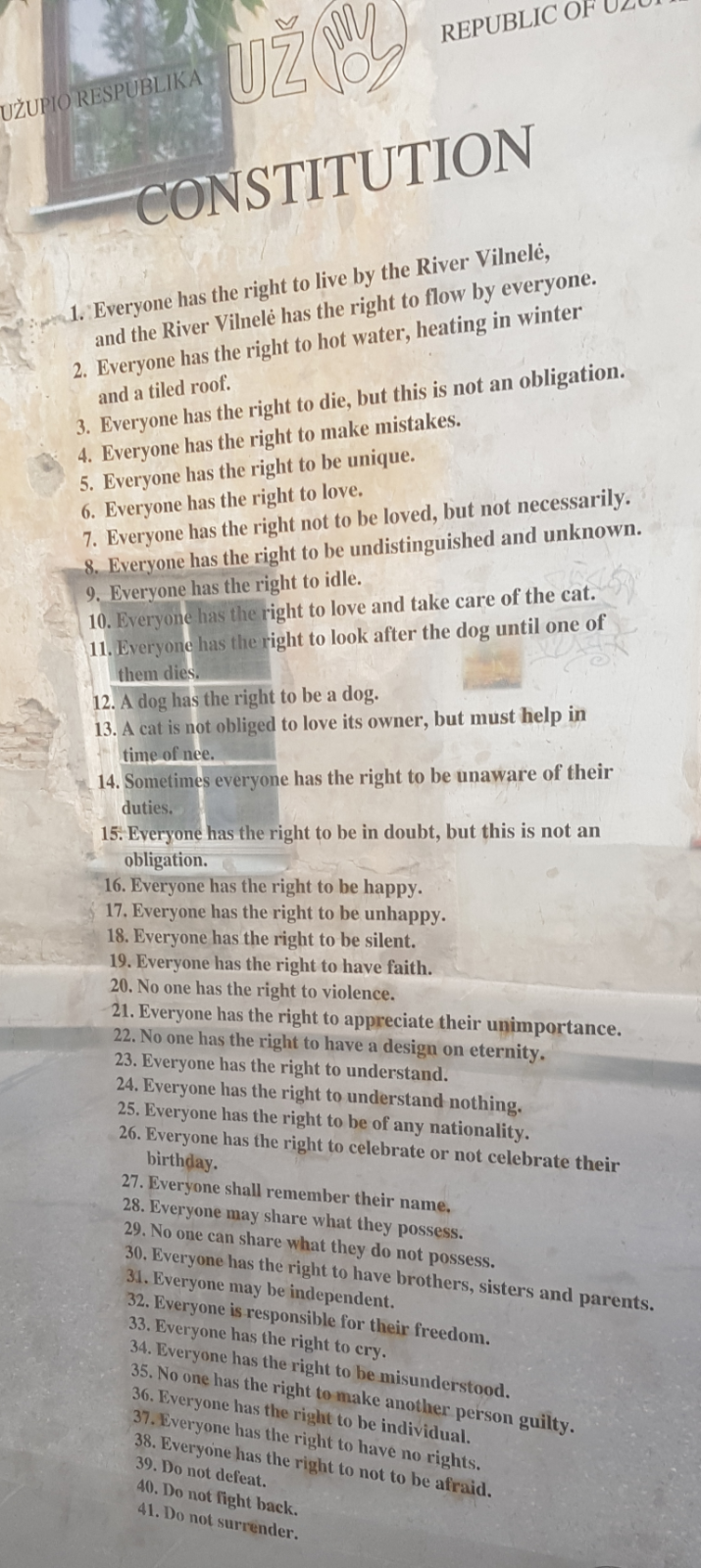
On Paupio street, a row of plaques displays the Užupis Constitution in various languages. It was first written in Lithuanian, then in English. Every year, a new plaque in a new language is revealed on Užupis Day.
The most inspiring aspect of the Constitution, especially from the perspective of someone whose country’s constitution was formed with many death-dealing stipulations, is the prevalence of the word “everyone.” The “First Amendment” to the Užupis Constitution is that “Everyone has the right to live by the River Vilnele, and the River Vilnele has the right to flow by everyone.” The second is that “Everyone has the right to hot water, heating in winter, and a tiled roof.”
The document honors both religious liberty and religious (and non-religious) diversity—“Everyone has the right to faith” and “No one has the right to have a design on eternity.” Agnosticism is welcome—“Everyone has the right to be in doubt, but this is not an obligation.”

A Peaceful Constitution
The last three articles seem like self-contradictory commandments.
Do not defeat.
Do not fight back.
Do not surrender.
I stared at those for quite a while on my last day in Užupis. In them, I heard echoes of my own constitution as a follower of Jesus. “Turn the other cheek” and “Peter, put your sword away.”
I also thought about the sacred power we give our founding documents, and how we’d all be better served if we approached them with unclinched fists and a little more whimsy.
Long live Užupis!
—
The Užupis Constitution
(As it appears on the English plaque on Paupio Street)
The Užupis Constitution terms:
- Everyone has the right to live by the River Vilnele, and the River Vilnele has the right to flow by everyone.
2. Everyone has the right to hot water, heating in winter and a tiled roof.
3. Everyone has the right to die, but this is not an obligation.
4. Everyone has the right to make mistakes.
5. Everyone has the right to be unique.
6. Everyone has the right to love.
7. Everyone has the right not to be loved, but not necessarily.
8. Everyone has the right to be undistinguished and unknown.
9. Everyone has the right to idle.
10. Everyone has the right to love and take care of the cat.
11. Everyone has the right to look after the dog until one of them dies.
12. A dog has the right to be a dog.
13. A cat is not obliged to love its owner, but must help in time of nee. (*See author’s note below.)
14. Sometimes everyone has the right to be unaware of their duties.
15. Everyone has the right to be in doubt, but this is not an obligation.
16. Everyone has the right to be happy.
17. Everyone has the right to be unhappy.
18. Everyone has the right to be silent.
19. Everyone has the right to have faith.
20. No one has the right to violence.
21. Everyone has the right to appreciate their unimportance.
22. No one has the right to have a design on eternity.
23. Everyone has the right to understand.
24. Everyone has the right to understand nothing.
25. Everyone has the right to be of any nationality.
26. Everyone has the right to celebrate or not celebrate their birthday.
27. Everyone shall remember their name.
28. Everyone may share what they possess.
29. No one can share what they do not possess.
30. Everyone has the right to have brothers, sisters and parents.
31. Everyone may be independent.
32. Everyone is responsible for their freedom.
33. Everyone has the right to cry.
34. Everyone has the right to be misunderstood.
35. No one has the right to make another person guilty.
36. Everyone has the right to be an individual.
37. Everyone has the right to have no rights.
38. Everyone has the right to not to be afraid.
39. Do not defeat.
40. Do not fight back.
41. Do not surrender.
*Author’s Note: I first read this as a typo, but then wondered if it was a playful commentary on the independence of cats. I couldn’t find a good answer, but on my last day in Užupis, I saw a French tour guide showing the Constitution to a group. I asked her if the translation of “need” was misspelled in French. It wasn’t, and she was unaware of the mistake in English. But she told me, “But don’t bring it up to the people of Užupis. They probably will just give you a more confusing answer. It’s best just to let it be.”
- About the Author
- Latest Posts

Senior Editor at Good Faith Media.