
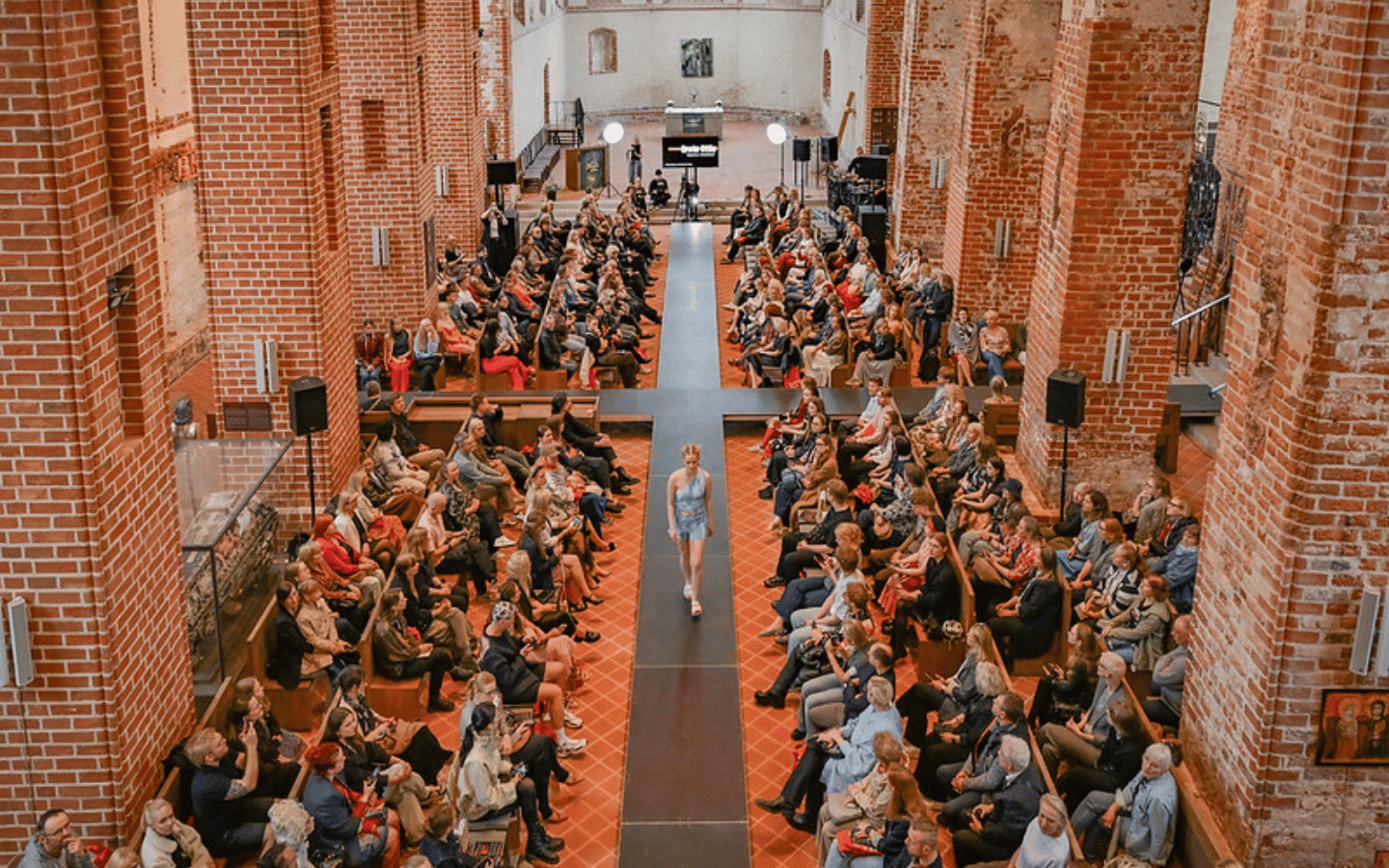
In June, St. John’s Church in Tartu, Estonia, hosted a fashion show created by the students of Pallas Art College. The annual event, “Mood-Performance-Dance,” takes place at a different location each year.
Pallas organizers stress that each new venue isn’t chosen randomly, but that the show is intricately connected to the location. “Space is not merely a backdrop but an active element of the performance,” the event’s website states. “As a historic place of worship, St. John’s Church creates a special atmosphere for today’s performance, where fashion and playfulness meet an environment charged with the history, spirituality, and unique milieu of the place.”
St. John’s, known locally as Jaani Kirik, is a Gothic brick building near the outer edges of Tartu’s Old Town. The original 14th-century structure has been rebuilt and restored several times. With its surviving terracotta figurines and cavernous, rustic sanctuary, Jaani Kirik carries the aesthetic of a country and faith forged in the fires of conflict, emerging stronger and with a heightened appreciation for beauty.
It also houses the Tartu University-St. John’s Congregation, which was created through a 2001 merger between two historic Lutheran churches.
Although Estonia is among the least religious countries in the world, the fashion show elicited responses similar to the online outrage you’d find if an evangelical church in the United States hosted a similar event.
Testing Boundaries
Before anyone rolls their eyes too quickly and hurls accusations of making mountains out of molehills, it’s important to remember that this wasn’t a fashion show with the little old ladies of a small Lutheran church in rural Minnesota modeling their Sunday best. Instead, it featured avant-garde apparel designed and modeled by Gen Z students at an art college in a European city.
It also featured a little skin. Depending on sensibilities, it wasn’t overly sexually suggestive, but enough to raise some eyebrows.
As you may expect, the critique came from church members concerned about desecrating a sacred space. They raised questions that many people of faith would raise: What are the boundaries? What does this say about us? Should space devoted to heavenly concerns be used for such earthly pursuits?
In interviews with Estonian media, St. John’s pastor, Triin Käpp, acknowledged that there were moments that tested the boundaries of what some (including herself) would consider good taste. But she also shared how thoughtful and purposeful the decision-making process to host the event was. It included members of her church, who were also involved in the art school, wanting to find common ground between the theme of the performance and the mission of the church.
“Most of the event was essentially profound and thought-provoking, giving young people the opportunity to express the pain of their lives in a space that helps to feel and alleviate that pain,” Käpp said in an interview with an Estonian religious publication. “I really hope that many young people will find their way to church again after this event.”
Religion by the Few, For the Many
However, members of St. John’s weren’t the only ones expressing concern about “Mood-Performance-Dance” taking place in a place of Christian worship. They weren’t even the loudest voices.
I watched the online outrage over the event with intrigue. As someone surrounded by a culture heavily influenced by puritanical ideals, the anger felt familiar. It carried with it hints of “How dare they!” (although no true Estonian would ever end a sentence with an exclamation).
But the more I dug, the more I realized these weren’t religious people throwing a fit. They were part of the vast majority of Estonians who, although they may practice some form of personal spirituality, have no formal connection to organized religion. Many of them, as is the case across Europe, aren’t even aware that active Christian congregations are worshipping inside these historic buildings they walk by every day.
It has always made perfect sense for “nonbelievers” in the U.S. to care about what Christian churches do. This is especially true during the second Trump presidency, when literal Christian Theocrats are operating the highest levers of power. The stakes are too high and Christian influence in our public institutions too deep for even the most agnostic citizen to ignore what happens in churches.
But in Estonia, where there is no expectation that even public figures be religious (and it may even hinder them if they are), this interest and outrage over a fashion show at a church made no sense to me. Why did they care?
During my recent visit, I mentioned this to my friend Uik and asked if he could explain it. Although he isn’t religious, Uik studies sociology of religion at Tartu University.
He told me there is a strong desire among some for an organized religious presence in the country, but no corresponding desire to actually practice religion. Then he used a phrase that caused my ears to perk up. “It’s vicar religion.”
I had never heard that term, but I recognized it immediately.
Later, in a conversation over coffee with Triin Käpp, St. John’s pastor, she echoed Uik’s sentiment. “Many Estonians want to have church buildings everywhere, but they don’t want to participate in what goes on inside them,” she said. “It’s vicar religion.”
Again, there was that term that I had never heard, but knew exactly what it meant.
Käpp told me the phrase comes from Grace Davie, a British sociologist of religion. When I looked it up, I saw the term Davie most often uses is “vicarious religion.”
For Uik and Triin Käpp, as it traveled the English-to-Estonian-to-English translation journey, “vicarious” must have become “vicar,” but I actually prefer it over the original. It feels more alive.
The layers of what vicar religion can mean for a society are endless, and Davie has spent much of her academic career peeling them back for readers to see. There is much to critique in the human instinct to expect something of a religion that they don’t expect of themselves. But vicar religion can be positive as well.
Belief and Beauty are Waiting
In a 2005 Pew Research event on religion, politics, and public life, Davie spoke to the usefulness of vicar religion during times of national tragedy or (sometimes) celebration. Incidentally, she used an example from Estonian and Swedish history.
In 1994, an Estonian ferry carrying almost a thousand passengers and crew sank in the Baltic Sea on its way to Sweden. Only 137 people survived in one of the largest peacetime shipping disasters after the sinking of the Titanic. The day after, much of the Swedish population, who, like Estonians, are not particularly religious, went to church.
“Nobody told them to, but the churches were open…and religious professionals were there to meet them,” Davie said. “They knew they had to be there. And the very next morning on the front of the main Swedish daily, there was an article by the archbishop putting the tragedy into a theological context and giving Swedish people a way of understanding what had happened.”
Davie added: “The churches were in place and the population came. But nothing would have happened unless there had been a disaster; all of it would have remained implicit and under the surface.”
This practice of vicar religion is prominent in religious communities, such as with the Benedictines. There is an idea they express that goes something like, “it’s ok if you don’t or can’t believe right now. We will believe for you, and will be here when (and if) you are ready.”
But I think this can go beyond belief as well. What if churches didn’t just practice good theology and robust belief on behalf of those who aren’t there; what if they also practiced beauty? And what if that beauty was there waiting for whoever needs it, at a time they need it the most?
I imagine the young Pallas art students may have been confused by some of the outrage they witnessed outside the walls of St. John’s church as a result of their event. But I’m thankful they found welcome, embrace, and beauty in a sacred space devoted to honoring the giver of all good things.
- About the Author
- Latest Posts

Senior Editor at Good Faith Media.