

The world feels increasingly fragile. Political tensions continue to rise, alliances are strained, and the language of war has become part of daily life.
Recently, the war with Iran has shown up not just at our gas pumps, but in our social media feeds.
We laugh at the memes. We share them, and we scroll past their reality. The danger is not just that war is being turned into memes, but that we are learning to experience war in this way.
In a now-deleted video, the White House circulated a post that captured this shift with unsettling clarity. Drawing from the visual language of the video game Call of Duty, the clip blended real footage with game imagery. It even included “killstreak” animations meant to reward “in-game” performance.
What should register in our minds as deadly force resembled video game play instead. It portrayed reality as an in-game achievement, where kills are celebrated and obliteration raises the score.
Familiarity Breeds Dismissal
It was jarring not because it was unrealistic, but because it was familiar. The aesthetics of entertainment were seamlessly overlaid on the realities of war by our government.
Missile strikes have become highlight reels to consume. Military action is framed in the familiarity of video game imagery.
War begins to resemble play. And when the game ends, we reset without reckoning with the real consequences or holding leaders accountable.
Even geopolitical rivals now engage one another not only through force but in the mockery of memes. It is fake, satirical and viral content designed to win attention as much as influence in the social media universe.
Iran has circulated its own stream of digital propaganda, including animated Lego-style shorts recreating the conflict. The clips present the violence through a disorienting, playful lens. They are simple, stylized and easy to share.
What once might have been dismissed outright can, through repetition and clever packaging, begin to feel familiar and even plausible. The result is confusion and a steady erosion of our ability to discern reality from constructed narrative.
War is no longer only fought on the battlefield. It is narrated, filtered, and consumed. And in that process, truth itself is becoming a casualty.
President Trump said, “I am not going to start a war. I am going to stop wars.”
However, once the U.S. engaged in this conflict, he spoke flippantly of death and loss of life in times of war: “Sadly, there will likely be more before it ends. That’s the way it is.”
That phrase, “That’s the way it is,” might be the most honest phrase he has spoken regarding the conflict. It may also be the most troubling. It reflects a world where conflict is assumed, where loss of life is expected, and where violence is treated as an inevitable part of the human narrative.
An Alternate Reality
Jesus offers a strikingly different vision: “Blessed are the peacemakers.” It is a simple but demanding statement because peacemaking requires proximity to suffering.
It requires seeing clearly what violence does to bodies, families, and communities. It requires seeing war as devastating rather than entertaining and refusing to accept it as normal, trivial, or inevitable.
Memes and animated shorts on social media do the opposite. They compress our reality and reward detachment. They allow us to scroll by the suffering without feeling the weight of war. We come to consume war rather than confront it.
This is where the Christian narrative must speak with urgency. At the center of the Christian story is not an abstraction but a body that was broken, executed and then put on display by the empire. The cross represents the depth and breadth of what violence does. And the resurrection is God’s refusal to let that reality be reduced or ignored.
The resurrection does not deny suffering, nor attempt to make it more palatable. It doesn’t sanitize the cost of the devastation. It does, however, declare that suffering and death do not have the final word. It restores weight to what our world would rather flatten and insists that human lives and the casualties of war do matter, eternally.
In the meme age, this insistence is radical. As we scroll past Lego-style explosions and stylized war imagery, we risk losing the ability to recognize what we are seeing.
When violence becomes familiar, expected, and casually consumed, compassion erodes. Grief becomes optional and the casualties of war become harder to perceive clearly.
Every share, like, and repost trains us to detach. War becomes distant because suffering is abstract, packaged, and flattened into content.
The resurrection calls us back to our humanity and to a reality that is not cartoonishly curated. It refuses a world that flattens suffering or turns it into spectacle, and instead holds together both real suffering and real hope. In doing so, it insists that peace is not born from detachment, but of compassionate engagement.
If we are consumed by the spectacle, then we risk losing both clarity and compassion. We are told, “That’s the way it is.” The resurrection responds, “That is not the way it has to end.”
Blessed are the meme makers? No.
Blessed are the peacemakers.
- About the Author
- Latest Posts
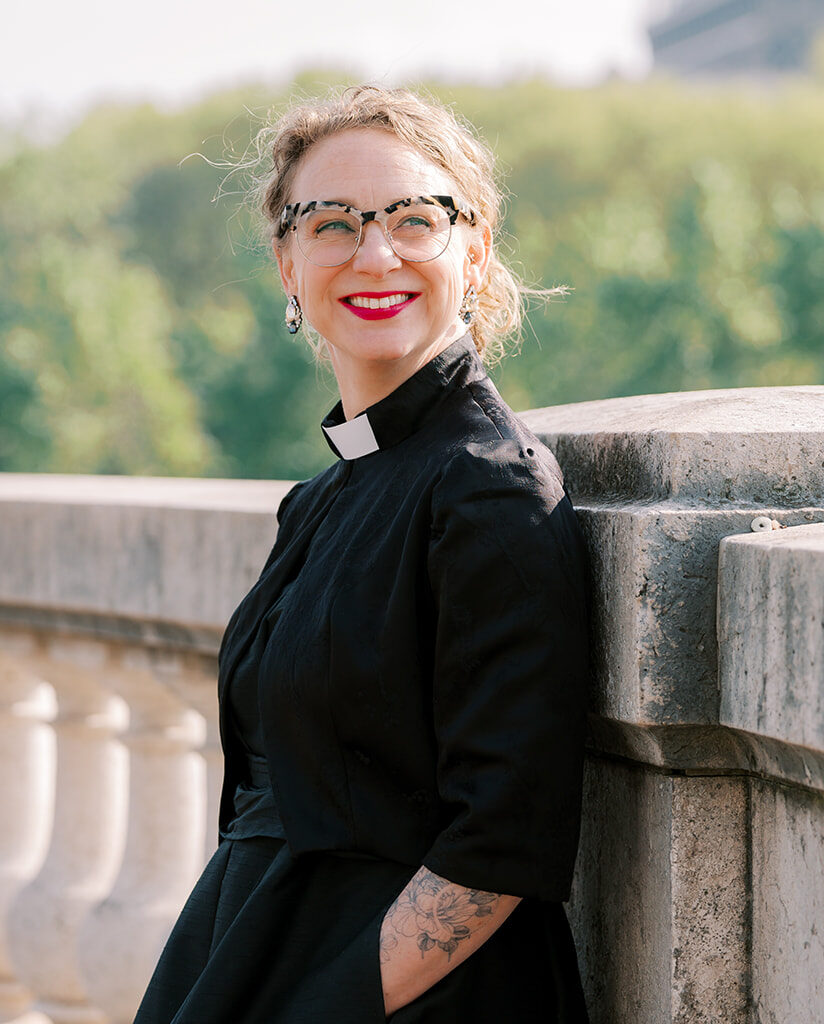
Rev. Michelle Wahila is an ordained PCUSA pastor, founder of Ruffled by Grace, and sought-after officiant and retreat leader. She creates heartfelt celebrations and soulful experiences that blend tradition with imagination. Now living in a 19th-century farmhouse in rural France with her family and a menagerie of pets, she enjoys gardening, making jam, and savoring a good cup of coffee.