
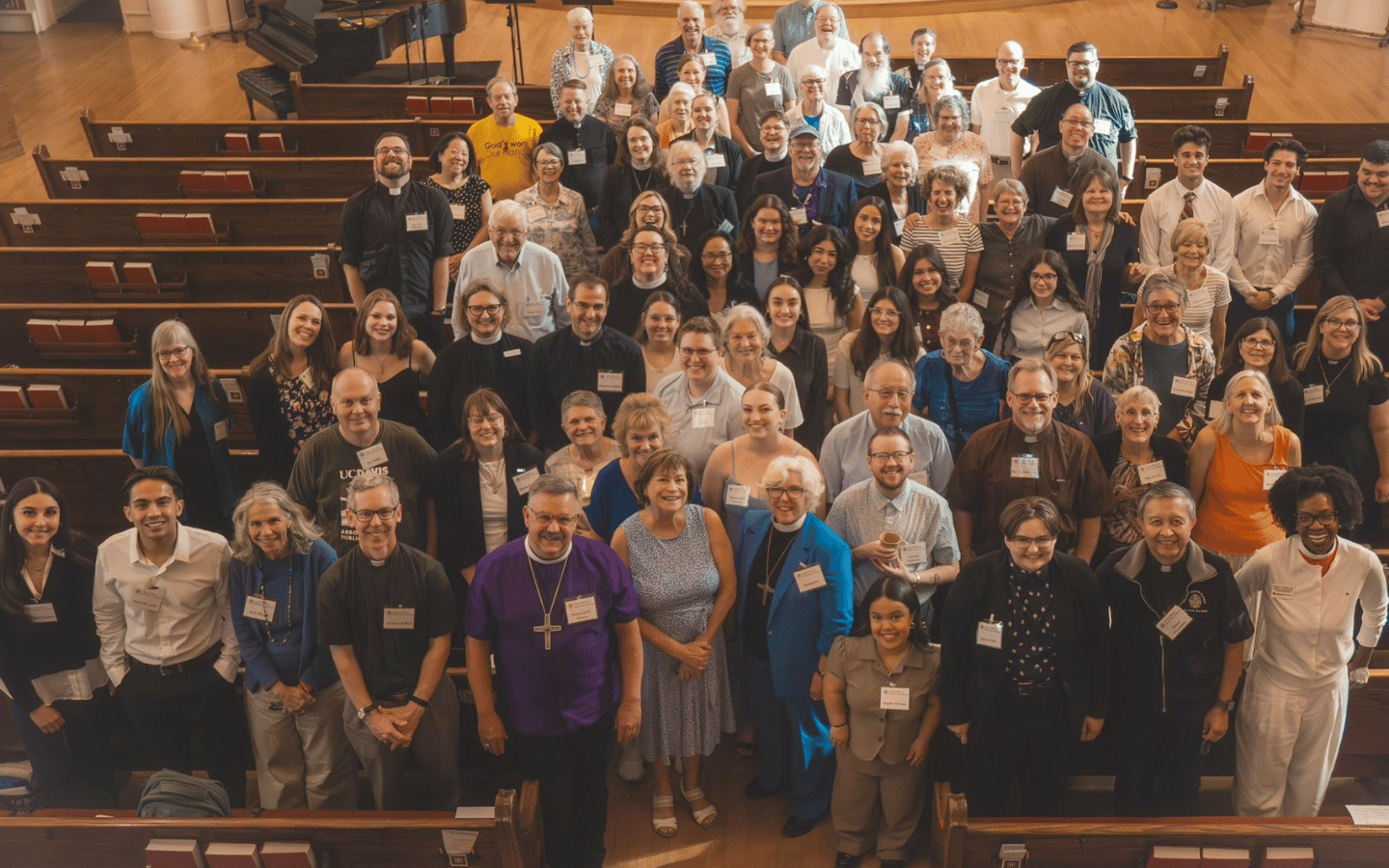
On May 20, 2026, over 100 Evangelical Lutheran Church in America (ELCA) church members, students, professors, pastors, deacons and bishops from California participated in the annual Lutheran Lobby Day in Sacramento. The event was hosted by the California Lutheran Office of Public Policy (LOPP). Some participants worshipped on Tuesday evening before the event at St. John’s Lutheran Church in Sacramento.
On Wednesday morning, attendees checked in at St. John’s. The group was well-instructed on the focus legislation by seven California Lutheran students who studied, researched and reported on six bills identified as priorities for the day.
Small groups of about four people each then moved to the “swing space,” the offices of state senators and Assembly members. While most advocated to legislative staff, some groups met with senators or Assembly members personally.
ELCA Lutherans take their vocation as citizens seriously. The legislative priorities this year centered on the environment, hunger and immigration issues. Several bills were of special focus:
Senate Bill (SB) 868, authored by Wiener, would allow the use of portable solar devices. By exempting interconnection requirements, it would benefit renters, who make up 44% of Californians, and increase clean energy use.
SB 1125, authored by Menjivar, would require the State Water Resources Control Board to develop a drinking water needs assessment. Water is the only utility that does not have a subsidy for low-income consumers. One in eight Californians is carrying water debt. Specifically, the assessment would focus on community water systems with fewer than 3,000 service connections.
Assembly Bill (AB) 1049 by Rodriguez seeks to eliminate sponsor-deeming rules for the state nutrition assistance program, the California Food Assistance Program. Currently, the program can use an immigration sponsor’s income to determine whether the sponsored family needs food assistance. Not all sponsors can provide financial assistance to those they sponsor, but immigrants still need food assistance.
AB 2299 by Calderon is the California Anti-Hunger Response and Employment Training Act of 2026. People who are out of work, underemployed, seeking work, or affected by humanitarian immigration-status barriers are excluded from the CalFresh program solely due to federal HR-1 time-limit work rules and humanitarian refugee status. If passed, this bill would remove the federal exclusions and expand access to the CFAP for those currently excluded.
SB 1105 by Perez is referred to by advocates as the Protect California Rights Act. It would protect Californians from discriminatory enforcement practices that undermine equal protection and public trust by prohibiting local and state law enforcement from assisting federal agents in any capacity that involves racial or identity profiling, criminalization of speech, or use of unauthorized weapons.
AB 1537 by Bryan, Carrillo and Ortega would bar local and state law enforcement officers from secondary employment, contract work or volunteer roles with the Department of Homeland Security, Immigration and Customs Enforcement, and other entities assisting federal immigration enforcement. Failure to comply could result in decertification as a peace officer.
The day ended with a final wrap-up, debriefing and prayer. Energized and exhausted, participants were excited about next year’s opportunities.
- About the Author
- Latest Posts

Pastor at St. Stephen’s Lutheran Church, El Dorado Hills, California.