
I don’t know if Odysseus went to confession often, but in Christopher Nolan’s The Odyssey, he does at least once.
The long-departed, though deceased, King of Ithaca returns home to his bride, Penelope, who has waited twenty years for his return. He has fought Trojans, a cyclops, giants, witches, seas, sirens and more to return to her. Only she does not know it yet. He is the incognito king, disguised as a beggar, confessing his sins to the queen.
After a nearly three-hour epic, this is where Christopher Nolan wants his audience to be: the confessional. And what does Odysseus have to confess? Simple: “We violated all that’s ever sacred between people.”
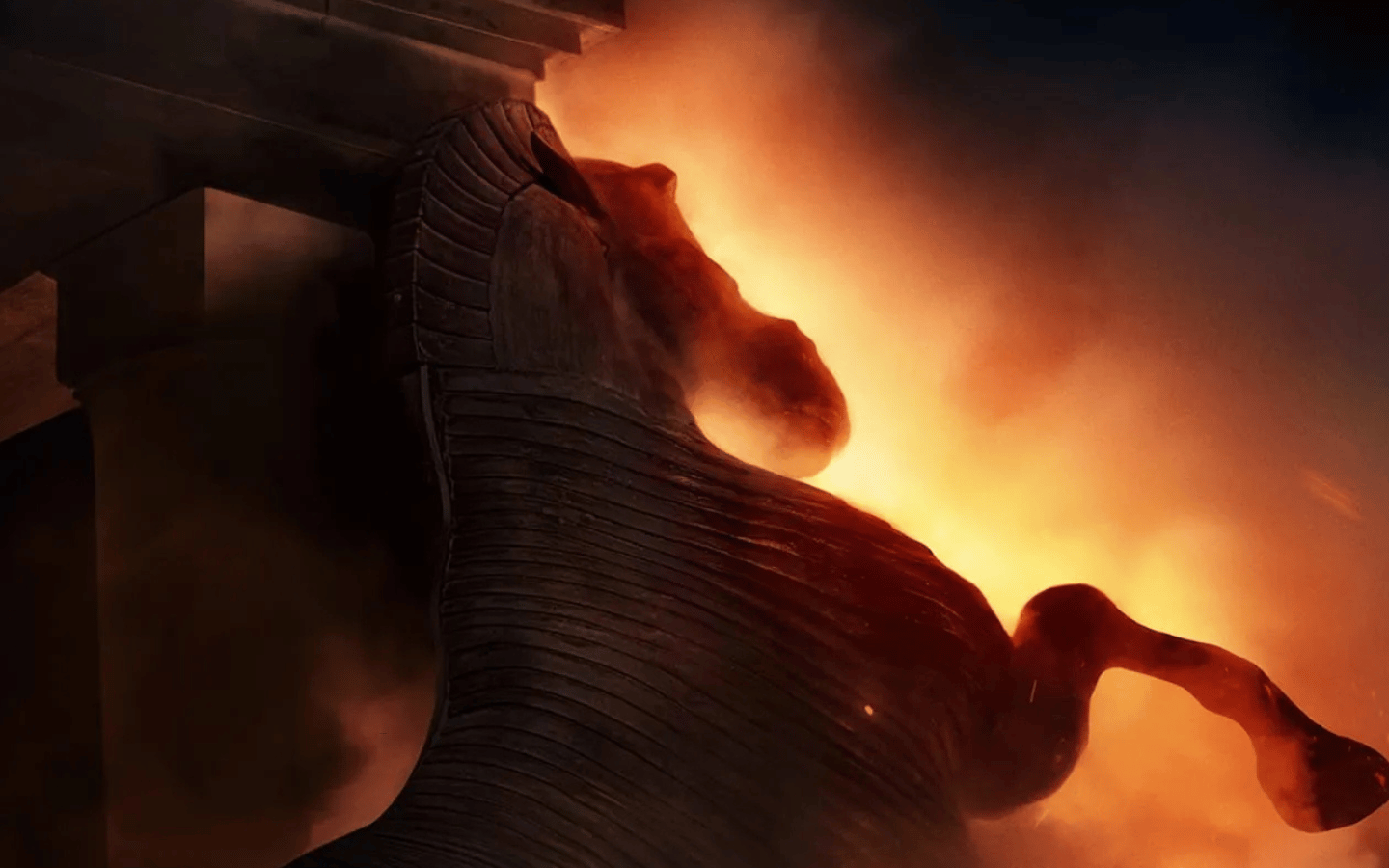
What does he mean? He’s speaking of what most of us learned to call “the Trojan horse.”
In Nolan’s The Odyssey, Zeus’ laws are paramount, and the law we hear about most is hospitality. Strangers and travelers are to be treated with welcome, dignity and respect. What’s more, gifts are part of hospitality, and a gift offered is not only a gift to the receiver but a gift to the gods.
Odysseus, burdened with the expectation of victory for his king, Agamemnon, and desirous of getting home, tests Zeus’ law. He offers Troy a gift and is punished with a years-long, life-threatening journey in which he loses all his men and barely survives himself.
Yet all the twists, turns and turmoil of Odysseus’ voyage aren’t what matter. What matters is that Odysseus has unleashed a new, more violent and cruel method of warfare. What used to be face-to-face is now animated by deceit and trickery—the jettisoning of social norms, even the norms of war.
The horse is a perversion of the expected hospitality; a gift becomes a weapon.
Nolan is stalking the same prey he did in 2023’s Oppenheimer. It could be that J.
Robert Oppenheimer is an echo of Odysseus, the genius who puts his mind to work for the fulfillment of destruction. Once successful, he regrets not only what he has done but what the world will now do with what he’s done.
Or it could be that both stories are pleading with us to consider not only the victors of violence and war but the long tail that will eventually kill us all. With every act of violence and war, even those some might deem necessary evils, our world becomes less humane.
Odysseus Always Returns
Each time a U.S. secretary of defense gleefully applauds the destructive power of the most ferocious killing machine in history, as if the death and destruction are part of some kind of video game, he reveals himself as a junior high boy high-fiving his friends with no appreciation of his immaturity and cruelty.
It is not ridiculous to believe that a country like Iran should not have a nuclear weapon. It is more ridiculous to shrug off the deaths of schoolgirls while we pursue our aims. But that’s what the long tail of catastrophic violence does.
This is what Oppenheimer and Odysseus discovered. The most just causes can be corrosive if we are led by those who lack the formation to recognize the corrosion of the soul or whose souls are already corroded. When humans lose the practice of hospitality, it always leads to hostility.
The early church did not invent hospitality. Hebrews 13:2 reminds us, “Do not neglect to show hospitality to strangers.”
It’s easy to bracket that teaching as merely interpersonal, but it is also public. The ones we wage war against are strangers we are called to love. That may not be great or realistic national policy, but it is still the requirement of those who are citizens of heaven.
There may never come a day when Christian women and men can extract ourselves from calls to and participation in war. Indeed, some Christians’ ingenuity and brilliance have been and will be used to wage more damaging war, just like Odysseus and Oppenheimer.
If that happens, my prayer is simple. Like Odysseus, once we recognize what we’ve done, we will go to confession.
- About the Author
- Latest Posts

CEO of Sean Palmer Coaching, Homiletician in Residence at Bammel Church in Houston, and co-host of the “Sacred Frames” movie podcast.