
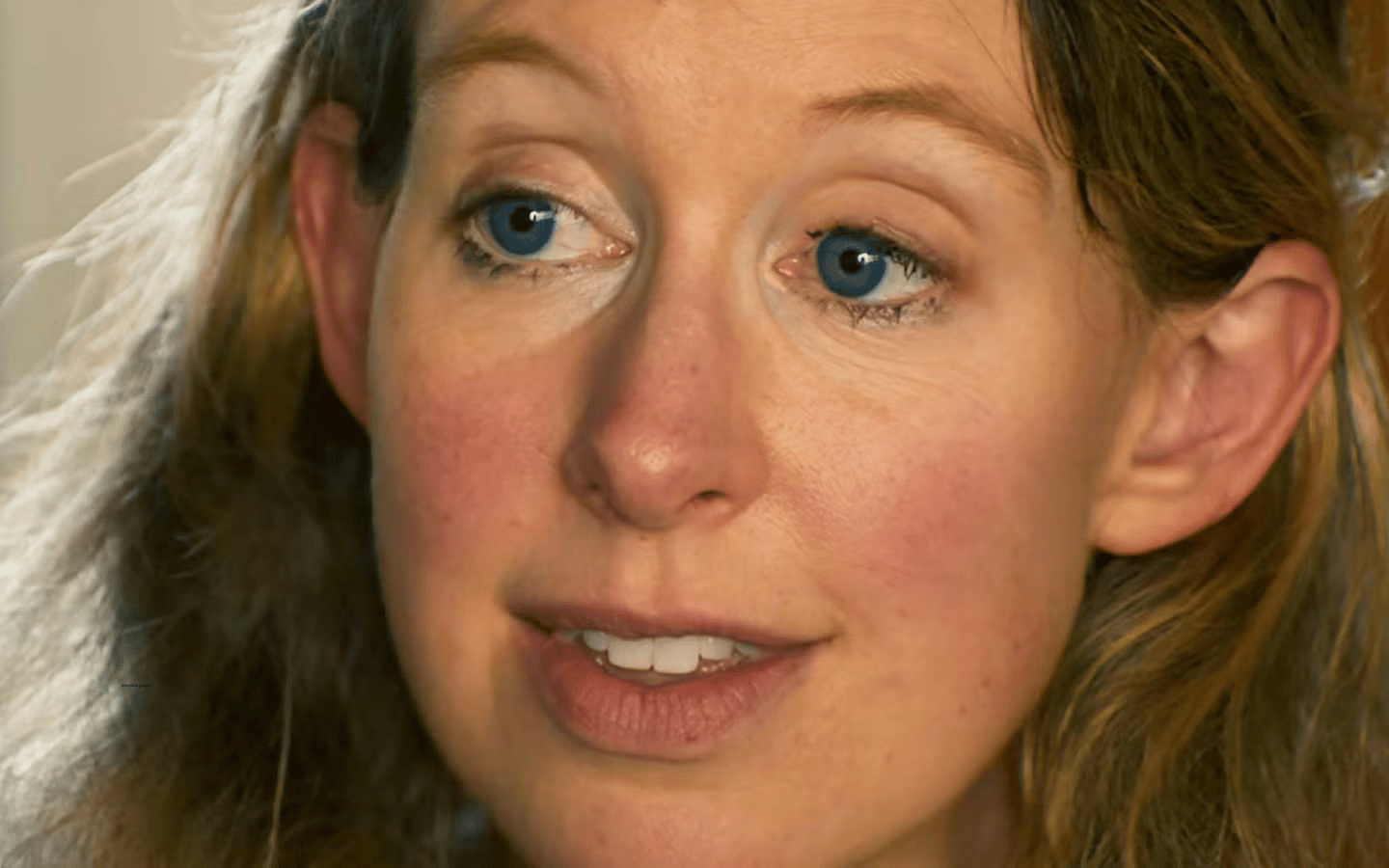
Every grift begins with a feeling. And Elizabeth Holmes is a grifter. Or maybe not.
She may be a sociopath or the tragic victim of her own inability to communicate or the sufferer of abuse from predatory men. Her flat affect and literalism left me wondering whether she is wired differently.
Regardless, watching You Can See Everything, you will feel something. What that is, no one knows. As reviewer Richard Brody said, the film is strange, wonderful and troubling.
One thing is certain: Directors Nathan Fielder and Lance Oppenheim either don’t know how you should feel or don’t want you to know.
Holmes was shaped by powerful men who may have and maybe still are using her for their own ends. But she also founded a company that committed massive fraud on investors and patients.
You Can See Everything spends thirty-four days with the convicted founder of Theranos before Holmes began her eleven-year prison sentence for wire fraud and conspiracy to commit wire fraud. It then picks up Holmes’ story two years into her sentence. The lingering question is whether she is a sociopath or survivor.
And if she’s not a crook, she is the latest participant in the time-honored tradition of side-stepping accountability: white girl tears.
White girl tears have been described as a social and cultural concept describing how expressions of distress or upset by white women are deployed— intentionally or reflexively, usually in racial interactions, to elicit privilege or to punish others. Recently, we have seen this with Amy Cooper, Theresa Klein, and others.
Ultimately, white girl tears leverage inherent sympathies built on the goodness and vulnerability of one population to weaponize empathy. Yet stories like Emmitt Till’s murder should invite us to cast doubt on anyone who wants us to simply believe them.
That mix of feelings creates the conflicted emotions Fielder and Oppenheim put on screen. Present in You Can See Everything are Holmes’ deer-in-the-headlights look, her parents, and her lovingly nursing her 6-month-old daughter.
Absent from the film are Holmes’ victims. We do not hear about Brittany Gould, who had already lost three pregnancies and was told by Theranos that she was miscarrying again but wasn’t.
Also missing was Erin Tompkins, who got a false positive test for HIV. These are real people Holmes and Theranos mistreated, regardless of how much Holmes loves her kids.
Fielder’s project ends up like an Elizabeth Holmes restoration project. The story was not Elizabeth’s lies about Theranos. Those belong to her then-boyfriend, Sunny Bawani.
It’s not about the pseudo-science regarding the questionable projects she’s involved with now. Those are owned by Billy Evans.
In her eyes, Elizabeth Holmes is never to blame. That seems equally true in Nathan Fielder’s eyes— a point the movie articulates powerfully in its final frames.
Much of You Can See Everything feels like Fielder is a grifter’s mark. By extension, we become a mark too.
But in the midst, I’m reminded that while scripture never mistakes tears for proof, it does reveal that they can be holy. And that God’s first move toward humans, regardless of behavior, is toward us— not against us.
And maybe that’s what Fielder is doing. Maybe he is asking not what’s in Elizabeth Holmes’ heart, but what is in ours when it comes to both sociopaths and survivors. Because she is both.
- About the Author
- Latest Posts

CEO of Sean Palmer Coaching, Homiletician in Residence at Bammel Church in Houston, and co-host of the “Sacred Frames” movie podcast.