

In April, evangelical speaker and author David Nasser was a guest on the Becoming Something podcast. Nasser arrived in the U.S. with his family as refugees from Iran when he was a child during the 1979 Islamic Revolution. At 18, he converted to Christianity. Nasser eventually began a ministry that uses his Muslim background as a springboard for conversations about evangelism.
Becoming Something is hosted by Jonathan Pokluda, a Waco, Texas, pastor who has gained national exposure as a speaker at Unite evangelism events on college campuses, through appearances on Fox News and, more recently, by touring with Christian music juggernaut Forrest Frank. Additionally, Pokluda’s podcast is extremely popular among evangelical college students and young adults. It often ranks among the top 25 most-listened-to Religion & Spirituality programs in the country.
In the weeks after Donald Trump launched a war against Iran, Nasser’s appearance on Becoming Something highlighted a couple of dangers in our public discourse around the war and our Muslim neighbors. Like many current events, I planned to write about this, letting the research tabs on my computer screen multiply and grow increasingly thin until the news cycle moved on to the next urgent thing.
But with the now six-month war occupying only a portion of the headlines, and with anti-Muslim rhetoric animating midterm campaigns, this may be a better time to return to Nasser and Pokluda’s conversation.
War
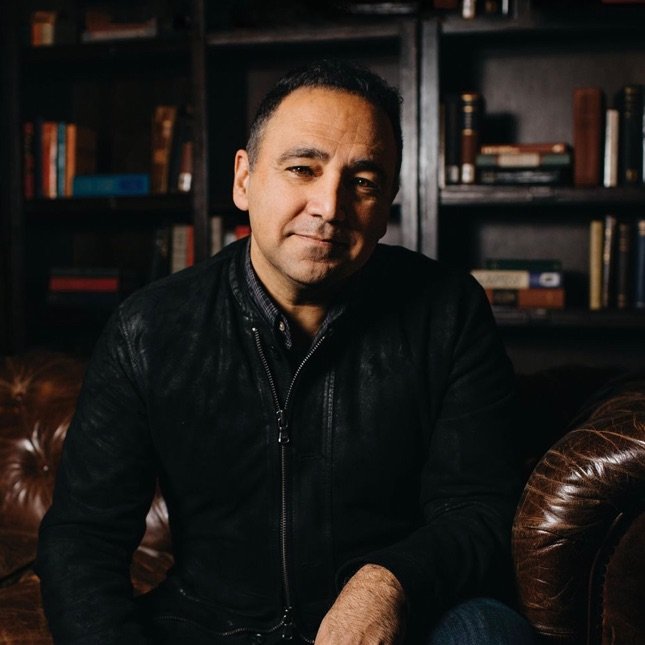
David Nasser
Pokluda invited Nasser on the podcast as an expert on Iran and asked him to explain to the audience the ins and outs of why we went to war. One of Pokluda’s co-hosts, Kathy Davidson, asked the questions on the lips of most Americans at the time: “Why war?” and “Why now?”
To his credit, Nasser prefaced his thoughts with a confession that he was simply giving his perspective on the situation. “I could be wrong,” he said, before launching into an explanation. It’s important to remember, however, that this rhetorical play to humility and admission of fallibility came after about 10 minutes of Pokluda and his co-hosts propping up Nasser as the expert on Iran. Also, what followed included no pushback or alternative views for Becoming Something’s young audience to consider.
“For 47 years, Iran has been waging war with the Western world,” Nasser said. “When tens of thousands of people are shouting, uniformly, ‘Death to America,’ when do you choose to believe that they might mean it?”
He then gave a generally factual overview of the history of Iran’s funding of terrorism over the decades, some of which has resulted in the deaths of U.S. citizens. Yet he included the highly emotional but false assertion that “September 11 was strongly funded by Iran.”
While the 9/11 Commission found that Iran had some passive involvement in the attacks, it provided no known financial support. Most of the 9/11 attacks were funded by individuals and networks within Saudi Arabia, a U.S. ally.
To his credit, Pokluda raised this in response to Nasser, who then went into a convoluted, Trump-like word journey through Iran, Hezbollah, Beirut and terrorism. This journey led to a quick, throwaway statement from Nasser conflating the Taliban with Iran.
Iran and the Taliban were bitter enemies in the years leading up to and after 9/11—a point that went unchallenged.
Nasser then addressed Davidson’s implied question of whether an imminent threat was what caused Trump to act when he did. Nasser noted that it is never good for your political party to start a war leading up to elections, suggesting Trump must have weighed that against any threats..
While it may prove true in this particular midterm cycle that the war is bad for Republicans (because Trump was already so unpopular), historically, the months after a war begins are usually good for public support of U.S. presidents. Trump knows this well, because he often suggested Obama would start a war before an election to boost his party’s chances of winning.
Nasser then suggested there was some inside information about nuclear weapons that must have affected Trump’s decision.
“And so they must have had intel that [Iran] was on the cusp of fast-becoming like North Korea,” he said. “[And] once they have the weapons, there is no more holding them accountable.” Nasser hinted that he had inside information to that effect, based on his family connections within Iran.
“I believe this was inevitable,” Nasser said. “And I want to see swift justice. I want to see the least amount of damage to the people of Iran and to our Marines. But in another sense, it’s exhilarating to me that this could be the moment where the people of Iran are finally liberated from these tyrants.”
All credible evidence, both in April and now, points to Iran being no closer to obtaining a nuclear weapon in February than it was when the U.S. bombed its enrichment facilities in 2025.
Nasser went on to say that the overwhelming sentiment in Iran was gratitude to Israel and the U.S. for bombing them.
Islam
Sadly, Nasser threaded familiar yet dangerous ideas about Islam into his uneven thoughts about the geopolitics of the war with Iran.
When speaking about the differences between the Islamic Republic of Iran and Western countries, Nasser pointed to the idea of theocracy. “When you read the Quran, it actually doesn’t believe in the separation of church and state,” he said. “Devout Muslims believe that the way to advance their cause is to do it through taking over government.”
Setting aside the gross simplification of Islam—and the irony of a U.S. evangelical Christian bringing this up as a critique in 2026—what Nasser said next was most alarming.
“Obviously I’m not speaking for many people who are listening who have kind, gracious Muslim neighbors who want to see freedom of religion in America,” he said. “But Islam at its core is not to come into a nation and exist with other religions, but to actually take over” (emphasis mine).
Here, Nasser brandishes a weapon against devout Muslims in America that is effective and dangerous because of how subtle it is: You may think you know about Islam because you have a Muslim friend. But if your Muslim friend doesn’t embrace the darkest interpretations of Islam in front of you, they are either ignorant of “real Islam,” or they are trying to deceive you.
This weapon doesn’t necessarily produce an angry army of Islamophobes, but it prevents people from ever trusting what their Muslim friends and neighbors tell them about their faith and experience in the world.
In platforming someone who converted to Christianity from Islam at a young age and deferring to his authority on the religion he left behind, Pokluda is asking us to embrace a standard that evangelical Christians would balk at if the shoe were on the other foot.
Imagine a nine-year-old boy from a nominal Christian family immigrating to Iran in 1979. He becomes fluent in Farsi, makes friends there and becomes so assimilated that, at 18, he converts to Islam. He eventually becomes known in Iran as a foremost Muslim expert on Christianity in the U.S. Part of his teaching is that if Christians don’t interpret the Old Testament as a call to murder all their enemies, then they either don’t understand Christianity or they are lying to you.
How well would U.S. evangelicals embrace that teacher as an accurate representative of their faith?
Silently Complicit

Jonathan Pokluda
Why bring up a four-month-old podcast now?
Jonathan Pokluda has hundreds of thousands of social media followers. His podcast is listened to by scores of white evangelical young people and, perhaps more importantly, their middle-class and wealthy parents. Yet he is just one individual in a robust network of evangelical voices that don’t identify as MAGA or Trump supporters, but whose methods and message ultimately lead to the same conclusions as Paula White or Sean Feucht.
We are six months into a war that only about a third of Americans still support. While that is a drastically low number, the war continues, gas prices are rising, and Iranians and U.S. soldiers are dying, all because of a Republican Congress beholden to the roughly 33% who still support the war. Because of how we get information, many of those 33% only know that, months ago, they heard some “expert” say it was necessary, and they haven’t given it a second thought since.
Yet this isn’t the first time Americans have been duped into supporting an unnecessary war, and it likely won’t be the last. For people who claim to follow Jesus, the more urgent need is for us to wake up to how anti-Islam voices are poisoning the well of goodwill with our neighbors.
Somali immigrants in Minnesota have been the target of despicable whisper campaigns ever since Trump announced he was running for a second term. This week, the New York Times analyzed the growing rise of Islamophobic attacks in Texas. And across the country, Muslim policymakers are being accused of covertly trying to take over and spread Sharia law.
The rhetoric espoused by David Nasser and given a platform to spread by folks like Jonathan Pokluda is designed to plant seeds of suspicion regarding our Muslim neighbors. Nasser’s podcast comments about the war and Islam were actually a springboard to talk about the core of his message, which is that he sees a Christian revival on the horizon in his native country. By quickly turning his attention to “heavenly matters” after sowing seeds of suspicion and disinformation, he attempts to wash his hands of the earthly damage his message inflicts on devout Muslims in our country who just want to live their lives in peace.
We must stand against that demonization and embrace our neighbors with the same trust and generosity that we want them to extend to us.
- About the Author
- Latest Posts

Senior Editor at Good Faith Media.