
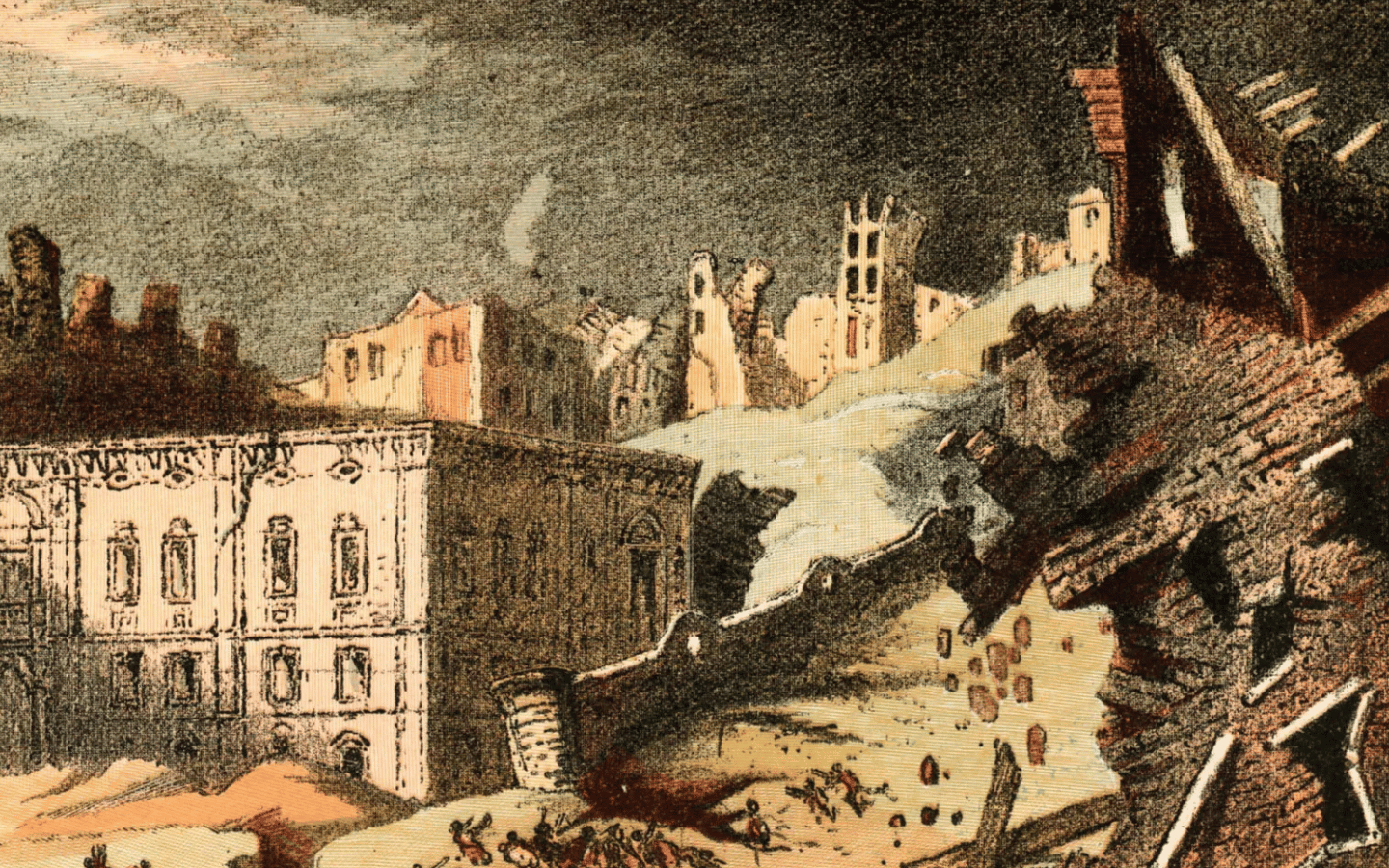
On Saturday, November 1, 1755, at 9:40 a.m., the premodern God, along with the Satan-God that is occasionally unleashed to do the dirty work, died in Lisbon. The death of the vengeful and merciless deity of the medieval world, along with the personification of evil, occurred on one of the holiest days, during the holiest moment of the Mass, when the transubstantiation miracle of the Eucharist was transpiring.
The churches of Lisbon were packed as the faithful came to worship on what was then one of the most sacred days of the Catholic calendar—All Saints’ Day. During the Eucharist, disaster struck. A fault along the boundary between the Eurasian and African tectonic plates shifted, triggering an earthquake with a magnitude of 8.5 to 9.0 that rattled the devout Catholic city.
Thousands died under the collapsing churches as they prepared to participate in communion. Survivors ran to the seashore to escape crumbling buildings. There, many more met their deaths from a tsunami triggered by the earthquake.
Then the worst occurred. Massive fires broke out throughout the city’s ruins due to overturned votive candles lit by the devout for All Saints’ Day. Fires destroyed 80 percent of the city. Some 40,000 to 70,000 of the faithful were crushed, drowned, or burned while worshipping an all-loving and all-merciful God.
Following these calamities, thousands more died during the ensuing chaos of hunger and dehydration.
How could this happen? What could be the theological reasoning?
A premodern mindset looked to God as causing the catastrophe.
Why would a city shake, bringing down houses and causing massive deaths? Because of the collective, unrepented sins of the people, forcing God to wipe them off the face of the earth, of course. (Think Noah’s flood.) Evil was everywhere and everyone, as sinners, was complicit.
Indeed, “What a fearful thing to fall into the hands of the living God” (Hebrews 10:31).
Prior to the death of this premodern deity, believers lived in a world full of demons who lured them away from the truth, a world where witches cast spells to lead people to perdition, and where magic was practiced by the perceived enemies of the true God, such as Jews and Muslims.
In this premodern Christian world, where the sciences were almost nonexistent and there were no such things as antibiotic medications, the slightest infection brought death. Complicating the understanding of illness was the belief that it was brought about by an angry God because of sin. Hence, the body could never be healed if the spiritual was ignored.
Consequently, physicians were forbidden from attending to the symptoms of a disease until the patient was first visited by a priest. Hope came in the form of the supernatural.
Fear of the ever-present surrounding evil and fear of falling into the hands of a vengeful God were dispelled, and salvation was found within the cult of saints. Believers clung to the God of miraculous deliverance for salvation from all the evil that surrounded them and all the sin that stained their souls.
Simplistic good/evil dichotomies that once satisfied the masses waned, falling short in providing reasonable answers for calamities. More than just Lisbon was shaken by the earthquake; so too was the very theological foundation of medieval Christianity and the understanding of God and Satan.
Skeptics influenced by the Enlightenment pushed back at the clergy’s simplistic answers. Voltaire’s poetic reflection summarized the prevailing sentiment. He penned an ode on the tragedy titled “Poem on the Lisbon Disaster or an Examination of the Axiom, ‘All Is Well’”:
To those expiring murmurs of distress,
To that appalling spectacle of woe,
Will ye reply: ‘You do but illustrate
The Iron laws that chain the will of God?’
Say ye, o’er that yet quivering mass of flesh:
‘God is avenged: the wage of sin is death?’
What crime, what sin, had those young hearts conceived
That lie, bleeding and torn, on their mother’s breast?
Did fallen Lisbon deeper drink of vice
Than London, Paris, or sunlit Madrid?
For rationalists like Immanuel Kant, evil was not rooted within human nature. He refused to demonize it or those who do evil, for even the wicked person does not will evil for the sake of evil but chooses to ignore and abandon moral law.
Although I am no Kantian, on this point he is correct. Hence, there is no such thing as original sin, nor original human goodness, except what originates within human free will and radical autonomy.
Evil is a choice. By externalizing evil in the form of some Satan, we fail to deal with its root causes in the choices and actions of humans consisting of flesh and blood. But just because there is no such thing as a Satan does not mean Satan does not exist.
A dialogue concerning the reality of Satan should not be the focus of our theological discussion, but rather the consequences of personifying evil. Simple good-versus-evil binaries constructed by religious leaders form an ethical perspective that is usually responsible for greater evils unleashed in the defense of the good.
Simplistic answers as to why horrible things happen to good people do more damage than good. Medieval deities have died—and “let the dead bury the dead.” Our task in this postmodern world in which we find ourselves is to understand this deity in whom we claim to believe without sacrificing our ability to think.
- About the Author
- Latest Posts
Professor of Social Ethics and Latinx Studies at Iliff School of Theology in Denver, Colorado, and a contributing correspondent at Good Faith Media.