
Editor’s note: Good Faith Media does not endorse political candidates.
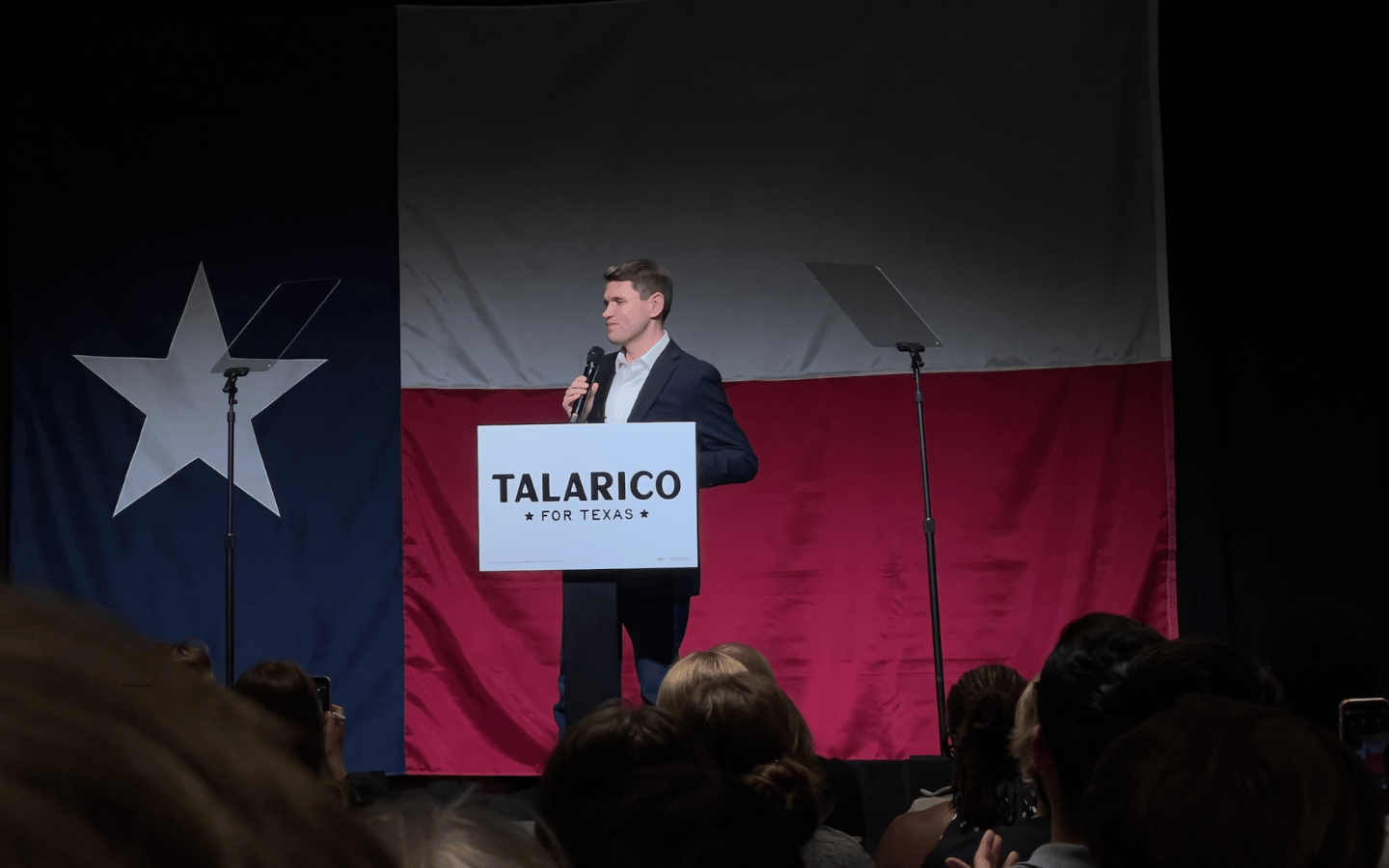
Last week, James Talarico, the Democratic nominee for U.S. Senate from Texas, held a campaign rally at Baylor University in Waco, Texas. Baylor doesn’t typically invite political candidates to hold campus events during election cycles. However, the administration made an exception when Turning Point USA (TPUSA) replaced Donald Trump Jr. with Ken Paxton, Talarico’s eventual Republican opponent, as a speaker at a highly publicized event it held on campus in April.
I applied for press credentials to the TPUSA event but was denied when organizers, at the last minute, restricted attendance to students only. I attended the Talarico rally as a reporter. The event wasn’t officially sanctioned by Baylor; Talarico’s campaign was simply allowed to rent space on campus.
Talarico gave a short stump speech before greeting supporters. Although his remarks didn’t lean as heavily into his Christian faith as he does in many of his interviews, the fact that a committed Christian seminarian who is a Democrat was holding a campaign rally at one of Texas’ most prominent evangelical institutions was heavy in the air.
I was curious how this reality landed with the estimated 1,000 students in attendance. The answers I received about Talarico’s faith gave voice to a rising generation of voters with no reference point for how candidates from the two major political parties have aligned themselves with religion over the past 50 years.
Miriam Ramirez, a first-time voter from Austin, Texas, expressed enthusiasm that Talarico is a person of faith. “Here in Texas, we are all about God, and faith is our number one thing,” she said. “The fact that [Talarico] is a person of faith and a Democrat is incredible.”
Ramirez grew up Protestant but is currently going through the process of becoming Catholic.
Even though Corpus Christi sophomore William Moore isn’t particularly religious himself, it doesn’t bother him that Talarico is so outspoken about his Christianity. “It doesn’t turn me off at all,” Moore said. “It gives me confidence that he’s a good person.”
Other students agreed with Ramirez and Moore that Talarico’s faith mattered, but few saw it as a central issue. The issues at the top of many of their minds included their parents’ ability to retire and their own future job prospects.
For Ramirez, corruption and inequality topped her concerns. “The top 1% holds more than the rest of us combined,” she said. “There was always a gap, but now that gap has expanded to where we even have our first trillionaire.”
Even more telling than the students’ responses to my questions about Talarico’s faith were their reactions to how I framed my questions about religion and politics. When I either implied or explicitly suggested that Republicans have claimed the mantle of Christianity more than Democrats, nothing resembling recognition registered on their faces.
In retrospect, this shouldn’t have surprised me. College freshmen, many of whom will be voting in their first election in November, were seven or eight years old when the infamous Access Hollywood recording was released, prompting evangelical leaders to give birth to the belief that “we aren’t electing a Sunday school teacher.”
They’ve watched as Republicans instituted dehumanizing immigration policies and remained silent as ICE has killed people in the streets. They’ve seen their preachers say nothing about Trump’s degrading treatment of women or Ken Paxton’s lifetime of corruption, all while preaching messages of purity and morality.
These students have never known a world in which Republicans could claim to be the party of Christian faith with a straight face.
Whether this new reality will shift the political dynamics in the U.S. this year remains to be seen. But it will eventually reshape how we all think about the conflation of religious and political identities.
- About the Author
- Latest Posts

Senior Editor at Good Faith Media.