
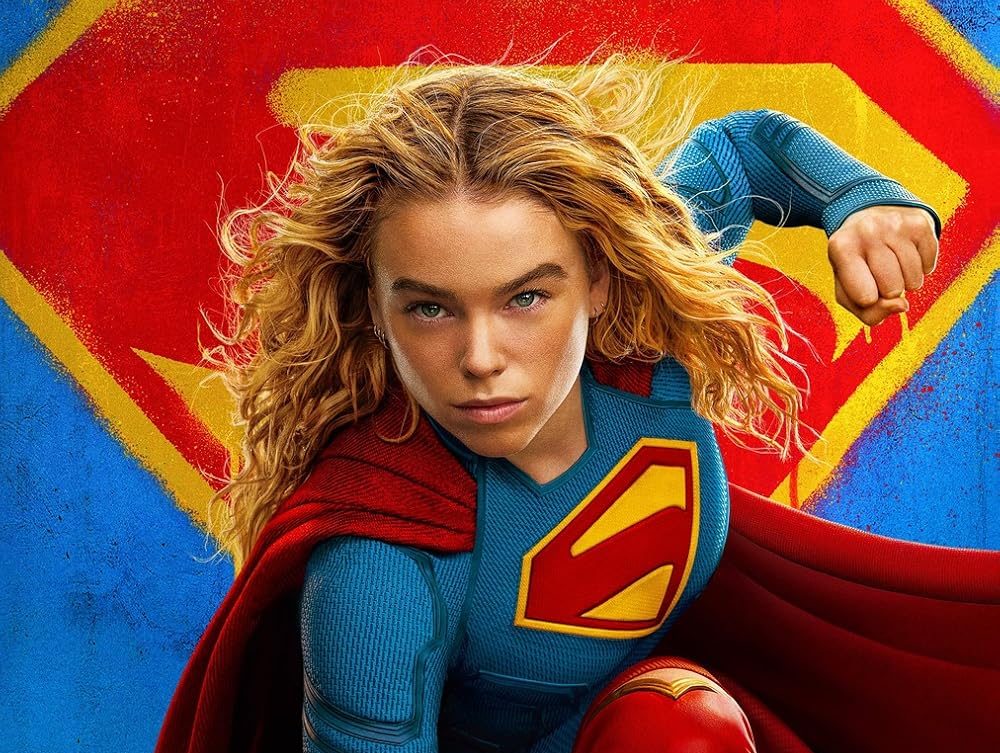
Milly Alcock is the best thing the film Supergirl has going for it. That should read as praise. Here it reads more like an autopsy.
Alcock plays Kara Zor-El, a hard-drinking, wisecracking, bruised survivor, and almost every critic who buried the film stopped first to salute her. The Hollywood Reporter called the movie an “uninspired slog” and still found room to admire its star.
That is the shape of the whole thing—a real talent, thrown clear of a wreck she did not cause.
Variety’s review put it plainly: The movie has no story. Watch it and you will see why.
Kara is off-planet when the film opens, drinking her way across one junk-heap world after another, avoiding a planet with a yellow sun. The plot finally arrives when her dog, Krypto, is shot with a poison dart and a clock starts ticking to find the antidote.
That is the engine of the script: a countdown to save a CGI terrier, who could simply have been taken to a planet with a yellow sun and been fine. A grieving girl, Ruthy, wants revenge on the mercenary who killed her family (for reasons?) and Kara more or less gets dragged along behind her.
No one in the film has any texture. No choice makes any sense. Characters move only to make the movie happen.
Unless you’re a child who just thinks lasers shooting out of Supergirl’s eyes is cool, which is more than fine, this movie is lazy, boilerplate, insulting.
Here is what should make us angry and it has almost nothing to do with this one movie. When a film built around a woman or a minority lead fails, two camps form and both of them lie.
The first camp says women superheroes do not work or at least don’t work for long. Minority leads do not sell. People said it about Halle Berry’s Catwoman and Jennifer Garner’s Elektra two decades ago, and Joss Whedon, years before the allegations that ended his standing in the industry, named the move for what it was.
There is always an excuse, he said. Two bad films from eight years back become a verdict on half the human race.
The second camp says the fans are bigots. They contend the failure is misogyny, racism and the toxic corners of the internet that claim any negative review is an expression of hatred.
Alcock herself took cruel, organized trolling for the sin of being a woman in a cape. That harassment deserves contempt.
Blame Game
But notice what both camps do. Both of them need the movie to be about identity so they never have to talk about the script.
The studio gets to blame the demographic. The defenders get to blame the audience. And the writers, who actually failed, walk away clean.
The evidence against both camps is sitting in the receipts.
Wonder Woman grossed more than $800 million in 2017 and was widely acclaimed. Captain Marvel crossed $1 billion. Black Panther is one of the most beloved films of its decade and a Best Picture nominee.
When the writing is there, the audience comes. Every time.
The variable was never the gender or the color of the lead. The variable is the script, the movie itself. Iron Man 2 was a mess and no one stood up to announce that white men cannot anchor a franchise.
So let us be honest about what actually shows up on screen. What’s clear is that people will see minority-led movies if they’re good, but when they are bad, we blame the minority, not the movie.
The Marvels opened to $46 million, the worst debut in the history of the Marvel Cinematic Universe. It ended with nearly $206 million worldwide, the lowest-grossing entry the franchise has ever produced. It was the first Marvel film to fail to clear $100 million at home, on a reported budget of close to $270 million.
That is not a marketing footnote. That is a movie audiences rejected.
Wonder Woman 1984 is, by my lights, one of the dumbest films its genre has produced. A wish-granting stone undoes the logic of the world.
Steve Trevor comes back to life inside another man’s body and Diana sleeps with him. The film never once notices the consent problem it has written.
The climax is a televised plea for the entire planet to renounce its wishes. Critics opened it at ninety percent on the embargo and watched their own consensus collapse to 57 percent once the lights came up.
It grossed under $170 million against a $200 million budget. The script needed neither.
At around 46%, Captain America: Brave New World sits at the very bottom of the Marvel Cinematic Universe’s critical rankings. It was hobbled by reshoots and a green screen the camera could not hide.
It scraped past $400 million worldwide on a smaller budget. Still, it underperformed badly against the Captain America name and against Anthony Mackie, who had carried a decade inside that universe and finally took the shield as the first black man to lead one of these films.
He earned a great movie. He got a forgettable one.
A Face on a Poster
This is how minorities are abused in the culture war. The people who most deserve great films keep getting handed half-cooked ones. They are then drafted into a fight as either the proof or the alibi.
The girl in the theater who wanted a hero who looked like her gets a poisoned-dog fetch quest and a one-note heroine. The boy who waited for Sam Wilson to lift the shield gets muddy effects and a plot stitched together from other people’s movies.
And when the box office comes in, no one says the writers failed them. They say the audience failed. They say the demographic failed. A reader once told me, The Marvels failed because it was “woke.”
The representation gets blamed for the mediocrity it was buried under.
Mediocrity aimed at the marginalized is its own kind of contempt. It assumes this audience will take whatever it is given, that a face on the poster is payment enough, that gratitude will cover for a story that was never finished.
So give her a story. Give her the best writers in the building, the rewrites, the locked script before a single camera rolls.
Alcock deserved that movie. So did Anthony Mackie.
Our heroines and our heroes of every color deserve to be the strongest thing in a film that is actually strong and not the lone survivor walking away from the crash.
Better scripts. Better stories. The same standard we have always extended, without apology and without a second thought, to the men in capes.
- About the Author
- Latest Posts

CEO of Sean Palmer Coaching, Homiletician in Residence at Bammel Church in Houston, and co-host of the “Sacred Frames” movie podcast.