
Editor’s Note: The following was first published on Mary Alice Birdwhistell’s Substack. “Rededicate 250” was held last Sunday in Washington, D.C.
Growing up in a church with weekly altar calls, I was regularly given the opportunity to “rededicate” my life to Christ. For those of us who had already been baptized, we didn’t need to be dunked in the water again, but sometimes it was nice to make a fresh start.
At its best, rededication was about hope — the belief that people could change, that grace could meet us again, that we were not locked forever into the worst version of ourselves.
But in the evangelical culture I grew up in, that longing often became tangled up with fear.
We were often asked, “If you died on your way home today, do you know that you know that you know that you would go to heaven?”
What if we hadn’t believed all the right things? What if we weren’t truly saved after all?
So we walked the aisle again. Just in case. Almost as an extra insurance policy to make sure we were fully “covered.” I rededicated my life at least three times.
Photo by IZIUMLAB on Unsplash
Which is part of why I can’t stop thinking about this weekend’s “Rededicate 250” event on the National Mall in Washington, D.C.
Because I’ve seen what happens when the language of faith gets braided together with fear and belonging and the promise of certainty. I’ve seen how words like revival, salvation, and rededication can carry both genuine spiritual longing and the temptation toward control.
And that’s why this weekend’s event feels so unsettling. Because beneath the patriotic branding and revival language lies a much bigger story.
At first glance, Rededicate 250 presents itself as a broad spiritual gathering celebrating the nation’s 250th birthday — a kind of national prayer service bringing together religious leaders from different traditions.
But let’s be honest about what this actually is.
Rededicate 250 is not a religious gathering that happens to involve politics. It is a political project using religion as its legitimizing language.
In addition to a host of conservative political leaders, faith leaders participating include: Franklin Graham, Jonathan Falwell (son of televangelist Jerry Falwell), Robert Jeffress, Jonathan “JP” Pokluda, Paula White, and Gordon Robertson (son of televangelist Pat Robertson).
Nearly every major speaker has publicly aligned themselves with the Trump administration or the broader MAGA evangelical movement. They are united by a shared belief that America was founded as a Christian nation and must be reclaimed as one.
Robert Jeffress, Pastor of First Baptist Dallas, openly embraces the label “Christian nationalist.” When asked about the term, he responded by laughing and saying that if being a Christian nationalist means being anti-abortion, anti-transgender, and for a closed border, then “count me in.”
Several featured speakers are also connected to the New Apostolic Reformation (NAR), a movement that teaches Christians are called to take “dominion” over every major sphere of society: government, education, media, business, family, and culture. This group believes that the 2020 election was stolen, and several key leaders were involved in the January 6 insurrection. While they may have been on the fringe at one point, the NAR now enjoys direct access to political power at the highest levels of government. And their framework, the Seven Mountains Mandate, has been described by scholars as “a mandate to colonize the Earth for God.”
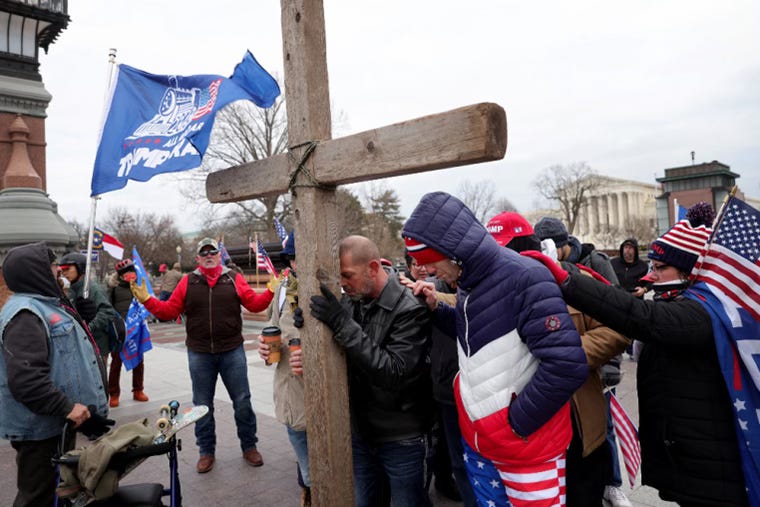
Win McNamee/Getty Images
And then there’s Lou Engle. His inclusion may be the clearest window into what this event truly represents.
In 2010, Engle traveled to Uganda and organized a rally praising the government’s “courage” and “righteousness” — the New York Times’ word — in advancing a bill that called for life imprisonment or the death penalty for gay people with AIDS. He later told a reporter he supported “some kind of restraint, a legal restraint and a punishment” for homosexuality. Back home, he has mobilized tens of thousands of young people using battle rhetoric and explicit calls for “vengeance.” He has compared the fight against gay rights to the Civil War, casting anti-gay activists as a romanticized Confederacy resisting federal overreach.
This is not an outlier who wandered onto the program. He is sharing a platform with the Speaker of the House and the Secretary of State. If you want to understand what this event is really about, start there.
Perhaps the most revealing thing about Rededicate 250 is not who is there — it’s who isn’t.
The historic mainline Protestant traditions that shaped much of American religious life are absent. So are Muslim, Hindu, and Buddhist Americans. Progressive and moderate evangelicals who reject Christian nationalism have no meaningful seat at the table. Black church traditions that have historically challenged state power rather than sanctified it are represented only through carefully selected conservative voices. Even the event’s Jewish and Catholic participants reflect a narrow political alignment rather than the breadth of those traditions themselves.
The lineup creates the appearance of religious diversity while advancing a deeply specific political ideology.

Scholars sometimes call this “Trumpian ecumenism” — coalitions united less by shared theology than by shared political allegiance.
But the clearest evidence that this is about political power rather than spiritual renewal is what happened behind the scenes.
A decade ago, Congress created a bipartisan America250 commission to oversee the nation’s semi quincentennial celebrations. But according to reporting from Baptist minister and journalist Brian Kaylor, Trump became frustrated that the commission was pushing back against some of his plans. So in December, he created his own nonprofit, Freedom 250, to lead the festivities instead, including Sunday’s day of prayer.
In other words: a bipartisan public project was replaced with a privately controlled, politically aligned one.
Freedom 250 has secured corporate sponsorships from John Deere, Lockheed Martin, Mastercard, Palantir, UFC, and United Airlines — underwriting what is, by any honest accounting, a partisan religious rally.
When Cabinet secretaries appear alongside Christian nationalist pastors. When taxpayer-supported agencies promote events tied to explicitly partisan religious movements. And when billion-dollar corporations underwrite it all…we should stop pretending this is simply a prayer gathering.
This is an attempt to fuse religious identity with state power.
And historically, that fusion has never ended well for either democracy or the church.
If this were truly a spiritual revival, why abandon the original bipartisan group entrusted with organizing it? Why would every speaker be so politically aligned? Why wouldn’t other religious communities, or even other Christians, be invited to participate?
Perhaps because this event was never about a rededication.
It’s about “restoring” a version of America that never truly existed in the first place.
About reclaiming power for one faction of a political party emmeshed with one narrow branch of Christianity.
And it’s about rewriting American history — telling a slanted story about where we’ve been in order to control where we’re going.
I’m grateful to my friends at the Interfaith Alliance who are pushing back publicly and prophetically against this movement. They are shining a light (quite literally) on the true purposes behind this event. Alongside artist Robin Bell, they are projecting the following messages upon the National Gallery of Art this weekend:
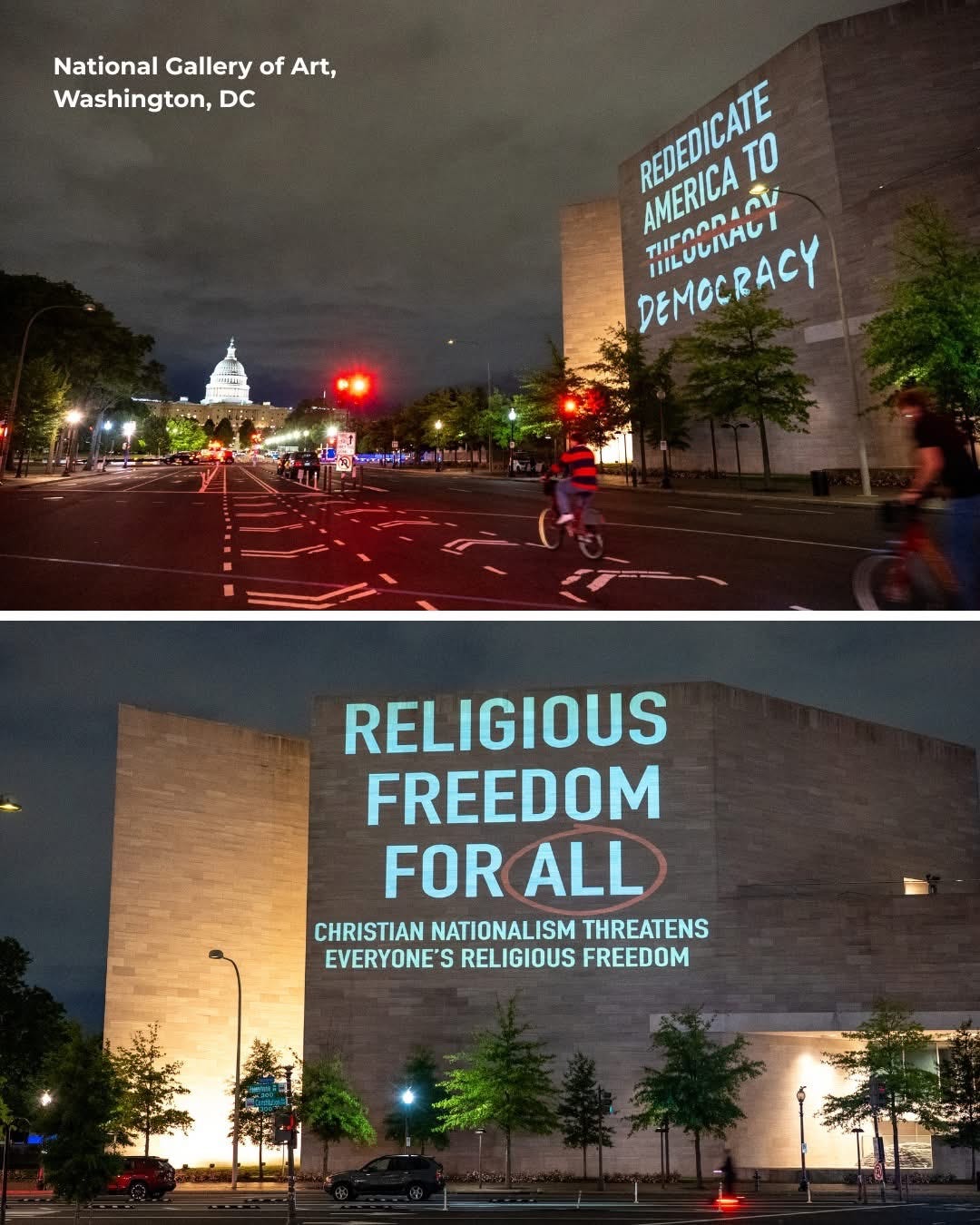
THIS is the kind of rededication I’m hungry for in our country!
You see, here’s what I remember most about those altar calls from my childhood.
Yes, there was fear. But underneath it, there was also something genuine — a longing to be different, to do better, to show up more fully for God and for the people around you.
Rededication, at its truest, was never supposed to be about domination.
It was about repentance — turning away from sin. And it was about turning toward something greater than yourself: Toward God. Toward compassion. Toward the neighbor you’d been ignoring.
What’s happening on the National Mall this weekend is the opposite of that.
It is a rededication rooted not in humility but in dominion.
Not in turning toward the neighbor, but in deciding who counts as one.
And not in the fear of God, but in the fear of losing cultural and political power.
A genuine rededication of this nation at 250 years would require something far more costly than a rally. It would require us to reckon honestly with the distance between our founding ideals and our founding sins. It would require making room at the table, not as performance, but as a practice, for people of all religions in this beautiful American mosaic. And it would require, in the best sense of the word, repentance: a turning around, a change of direction.
That’s not what’s genuinely being offered on Sunday. But it’s what’s still possible.
So consider this an altar call of a different kind. Not one driven by fear of who’s in and who’s out, but by faith in what we could still become together.
The fresh start is still available.
But it belongs to all of us — or it belongs to none of us at all.
- About the Author
- Latest Posts
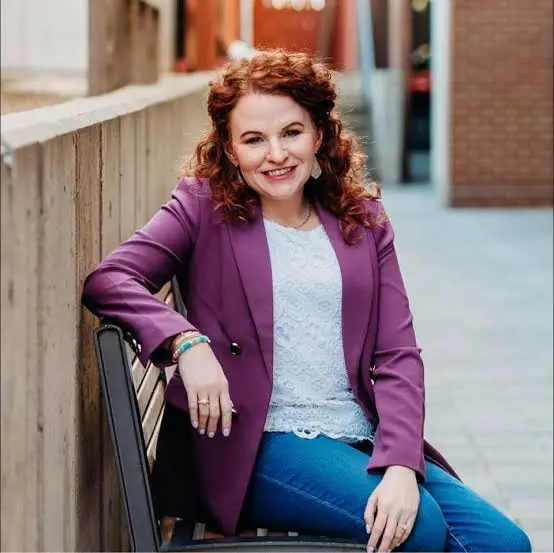
Pastor, preacher, and writer at https://maryalicebirdwhistell.substack.com/. Mary Alice is on the Good Faith Media Board of Directors.