
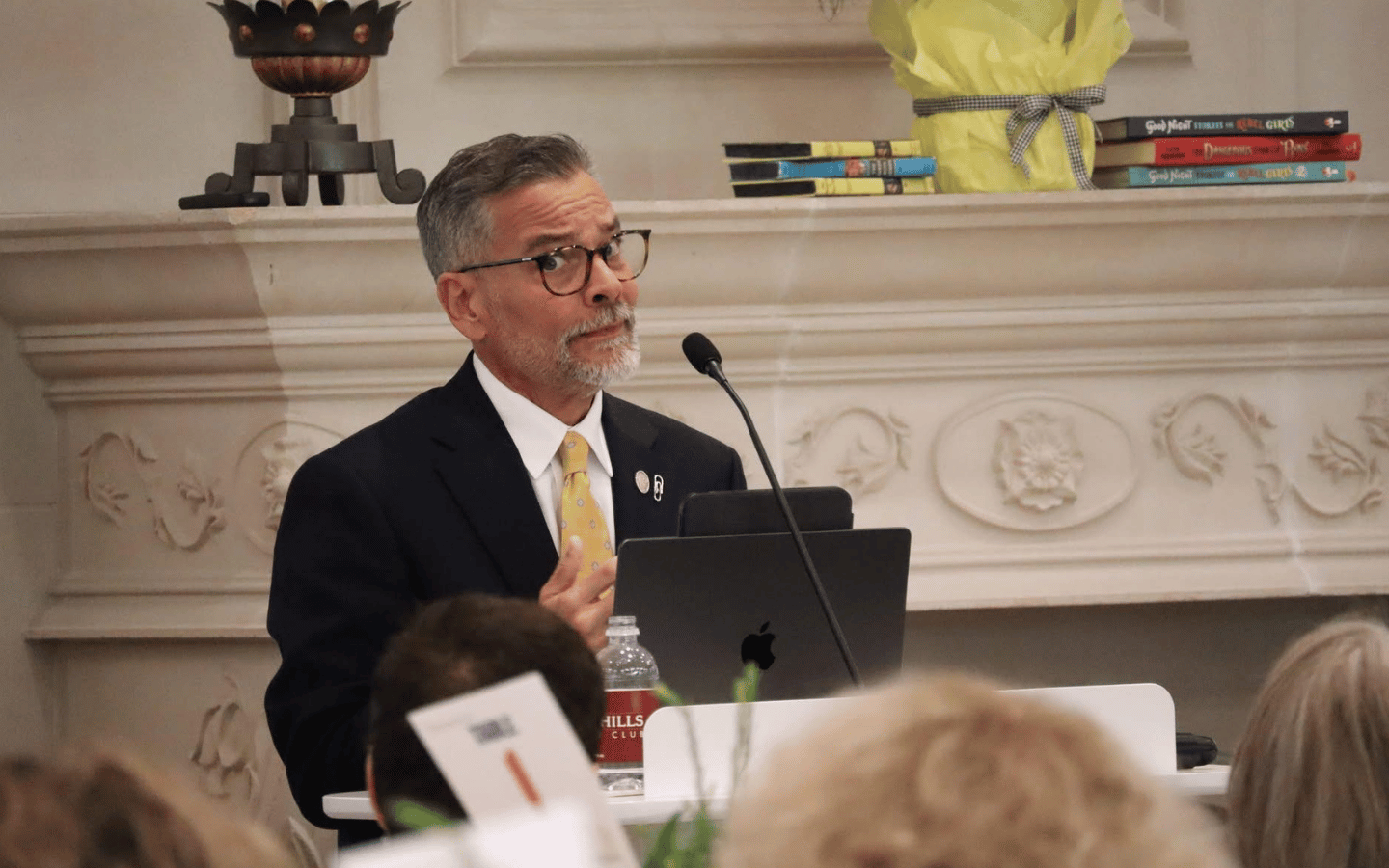
Editor’s Note: The following is adapted from remarks made by Mitch Randall to the Mainstream Coalition in Kansas City, Kansas, on April 19, 2026. The Mainstream Coalition defends the constitutional promise of religious freedom for all by standing firmly for the separation of church and state.
We are in a fight for the survival of public education in the United States, the most important public institution fueling what we know as democracy. In the extraordinary and thoughtful book The Education Wars: A Citizen’s Guide and Defense Manual, Jennifer Berkshire and Jack Schneider argue that if the United States ever loses public education, then it will never return.
At this moment in our nation’s history, can you imagine trying to navigate the partisan waters of Congress to establish a federal program like public education? It would be labeled a socialist ploy to indoctrinate students with a woke agenda and anti-patriotic ideology.
That may sound exaggerated, but it is happening right before our eyes.
If we lose public education, we will never get it back. To be even more blunt, if public education falls, democracy falls with it. The privatization movement, in partnership with right-wing religious zealots, continues a well-funded assault on teachers, administrators and one of the greatest treasures within the American experiment of self-governance: public education.
When the United States was founded, many of its leaders understood the immense value of public education for both the electorate and the country’s future success. Thomas Jefferson, primary author of the Declaration of Independence, advocated for public education in Virginia.
Writing to George Wythe in 1783, he said, “I think by far the most important bill in our whole code is that for the diffusion of knowledge among the people. No other sure foundation can be devised for the preservation of freedom and happiness.”
Jefferson’s political rival, John Adams, agreed. In support of the 1780 Massachusetts Constitution, Adams wrote, “And liberty cannot be preserved without a general knowledge among the people.” James Madison called education “the only guardian of true liberty.”
The evidence is clear: the Founders knew the significance of an educated citizenry. They believed freedom required an informed public.
Massachusetts educator Horace Mann later answered that call. In 1837, Mann used his position as secretary of the Massachusetts Board of Education to help lead the Common School Movement. He believed publicly funded schools could strengthen both democracy and social stability.
Mann also argued that tax-supported schools shifted education away from a family-fee model and into a shared community responsibility. In one of his best-known observations, Mann wrote that education is “the great equalizer of conditions of men … the balance wheel of the social machinery.”
The Anti-Public Education Strategy
So with such overwhelming evidence from the Founders and reformers, why do privatizers and Christian nationalists dislike and villainize public education so intensely?
The answer is simple: They cannot control it.
Education, by its very nature, is curious and inquisitive. It is fueled by questions, evidence, exploration and healthy doubt. Privatization and religious zealotry depend on something different: control, hierarchy and systems that discourage inquiry.
Heather Cox Richardson wrote in Democracy Awakens: Notes on the State of America, “Democracies die more often through the ballot box than at gunpoint.” Randi Weingarten reinforced that warning in Why Fascists Fear Teachers, writing that democracies often fall not through military coups but through leaders who use democratic systems to dismantle democracy itself.
That is exactly what many of us have experienced in Oklahoma.
Privatization
Before discussing Christian nationalism, we need to be realistic about the commitment privatizers have toward deconstructing public education and rebuilding a system that benefits the wealthy and privileged.The idea of privatizing public education is about more than creating exclusive opportunities for affluent families. It is about changing the very fabric of the American experience.
The modern school choice movement has roots in segregation. After Brown v. Board of Education in 1954, many white Christian leaders resisted integration. As desegregation spread, white flight to the suburbs created a new era of separation.
As suburban development accelerated and many cities declined, tax dollars that funded urban schools declined as well. When states attempted more equitable funding systems, they often faced fierce resistance. The phrase “local dollars should stay within local communities” frequently served as a more acceptable way of saying students of different races should not mix.
Over time, as explicit racism became less socially acceptable, vouchers and school choice were given new life through economic language.
School choice is often marketed as an opportunity for marginalized families to attend private schools. It sounds appealing on the surface. But in practice, voucher systems overwhelmingly benefit wealthier households already positioned to take advantage of them.
In states like Arizona and Arkansas, many vouchers went to families already sending their children to private schools. Many of those families earned high incomes.
Let me be clear: I am not against private schools. Have as many as you want. What I oppose is private schools being funded by public dollars.
And while I am at it, I would put many public schools up against private ones any day. Private does not mean better. It means private.
Rural communities often have few or no private school options, meaning the greatest benefits go to suburban and metropolitan families. For-profit schools rarely prioritize poor or rural communities because their central purpose is profit.
That leads to one of the dirty secrets of the privatization movement: Ultra-wealthy individuals and corporations see public education as an untapped market to monetize and a labor force to shape. Some anti-public education advocates want workers educated just enough to perform tasks, but not empowered enough to question authority.
There are many economic and policy reasons to oppose vouchers funded by taxpayers. But as a person of faith, an ordained Baptist minister and a citizen of the Muscogee Nation, my deepest objection centers on the separation of church and state.
Religious Zealotry
In my home state of Oklahoma, public schools have become a battleground between those seeking to dismantle the wall of separation between church and state and those who understand why that wall matters.
The first 16 words of the First Amendment read: “Congress shall make no law respecting an establishment of religion, or prohibiting the free exercise thereof.”
Christian nationalists are correct when they say the exact phrase “wall of separation between church and state” does not appear in the Constitution. But between the Establishment Clause and the Free Exercise Clause lies a vital constitutional principle: government should not control religion, and religion should not control government. That principle has deep American roots.
Many who arrived in colonial America came fleeing religious persecution. Yet some who had been persecuted quickly became persecutors themselves.
Roger Williams, observing abuses in Massachusetts Bay, argued for a “hedge” between the “garden” of the church and the “wilderness” of the world. After the Constitution was adopted, Thomas Jefferson built on that metaphor. In his 1802 letter to Baptists in Danbury, Connecticut, he described the First Amendment as building “a wall of separation between Church & State.”
Nearly a century and a half later, Supreme Court Justice Hugo Black reaffirmed the principle in Everson v. Board of Education, writing, “That wall must be kept high and impregnable.” The metaphor has evolved over time, but the principle remains sound: Good fences make good neighbors.
That is why many Oklahomans pushed back when former State Superintendent Ryan Walters advanced an ultra-Christian nationalist agenda in public schools.
Americans United for Separation of Church and State filed lawsuits challenging Bible mandates and distorted social studies standards. Oklahoma Attorney General Gentner Drummond also challenged those actions, and the Oklahoma Supreme Court agreed.
Article 1, Section 5, of the Oklahoma Constitution states that public schools must remain “free from sectarian control.”
Why This Is Personal
This issue is deeply personal to me, which is why I mention my Muscogee heritage. Oklahoma has a painful history of “educating” Native American children with taxpayer dollars through Christian missionary institutions. In many cases, those schools were less about education than forced assimilation.
My great-grandmother, Eloise “Honey” Boudinot, and her younger sister Ruby were sent as children to Chilocco Indian Agricultural School near the Oklahoma-Kansas border. They were uprooted from their family and community in eastern Oklahoma.
Upon arrival, they were forced to cut their long hair, which held cultural and spiritual significance. Their hair was restyled according to white Protestant norms. They were told they could no longer speak Muscogee. If caught using their native language, they faced punishment.
They were also required to attend Christian worship services, and missing worship could bring physical discipline. That kind of forced faith leaves deep scars. We did not use the phrase Christian nationalism then, but the ideological echoes are unmistakable now.
If right-wing Christian nationalists succeed in destroying public education, another era of education by assimilation could emerge. Curiosity and critical thinking would be replaced by control and conformity. We must never allow that to happen on our watch.
Conclusion
During the Nazi occupation of Norway in World War II, Norwegians wore paperclips on their lapels as a symbol of solidarity and resistance. The paperclip represented the idea that we are bound together.
People often ask how we can stand up to privatizers and Christian nationalists seeking to dismantle public education and replace it with privatized control and conformity. My answer is simple: Look for the teachers and students who are already leading the way.
Diane Ravitch wrote, “Public education is not broken. It is not failing or declining. The diagnosis is wrong.”
No one has the moral authority to spend decades trying to weaken public education and then claim the solution is more privatization and more religion.
Our schools, teachers and students are in danger, but not from inside the schoolhouse walls. They are in danger from those seeking to dismantle public education, discard the common good and tear down the wall separating church and state.
It is time for us to stand up, speak out and step forward for public education. It is time to be vocal.
It is time to support teachers.
It is time to volunteer.
It is time to run for local school boards.
It is time to support public education candidates.
It is time to vote and encourage others to vote.
It is time to look our children and grandchildren in the eyes and say clearly, “Not on our watch.”
As long as we breathe, we will work to ensure your education remains intact and fully funded by a government that bears responsibility for your “life, liberty and pursuit of happiness.”
We are bound in the paperclip of democracy, seeking together the more perfect union still before us.
We can do this, but we must do it together.
Thank you. Thank a teacher and volunteer at your local school.
- About the Author
- Latest Posts

CEO of Good Faith Media.