
“There’s no AC in the sanctuary.” That’s what the text said.
The church administrator sent it to me. She’d also included the chair of the building and grounds committee in the group chat.
“Helluva time for it to give out,” I wrote back.
Summer in North Carolina can start as early as April and stay around like an unwelcome house guest through November. We were in the second week of July, otherwise known as the Seventh Circle of Hell.
I have found that change doesn’t happen in churches unless it involves the loss of comfort. I’ve also come to learn that sweat rolling off foreheads during the last verse of “Just As I Am” is enough to convert even the staunchest of traditionalists.
Where could we go? Our large fellowship hall wasn’t an option. Another church uses the space on Sunday, and somehow asking them to move their service so that we could have ours didn’t seem the most Christian thing to do.
“How about we move it to the Gathering area,” I told staff. And so we did.
Grabbing the mobile keyboard, the extra lectern, and some folding chairs, we began making a space. We moved couches around to form a rough semi-circle.
We made an altar out of a table that typically holds bulletins and upcoming event flyers. Next came a soundboard, a speaker, and enough extension cord to reach a wall socket. When Sunday came, folks found a makeshift shabby-chic sanctuary.
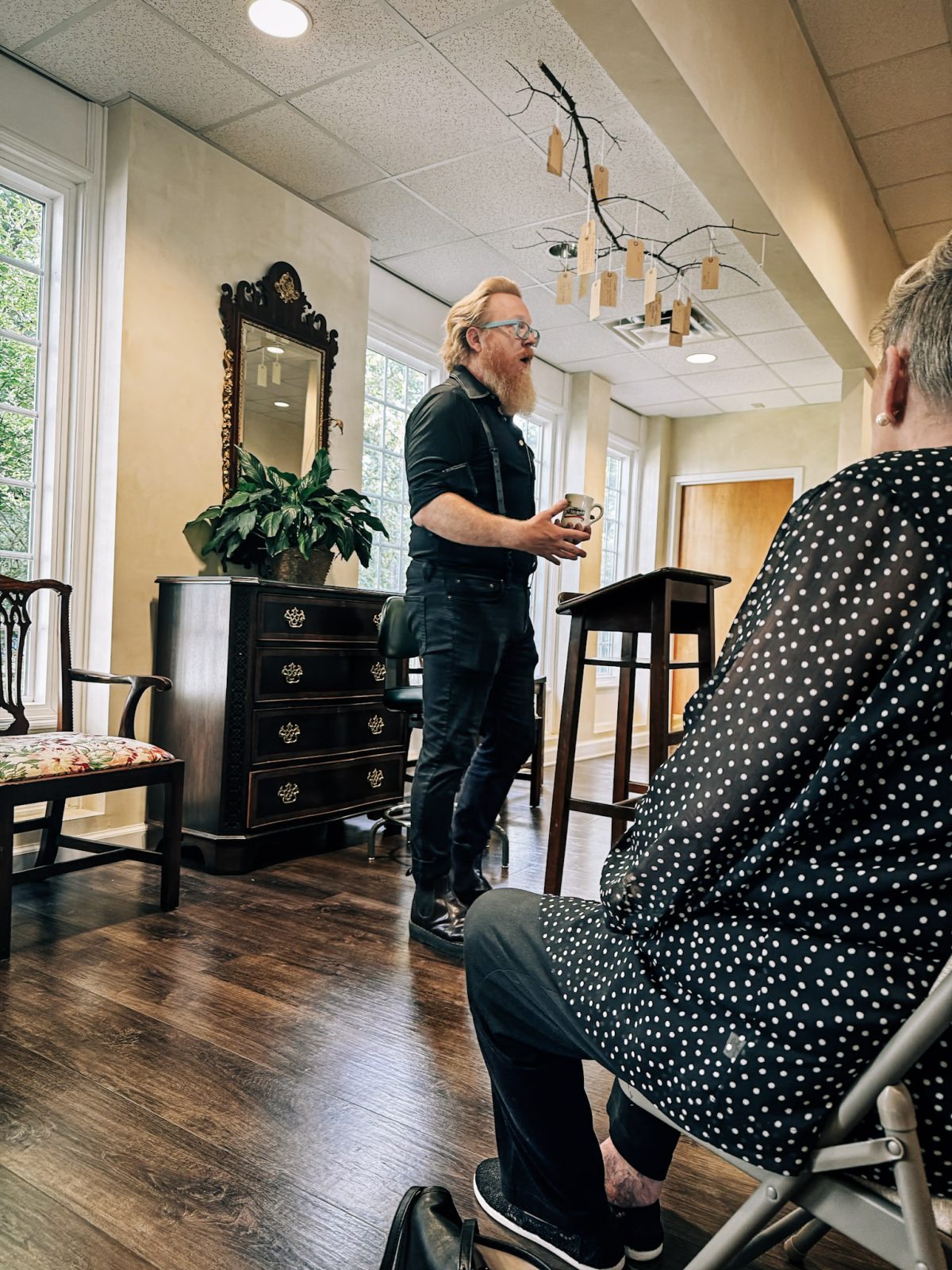 With a few eyebrows raised, the faithful claimed their seats. Things were intimate whether you wanted them to be or not.
The service had many of the same movements as any other Sunday morning, but something was different.
For one, the staff wasn’t up on a stage. We were on the floor a couple of feet from the congregation. I ditched the cassock I’d worn since Lent and went extra casual, donning a bolo tie.
When we stood to sing hymns, voices harmonized in a way I’d never heard them before. People sang louder and with more confidence.
“How was service today?” my spouse asked.
“Different,” I said.
“Good different?” she asked.
“Yeah, I think so,” I said.
Later, in a staff meeting, we talked about what was different. We kept using the word “energy” to describe what we felt.
We noticed the people seemed to connect better. We sang old songs with a fresh spirit.
We shared that people didn’t just go through the motions; there was a release of expectation. There was a stripping away of the Sunday-morning formality.
“Something is happening here,” someone said. I agreed.
And then, as best I can describe, the Holy Spirit slipped under the conference room door and pushed the following words right out of my mouth. “What if we just stayed in the Gathering area for a while?”
Those words changed the rest of our summer. For the next several weeks, we stayed put. We tossed out the playbook of what Sunday mornings had been.
Our new altar table was free of brass. In their place, I set out one of our massive grow bags from our garden holding tomato, basil and cucumber plants. My wife let us borrow her goldfish plant, whose vines crept down to the floor and around the basket of garden tools I’d brought.
We purchased tiny packets, filled them with sunflower seeds, handed them out during the service, and told folks to toss them in the garden beds right outside the church doors as they left.
A few weeks later, I dropped a well-worn pair of L.L. Bean Boots on that same table. Our children’s minister supplied us with her tasseled walking stick. Field Notes, a guide to the Appalachian Trail, and a stickered thermos filled out the rest of the space.
We talked about going on a journey and choosing what we wanted to take with us and what we wanted to leave behind. At the end of the service, we wrote down our answers to those questions on luggage tags and placed them in a large basket.
We used the tags the following week, tying them to a huge dead branch we’d found out in front of the building courtesy of an afternoon summer storm. We hung the branch from the ceiling above the altar table. We took smaller twigs and placed them in vases.
The hopes and dreams of a church surrounded us, dangling with the fragility of an autumn leaf.
I stopped preaching a 20-minute sermon. Instead, I spoke for several minutes and then posed a question. While talking about a passage from First Peter and the stones that can trip us up, I paused and asked: “If you took away our building, programs, traditions, history, what would still make us a church?” I asked folks to turn to those beside them and share their answers.
I started doing this every week. People got used to talking not only with each other, but with me during the service.
They let out “amens” a little easier. They commented out loud when I made a point.
One Sunday, a woman who works security at the local college let out a string of “alrights” and “come on nows.” It was an unplanned call-and-response. An organic litany I couldn’t claim responsibility for; the people were doing it themselves.
We were creating worship together.
Everything changed, or at least shifted. We had moved and God was moving.
The “children’s moment” evolved into a “moment of wonder” that included all ages.
Two former missionaries elevated the music with their almost otherworldly ability to play piano four hands. They lightly pulled strings, got the choir to meet and practice, and performed pieces old and new.
One morning, a couple came forward during the closing hymn to join the church. I asked those sitting there to cast their votes.
“All in favor of these two fine people joining our fellowship, say amen,” I said. The room erupted with amens.
“Now, if there are any who oppose this joining, I’d politely ask you to get the hell out.” The room erupted again. This time with heavenly laughter.
Visitors came. One or two each week. A father who had come with his freshman daughter asked if he could say something at the end of the service.
“This is only our first time with y’all,” he started, “but I can tell that God is doing something here.”
Of course, not all was merry and bright. A handful of concerned souls wanted to know when we planned to return to the sanctuary. They confessed that what we were doing wasn’t working for them. I assured them we would and began to plan what our return might look like and mean.
As we discussed reentering the sanctuary, the interim music minister voiced his own concern. “I worry that when we go back to the sanctuary, we’ll lose what we’ve gained this summer,” he said. No one there wanted that to happen.
We decided to make our return on the heels of a three-day homecoming weekend. We planned to put up tents and bunting. Friday night would be a dinner on the grounds featuring everyone’s best potluck offering.
We wanted a local Americana/Folk band. Saturday would be a lineup of guest speakers. Former staff members, missionaries commissioned by the church, and a former congregant who accepted the call to enter ministry.
We’d cap the night off with an old-fashioned hymn sing. We didn’t call it a revival, but a renewal.
All went as planned. All of it led to Sunday morning.
In the weeks leading up to the return, I walked the sanctuary with others and asked questions about what we could do. Like many mainline churches in the United States, our church has been in decline. A pandemic didn’t help.
The sanctuary, originally intended as a chapel, seated about 250 and rarely came close to capacity outside of a Christmas here or an Easter there. The space wasn’t built for the congregation we had. Our weekly numbers are closer to 75-80 people, with bumps and slumps depending on the time of year.
It was hard to feel connected when we were so separated on Sunday mornings. So we took out some pews. Eight to be exact.
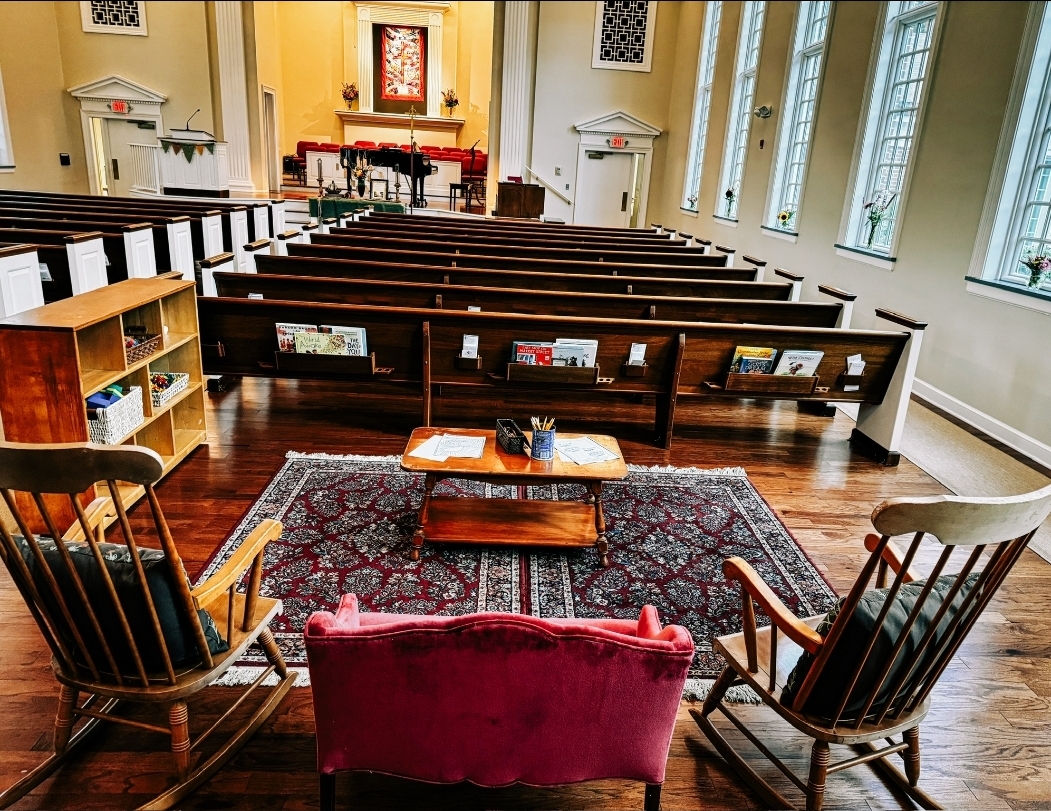
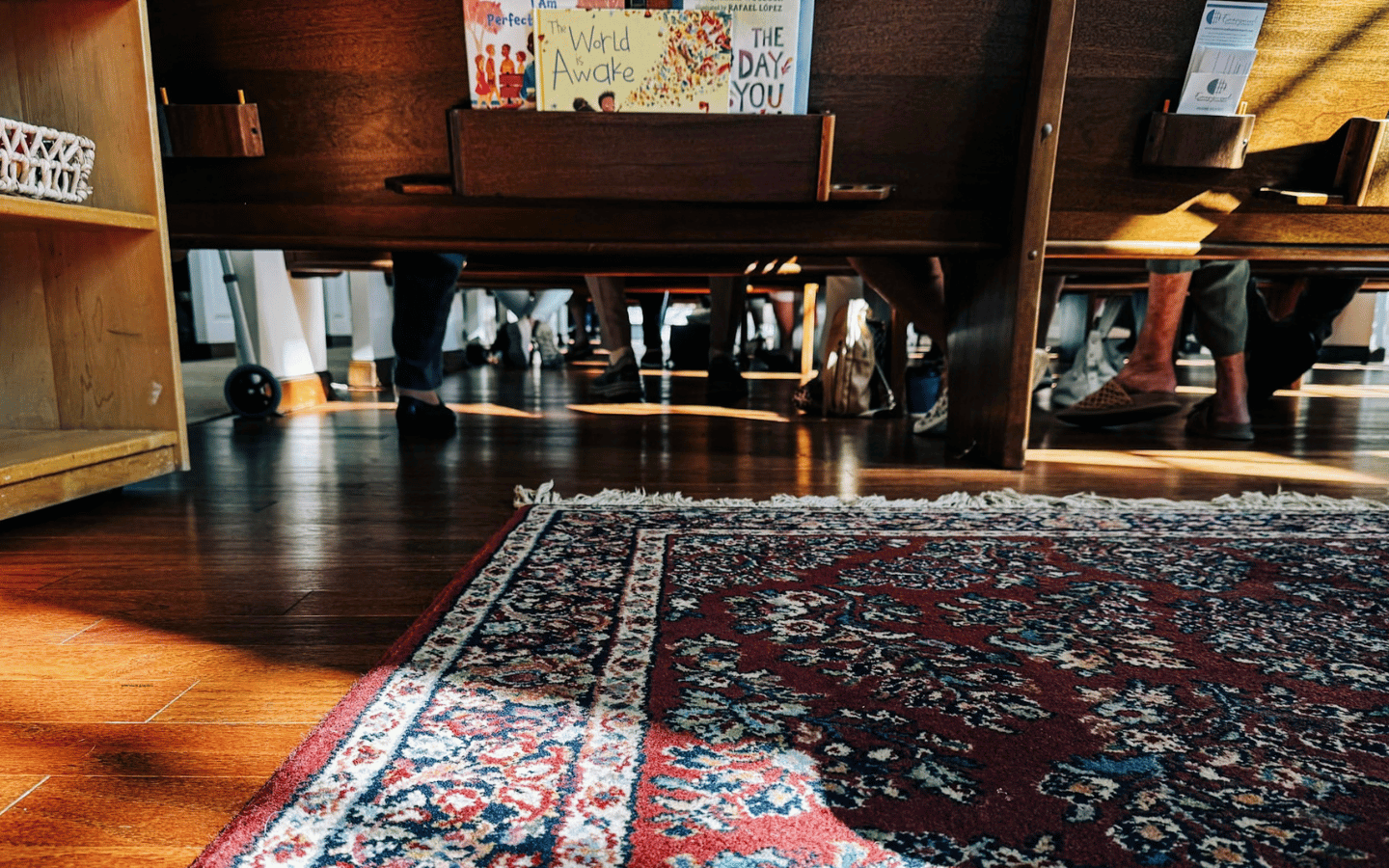
But we didn’t leave the space empty. On one side we placed rugs, rocking chairs, and a small coffee table.
We made a rolling shelving unit several years ago to hold toys in a children’s room. We decided to place it out there and fill it with soft toys, coloring books, markers and crayons.
Where dusty Bibles and hymnals once sat on the back of the last pew, we placed age-appropriate books. We added a small suede couch for elementary-age children.
We brought in three dining room-sized tables for the opposite side. We scooted in their accompanying chairs. We set out burlap table runners with vases full of flowers from the local farmers market.
 On September 13th, the people lined up outside the sanctuary doors. Their numbers wrapped around the building.
When the doors opened, the children’s minister and I entered first, carrying two lanterns lit with the fire symbolizing the Spirit of God. Young and old entered behind us.
Some took to the familiar pews they knew. Families made their way to the children’s area. Kids needed no prompting with the toys and space made for them.
Likewise, the tables filled up fast. High school students sat with friends. Beside them, septuagenarian saints. It was intergenerational in the flesh.
Bringing up the rear was the Rev. Dr. Corey Walker, Dean of Wake Forest School of Divinity and proclaimer of the Word for the day. Behind him, Hanna McMahan King, Assistant Dean of Development for the Divinity School, carried the processional cross.
As I watched people enter, I saw a glimpse of how true change happens for a church.
It happens when something stops working or breaks.
It happens when people are willing to experiment.
It happens when we’re not completely sure of the outcome.
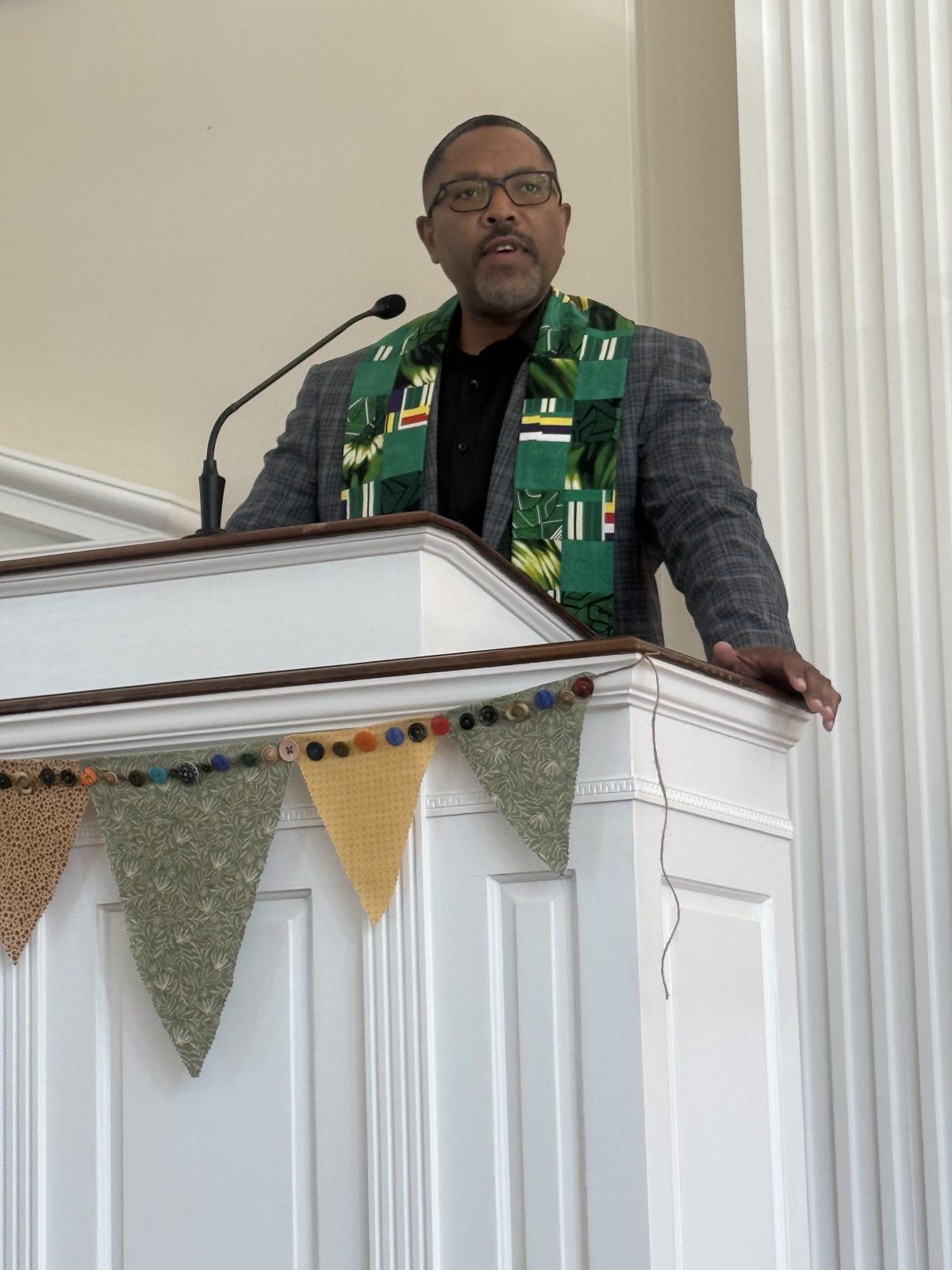 I can tell you, too, that the change I witnessed in a group of people didn’t happen because I had some grand vision for transformation. I was just trying to figure out where 75 sweaty Baptists were going to worship one week.
It’s funny how things shake out.
Since I arrived last year, there was talk about how to help people in our church feel more connected and closer to each other. Who knew taking out pews and putting in tables was part of the answer?
We had talked about making a space for young families in the service. All it took was a basket of crayons, some rugs and rocking chairs.
We had talked about getting away from one-sided worship. So I let go of my twenty-minute sermon and started talking to the people in the pews and they, in turn, started talking to each other.
I didn’t have a plan built by analytics or a spreadsheet. I hadn’t researched church growth or alternative means of worship.
I just started moving things around and the church started moving too. It got permission to.
And sometimes that permission, that holy disruption, is all you need.
- About the Author
- Latest Posts
Justin Cox received his theological education from Campbell University, Wake Forest University School of Divinity, and McAfee School of Theology where he earned his Doctor of Ministry. He is an ordained minister holding standing in the Cooperative Baptist Fellowship and American Baptist Churches USA. When not spending time with his spouse and daughters, he can be found writing and baking late into the night. His thoughts and reflections are his own.