
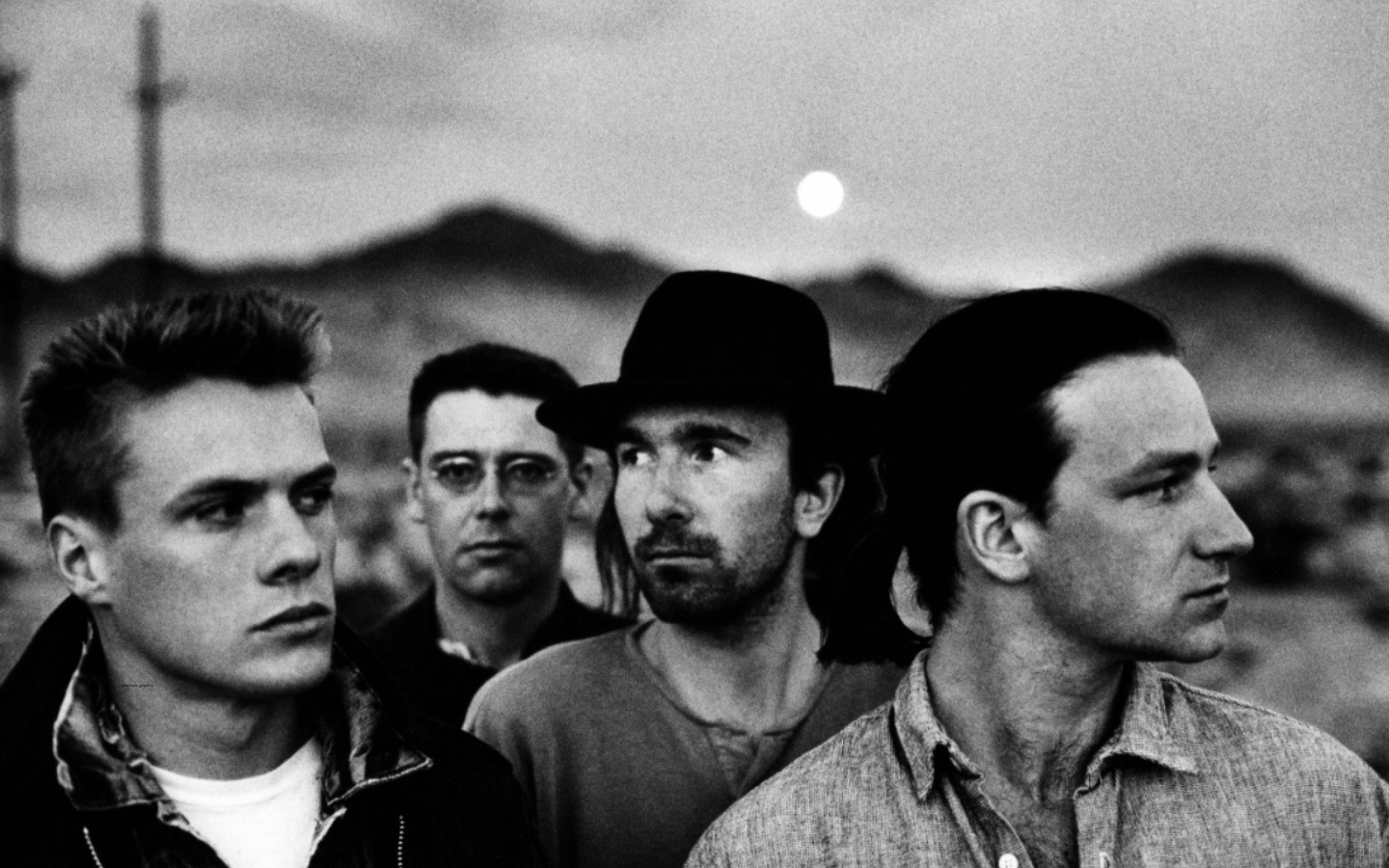
When the Irish rock band U2 became global superstars with the March 1987 release of their masterpiece album The Joshua Tree, I was a 12-year-old East Texas kid whose musical tastes had yet to break free from country radio. Cable television had just arrived in my town, and with it, MTV introduced me to the videos for “I Still Haven’t Found What I’m Looking For” and the famous L.A. rooftop shoot of the band performing “Where the Streets Have No Name.”
Those songs intrigued me. I think I had enough latent spirituality to sense a connection between Bono’s vocal and lyrical yearning and the Christian story that had animated my childhood. But I was too young for U2 to latch onto my imagination beyond being background music for my early adolescence.
Fast forward a couple of years. I was a teenager perusing the VHS tapes in the aisle of my local video store when I came across a copy of the documentary film for the 1988 album Rattle and Hum. The film featured concert footage that included tunes from The Joshua Tree, as well as songs that paid homage to music legends such as the Beatles, Bob Dylan and B.B. King.
Although critics largely panned both Rattle and Hum and its accompanying documentary as too pretentious, I was hooked. It was the first rock album I ever fell in love with. Even so, though I still suspected U2 and I shared a common worldview, I couldn’t put an accurate label on the group for what they actually were: a Christian band.
Trigger warning for longtime U2 fans: What I will share next will make you shudder.

U2
By the time I was a freshman in college, I had been thoroughly indoctrinated in the evangelical belief that there were solid dividing lines between art that was “secular” and art that was “Christian.” Everything belonged in one category or the other. “Christian” albums belonged in the cassette and CD players of good Christians. “Secular” albums belonged in the pit of hell.
And so, during a particularly zealous season of my life, some friends and I held a bonfire where we destroyed the books and albums that were holding us back from fully loving Jesus. Included in my stash was U2’s Rattle and Hum.
When All That You Can’t Leave Behind was released in 2000, I had long ago reneged on my commitment to only listen to “Christian” music for the rest of my life. I had repurchased Rattle and Hum and added The Joshua Tree to my CD collection, and now I had new U2 music to enjoy. But I didn’t take the time to familiarize myself with the handful of albums they released in the intervening years, nor with their earlier work.
Because of this, I had a rudimentary knowledge of the band’s more popular music and had gleaned that their Christian commitments (particularly Bono’s) went deeper than just passively influencing their lyrics. Although there were resources available, I relied on my more U2-fluent friends to educate me on the details of the Irishmen’s faith.
I resisted reading any book-length treatment of the subject. This was partly from an aversion to the “Gospel According to…” books that filled the shelves of retail outlets in the early 2000s as Christian writers discovered the commercial possibilities of synthesizing Christian thought with popular culture. Mostly, though, I was just content with enjoying the music.
But with this week marking the 50th anniversary of the band’s formation, and the dismal state of the world driving many of us to search for meaning, hope, and joy, this seemed like an apt time to change that.
Pilgrim’s Guide
(Cascade Books)
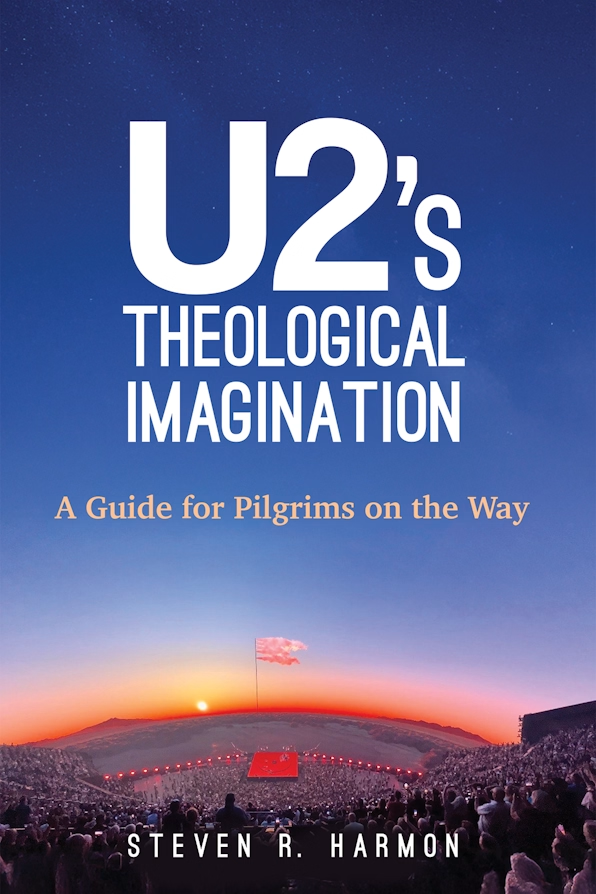
Enter Steve Harmon’s new book, U2’s Theological Imagination: A Guide for Pilgrims on the Way. Harmon is Professor of Historical Theology at Gardner-Webb University School of Divinity.
As a theologian and U2 fan since discovering the War album in his sophomore year of high school, Harmon noticed that, despite the numerous books exploring the band’s faith, few offered an extensive theological treatment of its Christian imagination. In Chapter 2 of U2’s Theological Imagination, he describes the overarching theological themes in the band’s extensive catalog; in subsequent chapters, he fleshes out how those themes play out in various songs and tours.
Harmon explains, however, that while Christian themes abound in their work, they “make sense only in light of the biblical stories in which they are rooted.” He writes, “[T]his means that their deepest import is often veiled from those who do not already share with U2 the framework of biblical narrative.”
So Harmon’s book, like U2’s music, will most resonate with those with “ears to hear.”
In addition to its rootedness in the biblical narrative, Harmon sets U2’s music within the contexts of liturgy, trinitarian theology, the “end times” (eschatology), personal salvation and the Christian practice of social engagement.
One helpful element of Harmon’s framing is his exploration of how these themes appear not only lyrically but also in the band’s distinctive sound. This helped give voice to my early adolescent experience of feeling something deeply spiritual about U2’s music but being unable to articulate it.
In describing the theological aspect of God’s reign—that it is both present and somewhere in the future—he explains how The Edge (U2’s guitarist) utilizes elements such as the delay effect “as a compositional technique to create notes that are not directly played but are integral to the music.” Additionally, his use of the open-fifth chord results, Harmon writes, in “the yearning sound of the already/not-yet tension of Christian eschatology translated into the idiom of post-punk rock music.”
The book offers an excellent treatment of what many people know U2 for, which is how their Christian identity influences how they think about issues of justice around the world. This includes penning songs and advocating for causes that put their Irish identity into conversation with “the civil rights movement in the United States, the struggle against apartheid in South Africa, opposition to the violence of the military junta in El Salvador [which Harmon explores in depth in Chapter 3], resistance to the repression of the military government in Myanmar, and efforts to secure debt relief for developing countries and medical assistance for sub-Saharan African countries affected by AIDS and other infectious diseases.”
Through this social engagement, Harmon describes how “U2’s theological imagination is concerned with spiritual issues that are not merely interiorized; the spirituality of this imagination is a holistic one, addressing the materially and socially embodied contexts of Christians and the Christian communities to which they belong.”
U2’s Theological Imagination: A Guide for Pilgrims on the Way occupies fewer than 100 pages. However, if you are like me, it will take longer to read than most short books. That’s not because it’s inaccessible; theologians and lay readers alike will find it incredibly engaging.
Rather, it is because every page is full of so much wisdom that it sent me to my music library to reacquaint myself with U2 songs I’ve loved and others I missed along the way.
- About the Author
- Latest Posts

Senior Editor at Good Faith Media.