
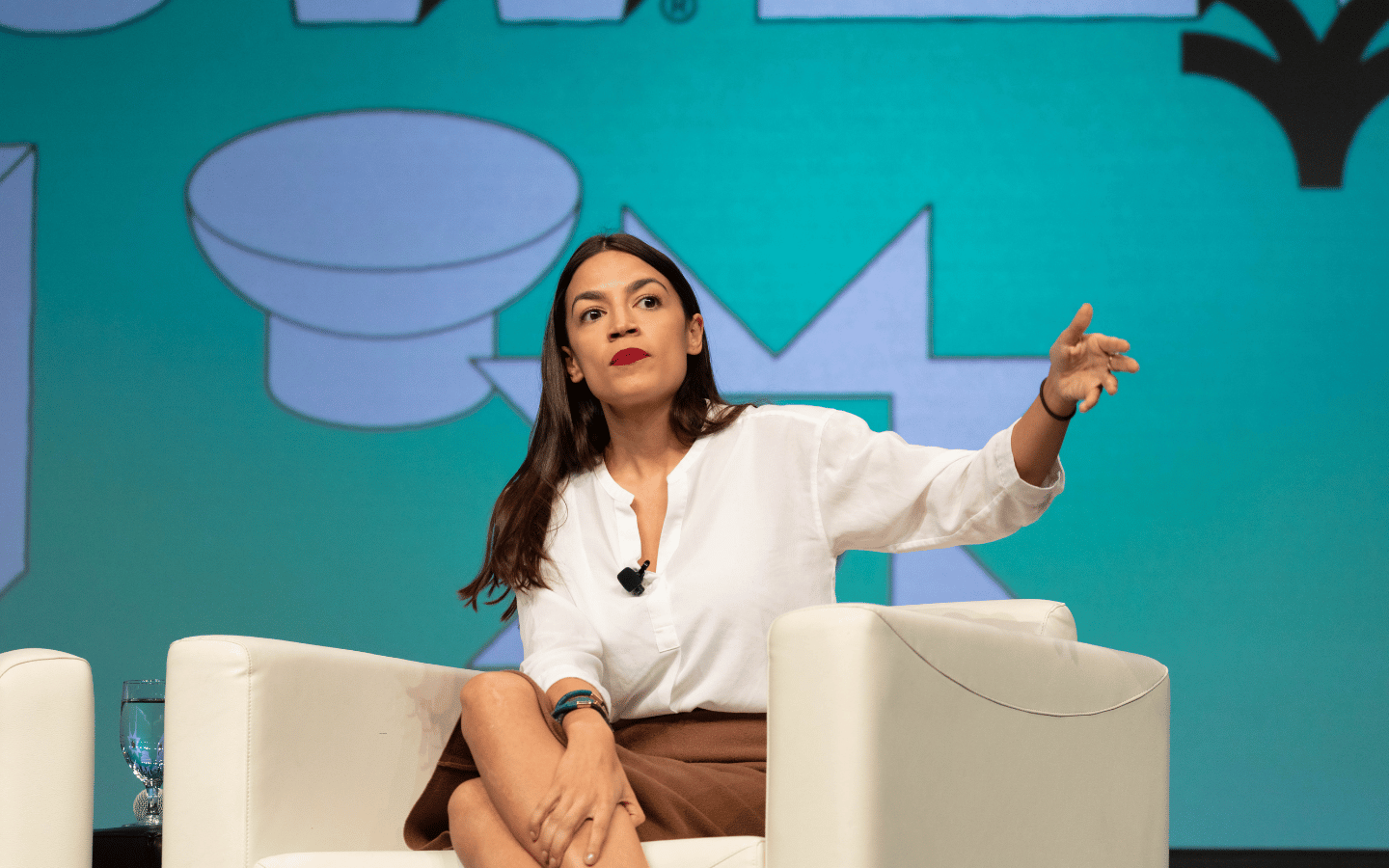
In an interview with ABC News earlier this month, Alexandria Ocasio-Cortez (AOC) was asked about the previous political positions of Wisconsin gubernatorial candidate Francesca Hong, including canceling Thanksgiving, abolishing prisons and defunding the police.
In response to Hong’s comments and the positions she’s since recanted, AOC replied, “Woke 1 was crazy,” echoing a phrase from Chi Ossé, a New York City Council member from Brooklyn. She went on to say that pandemic-era shutdowns and unemployment opened the door to entertaining a wide range of policy proposals around crime that hadn’t been discussed before.
“I actually think the discussions that were had from that time were quite fruitful,” she said. “When we talk about crime today, it’s fundamentally different than how we talked about bringing crime down [before]. And we all share the goals of having as low a crime rate as possible. Of course, rhetoric from that time is not rhetoric that we’d use today.”
Despite her clarification, the internet latched onto her “Woke 1 was crazy” comment and ran with it.
‘Woke 1’
For activist Maya Contreras, the negative responses to “wokeism” were to be expected.
“The pervasiveness of white supremacy in America is so entrenched that mentioning solutions to root it out triggers immediate backlash from those who benefit from white supremacy or those who uphold it,” Contreras wrote on Threads.
Although she isn’t surprised by some progressives walking back their support for “Woke 1” positions, she isn’t bothered by it either. Contreras sees it as a tactic used by politicians of color (AOC, Brandon Johnson, Zohran Mamdani) who “understand white supremacy intimately.” She values these politicians seeking to reform an unjust system from within (which requires tempering their speech), all while organizers and activists do the equally important work of agitation outside the system.
While Contreras sought to explain the moment, others took offense at AOC’s comments, claiming they had been actively harmed by “Woke 1” policies and demanding that she do more than laugh off the movement.
‘Woke’ at Bates
AOC’s interview came at a perfect time for Tyler Austin Harper, whose The Atlantic cover story, “Why I Quit the Tenure Track: The insufferable hypocrisy of elite academia,” was released the next day.
Harper, who earned a Ph.D. in comparative literature from New York University, joined the faculty of Bates College in 2020. As a Black man in academia, he was excited to join the faculty of one of the few U.S. universities founded by abolitionists. When he mentioned this to his dean, a white biology professor, he was taken aback by his patronizing response. Although the university had been founded by an abolitionist, the dean said, it was nevertheless funded by a man who had made his fortune by processing cotton produced through enslavement in the South.
“I had come into Bates rather smitten with the idea that I was a Black academic joining the ranks of a faculty whose predecessors had agitated for Black freedom,” Harper wrote. “[B]ut the dean seemed to feel that this was actually something to be faintly embarrassed of, a history that was best mentioned, if at all, only after layering on an array of caveats.”
This was an early signal to Harper that Bates may not be a good fit for him. He spent the rest of his essay chronicling the next few years, which roughly coincided in time and spirit with what AOC called “Woke 1.”
Harper critiqued the university’s Diversity, Equity, and Inclusion (DEI) curriculum efforts. He argued they were misdirected and would inevitably—and ironically—increase the workload, but not the compensation, of young, Black faculty. He suggested many of these race-related initiatives by the university’s white leadership were a cosmetic ruse to hide the union-busting they were doing behind the scenes.
Harper’s article, which detailed many more of his grievances, received a lot of praise on social media from “anti-woke” crusaders and institutionalist progressives. But not everyone was buying it. Many questioned his academic bona fides and his interpretation of the events during his time at Bates.
In a thoughtful response, Andrew Baker, who was a faculty colleague of Harper’s at Bates, interpreted the times differently. As another self-proclaimed “token black professor,” Baker believes Harper didn’t understand the nuances of what his colleagues were attempting to do through their curriculum DEI proposals.
“[I]n a piece that purports to center labor exploitation, the author is curiously uninterested in considering an obvious alternative,” Baker writes. Which is, “the myriad and sophisticated ways that black students and faculty members have, for many decades, collectively resisted degradation by leveraging their status as valuable, tokenized icons that white institutions use as living, breathing, touchable evidence of their professed commitment to racial justice.”
Baker makes a similar argument as Maya Contreras: Black activists have always understood the multiple, seemingly contradictory paths toward liberation.
Out of the Tower
Anyone who wants to thoughtfully consider AOC’s “Woke 1” comments would do well to read Harper’s article and the responses to it. They deal with important issues such as academic freedom, activist language, racism, and classism. But more than anything, they exhibit what many white progressives have a hard time understanding, which is that “people of color,” like all people, don’t constitute a monolith when it comes to cultural issues.
“In my observation, woke white academics—who are largely acculturated to defer to the ‘lived experience’ of their Black and brown students and colleagues—had next to no ability to make decisions when confronted with minorities who disagreed with one another,” Harper wrote. “Encountering ‘marginalized’ people with opposing views tended to create a kind of cognitive paralysis in some of my white co-workers.”
But it’s not necessarily the substance of these conversations that best highlights this cultural moment of backlash against what some call “wokeism.” It’s where these ideas originate and how they reach the masses.
For much of modern history, language describing particular injustices—and the solutions to address them—often developed as a dialogue between activists in affected communities and elite institutions (universities, religious communities, the media). Concepts were proposed, tested, refined, and then accepted or discarded based on their effectiveness.
The terminology used to describe these concepts was often communicated in shorthand, which made it inaccessible to most people outside the institutional or activist spaces where it originated. The language had to undergo cultural translation before the masses embraced it.
The internet changed everything.
From the killing of Trayvon Martin and the #MeToo movement, and accelerated with the murder of George Floyd and the pandemic, humanity’s injustices had no place to hide. They arrived to us unfiltered through screens we hold in our hands. Some of their solutions, which weren’t new, also reached us directly through our phones. And they came to us without having gone through the old processes of cultural translation.
“Defund the police” is a perfect example. Those who embrace that idea occupy a wide spectrum of what it actually means. Some mean completely abolishing police departments as they currently exist, while others interpret it as tinkering around the edges of police budgets to redirect funds toward more palatable crime-prevention strategies. Most fall somewhere in the middle. Regardless of the nuance, though, the masses only heard “defund the police” and interpreted it however they pleased.
Suddenly, we were exposed to phrases like “intersectionality,” “systemic,” and “decolonization.” If we were in a profession or had a level of privilege that gave us space to quickly understand and adapt to these concepts, we could try. But most people didn’t have that kind of time. They were hustling for side gigs, figuring out how to homeschool their kids, and negotiating an unpredictable world with a virus that could kill them in a week or infect them with no symptoms at all.
The terminology and ideas perplexed many in the communities they purported to help, and some even rejected them, such as “Latinx.”
Some folks in historically oppressed communities find the language and tactics of progressives silly, even if they agree with the general goals.
A few years ago, I was traveling with my friend Dan at DFW Airport. He had TSA Pre-Check; I didn’t. Dan is an incredible human being, but not the kind who would wait in line for 20 minutes when he could zip through in two, even to stand in solidarity with a friend. While I was waiting, he texted me to tell me he was in line at Chick-fil-A and to ask if I wanted him to get me anything.
“Uhhhh…this feels like a trick,” I replied.
Dan is gay.
He fully understands how problematic it is that Chick-fil-A’s charitable foundation once donated to an organization that supported conversion therapy, a brutal practice that Dan had been subjected to when he was younger. He also really loves their chicken sandwiches.
Speaking the People’s Language
Do many reject “woke” ideas because they benefit from the injustices they seek to remedy? Absolutely. Are the people who are backtracking on those ideas betraying the victims of injustice for political gain? Maybe.
But progressives shouldn’t ignore the possibility that we bear some of the blame for this recalibration.
The irony is that the term at the center of this debate, “woke,” didn’t grow in the elite halls of academia or the audience-tested world of public opinion. It was born in the Blues.
Maya Contreras reminded her followers on Threads that what AOC called “Woke 1” was a misnomer, since “woke” has been in use since at least the 1930s. In his 1938 song, “Scottsboro Boys,” singer Huddie Ledbetter, known professionally as Lead Belly, urged Black Americans to “stay woke,” meaning to be on guard against the persistence of white supremacy in the United States. In his song “Jim Crow Blues,” he talked about feeling sorry for many people who just haven’t “woke yet.”
Interestingly, Lead Belly was born in Caddo Parish, Louisiana, near Shreveport. He grew up and began his musical career in Harrison County, Texas—where I went to college. On the same soil where I learned to use vaunted words like “deontological,” “soteriology,” and “systemic,” Lead Belly learned the people’s language of love and hate, rejection and embrace.
I’m a product of and defender of higher education. But those of us seeking to advance God’s agenda of inclusion, justice, and mercy would serve humanity better if we closed our books and learned Huddie Ledbetter’s language instead.
- About the Author
- Latest Posts

Senior Editor at Good Faith Media.