
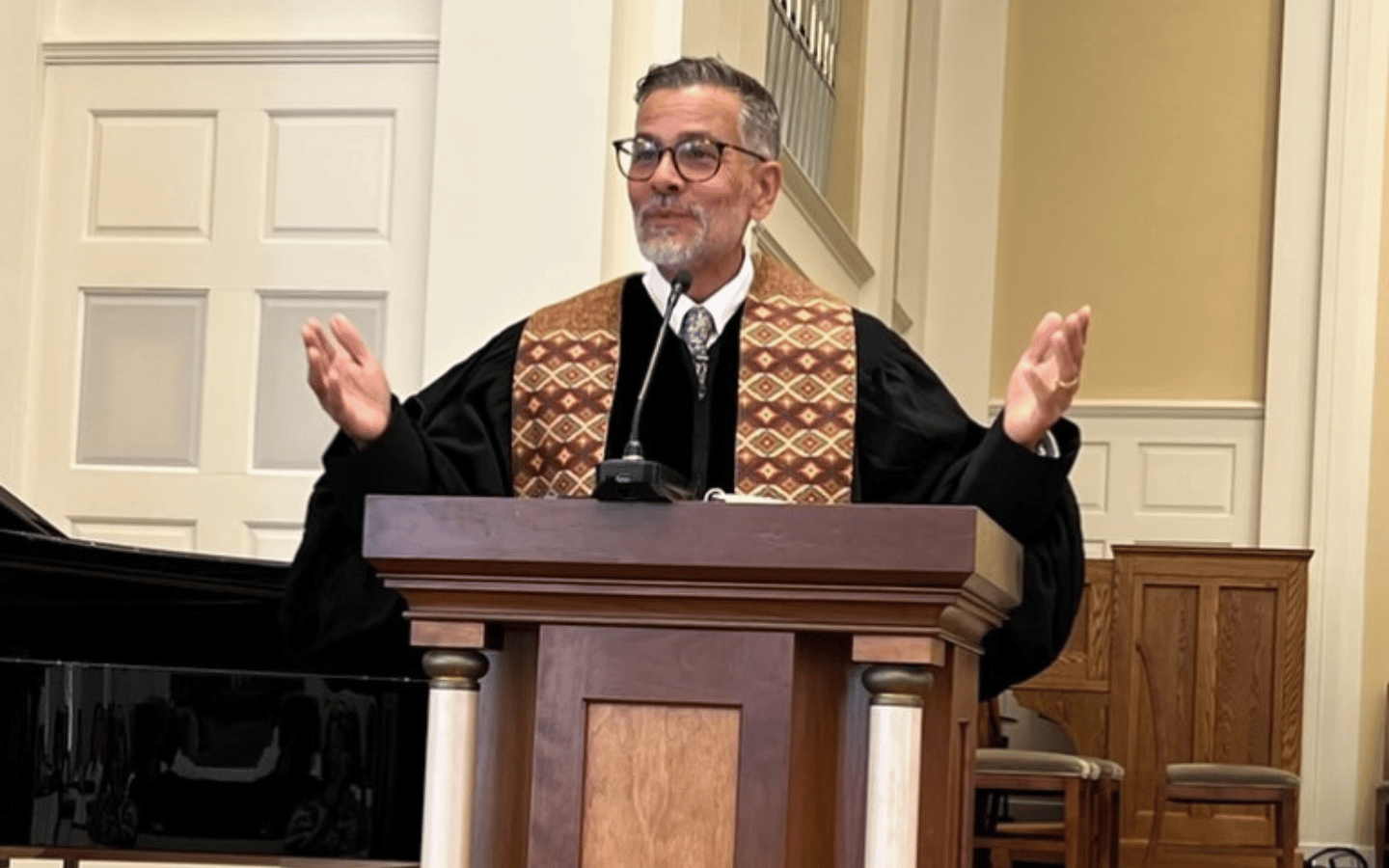
Editor’s Note: The following is adapted from a sermon Mitch Randall gave on April 9, 2026, at SMU’s Perkins School of Theology.
It takes every ounce of restraint within me not to denounce my Christian faith.
I am a son of the Muscogee (Creeks). My colonized name is Rodney Mitchell Randall, given to me through a generational succession of white-washed naming rites. The federal government rejected Indigenous names when my ancestors registered for the Dawes Rolls between 1898 and 1914, forcing them to “rename” themselves to sound more “Christian.”
I am also a descendant of White European Protestants who enacted those policies. I am proud of my Anglo-heritage from the Randall, Sheifield and Slavens sides of my family tree. (I’ve even got a great sermon about being the grandson of an Alabama bootlegger, but I’ll save that for another day.)
But for now, I want to introduce you to the Boudinots’, McIntosh’s and Childers’ lines. Through those names, Indigenous blood flows in my veins. I am the son of the Ecovlke Clan (Deer Clan), where chiefs, warriors, artisans and social advocates once roamed the land.
My great-great-grandmother, Mildred Childers, was the first woman ever elected to the Muscogee Council of Warriors. She registered Native voters when my people were finally allowed to vote in 1924. Her legacy remains an inspiration to my entire family.
My Indigenous name was given to me by a Comanche Chief (and World War II Code Talker), Charles Chibiddy. With sage circling my head and the chief praying to the Great Spirit in his native language, he looked into my eyes and declared, “You are now Numu Kustu, Sacred Buffalo.”
Little did I know, but that sweet grass seed planted in my soul that day would begin a process of finding my true self. It also meant unlearning my old self.
We did not have a name for it back then, but it’s known today as decolonization. You might call it deconstruction, but for my people, it’s much more than that.
So, with that background, in the words of the Muscogee teens in FX’s phenomenal television series, Reservation Dogs, written and directed by fellow Muscogee (Creek) Sterlin Harjo: “Skoden”—“Let’s go!”
Peter Gets It Wrong and Right (First Peter 3:3-6)
The Apostle Peter wrote, “He has given us new birth into a living hope through the resurrection of Jesus Christ from the dead, and into an inheritance that can never perish, spoil or fade.” I must admit…I have questions for the head of the church.
Never, perish?
Never spoil?
Never fade?
While I admire Peter’s optimism, I’m afraid the faith of Rabbi Jesus did perish in the fourth century. That, of course, is when the Roman Emperor Constantine was converted to Christianity.
Almost overnight, the Christian faith became a tool of empire. The Jesus movement perished and was spoiled at the hands of the Eurocentric patriarchy. And it most certainly faded when imperialism took the place of the genuine justice-seeking Jesus movement.
So, with all due respect to the Rock, I’d say parts of the Christian faith are in much worse shape now than when Jesus left it. However, Peter did get something right a little later in his letter when he wrote, “In all this you greatly rejoice, though now for a little while you may have had to suffer grief in all kinds of trials.”
For most of my formative years, seminary days, and years as a young pastor, I was repeatedly told the numerous narratives of outside persecution upon the church. They were both dramatic and provocative, and I was told to cling to my faith no matter the cost.
Saints throughout history certainly suffered at the hands of outside oppressors. The stories of martyrs fill our books and break our hearts.
However, there are other stories that should also fill our libraries and break our hearts. These will not be found in Fox’s Book of Martyrs, but they are nonetheless part of the larger Christian story.
They are stories where the oppressed become the oppressor. Two particular narrative lines highlight this.
The European Christian Invasion of North America
Before Columbus arrived in 1492, the Indigenous population of North America numbered 60 million. In comparison, Europe had a population between 70 and 88 million. As Europe invaded the Americas, the Indigenous populations drastically declined by 90% in the early 1600s.
According to anthropologists, Europeans brought measles, smallpox, influenza and the bubonic plague across the Atlantic, with devastating consequences for the Indigenous populations. Before a single shot was fired, disease became the weapon of destruction and genocide.
In his book 1491, Charles C. Mann wrote, “Much of this world vanished after Columbus, swept away by disease and subjugation. So thorough was the erasure that within a few generations neither conqueror nor conquered knew that this world had existed.”
White eyes were blind to the brown beauty and sophistication of the Indigenous peoples and their complex systems. Even though their inability or refusal to see the beauty and sophistication of Indigenous ways was devastating, it was still not enough.
European Christians needed spiritual cover for the economic opportunities before them. They needed a baptism of sorts to cleanse them for what they were about to do.
Columbus does not disappoint.
The wayward explorer headed back to Europe in 1493 to report and speak with Pope Alexander VI. The pope was happy to collude with Columbus in a mission to save souls and grab some land along the way. On May 4, 1493, he issued the Papal Bull, “Inter Catera.”
The bull read, “Out of our own sole largess and certain knowledge and out of the fullness of our apostolic power, by the authority of Almighty God conferred upon us in blessed Peter and of the vicarship of Jesus Christ, which we hold on earth, do by tenor of these presents, should any of said islands have been found by your envoys and captains, give, grant, and assign to you and your heirs and successors…And we make, appoint, and depute you and your said heirs and successors lords of them with full and free power, authority, and jurisdiction of every kind.”
This gave rise to the Doctrine of Christian Discovery. Thereafter, the European Christian invasion of the Americas was full speed ahead.
Jamestown was founded in 1607, and Plymouth in 1620.
Needing free labor for the resources of their unholy venture, Christians looked towards Africa. The second narrative introduces the arrival of enslaved Africans to Virginia in 1619. Through the 19th century, the transatlantic slave trade transported between 10 and 12 million Africans across the Atlantic Ocean.
No Indigenous person was safe in the world—Native Americans, Africans, Asians, Latinos, Eastern Indians, Pakistanis, Palestinians.
The Doctrine of Christian Discovery is the theological foundation for what we now know as white supremacy. The United States is built on stolen lands, stolen labor, and stolen lives. And here is the hard truth every Christian needs to understand: The Christian Church and her disciples colluded with empire to make all of this happen.
When John Winthrop equated the New World to a “city on a hill” in 1630, the American dream became a global nightmare for the descendants of Indigenous peoples globally. For my people, displacement came quickly during Western expansion under the spiritual banner of Manifest Destiny when President Andrew Jackson issued the Indian Removal Act of 1830, leading to the Trail of Tears.
Approximately 100,000 indigenous people were forced from their homes in the Southeast. The physical trail consisted of several overland routes and one main water route stretching some 5,045 miles across portions of nine states.
Once my ancestors arrived in Indian Territory (present-day Oklahoma), an assimilation process quickly began to ease their cultural ways. They were forced to abandon their given names in favor of Christian names.
Their children were sent to boarding schools where their hair was cut, they were made to wear military-style uniforms and were forbidden to speak their native languages. They were whipped when it was determined they disobeyed, and in the worst cases, they were abused by their Christian caretakers.
My great-grandmother, Eliois Beautinote, and her little sister, Ruby, were sent to Chilacco Boarding School in Northern Oklahoma, where they suffered at the hands of Christian oppressors funded by the United States of America. They were nine and seven years old.
Indigenous peoples, along with our African siblings, have been victims of the systemic stranglehold white supremacy has had around our necks. From the genocide of Native Americans to the chattel enslavement of Africans and their descendants, from Asian internment encampments to ICE raids, the real Christian witness has been one of conquest, conversion and control.
One More Step Past Decolonization
Why, after all this, do people of color continue to gravitate towards this Jesus character? Why follow someone whose followers have treated you so badly?
As much as it pains me, returning to Peter can be helpful in understanding: “In all this you greatly rejoice, though now for a little while you may have had to suffer grief in all kinds of trials. These have come so that the proven genuineness of your faith—of greater worth than gold, which perishes even though refined by fire—may result in praise, glory, and honor when Jesus Christ is revealed.”
It must be stated that the suffering of brown and black bodies was not a divine requirement to find Jesus. It was an unjust and evil portal introducing them to Jesus: a man who resembled them more than he resembled their oppressors.
As a person with Indigenous heritage, why do I still believe after everything I know? Because I still identify with that subversive rabble-rouser, that beautiful brown Indigenous Rabbi, more so than the oppressors who bear his name.
When Native, African, Asian and Latin Americans read the story of Jesus, they see him as one of them: an outsider rejected by the ruling class advocating to bring others together through the only thing more powerful than the hateful oppression of Empire—Love.
Peter gets it right in the end: “Though you have not seen him, you love him; and even though you do not see him now, you believe in him and are filled with an inexpressible and glorious joy, for you are receiving the end result of your faith, the salvation of your souls.”
Drowning Out Empire
There is a metaphor for how my people turned hatred and oppression into comfort and love. I invite you to join me on the Trail of Tears.
You’ve just left your ancestral home, the lands where your people roamed for thousands of years. The home where you raised crops, fished, hunted, danced, sang, and raised your families.
It is winter and the bitter cold bears down. Your moccasins crunch into the snow, sending chills from your feet up your spine. So many of your family and friends have already died on this forced march.
The U.S. cavalry rides alongside you, soldiers dressed in blue uniforms high upon their horses. Their guns strapped to their sides, a stark reminder that white logic uses force to bring about “civilization.”
The soldiers cough and hack from the cold. Their horses neigh and winnie.
Night is falling and the time to make camp is at hand.
The bugler begins to blare his horn, playing an evening song announcing the end of the day. Startled by the brashness of the bugle, little babies begin to cry in their mothers’ arms.
The bugle plays louder, an attempt to drown out their little voices. The babies respond, elevating their cries.
But then, something happens, a transcendent moment. The mothers begin to sing.
They have created lullabies that coincide with the bugle’s tune. The babies hear their mother’s voice, and their cries begin to soften. The love of mothers drowned out the piercing oppression of Empire.
That is Jesus for us.
Community overcomes Empire.
Culture outlasts capitalism.
And love conquers hate.
In the words of my people, vnokeckv (uh-no-gitch-guh), “together, we love.”
MVTO – Thank you.
SKODEN – Let’s go.
AMEN – Let it be.
- About the Author
- Latest Posts

CEO of Good Faith Media.