
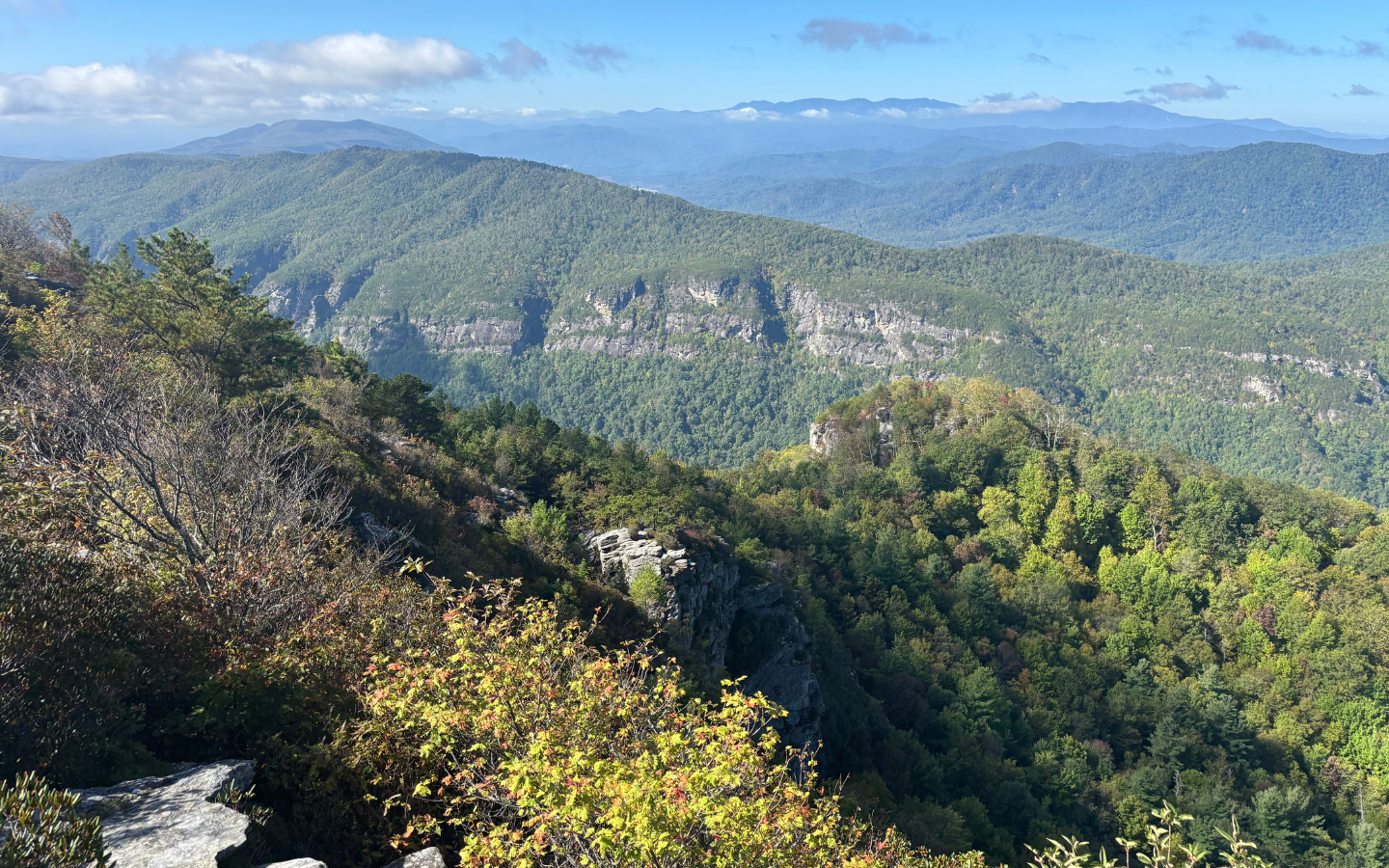
A few months ago, I woke before dawn and drove into the mountains, chasing a small, fleeting miracle.
The trailhead for the Daffodil Flats hike sits along the rim of the Linville Gorge, sometimes called the Grand Canyon of the East. It is a place that feels untamed in the best sense: steep, stubborn and unapologetically wild. The trail wastes no time. It drops you three miles straight down into the gorge, as if to remind you from the beginning that beauty often requires descent.
As I made my way down, I had the same thought most hikers have: What goes down must come back up. Already, I was dreading the climb.
But at the bottom, the world opened.
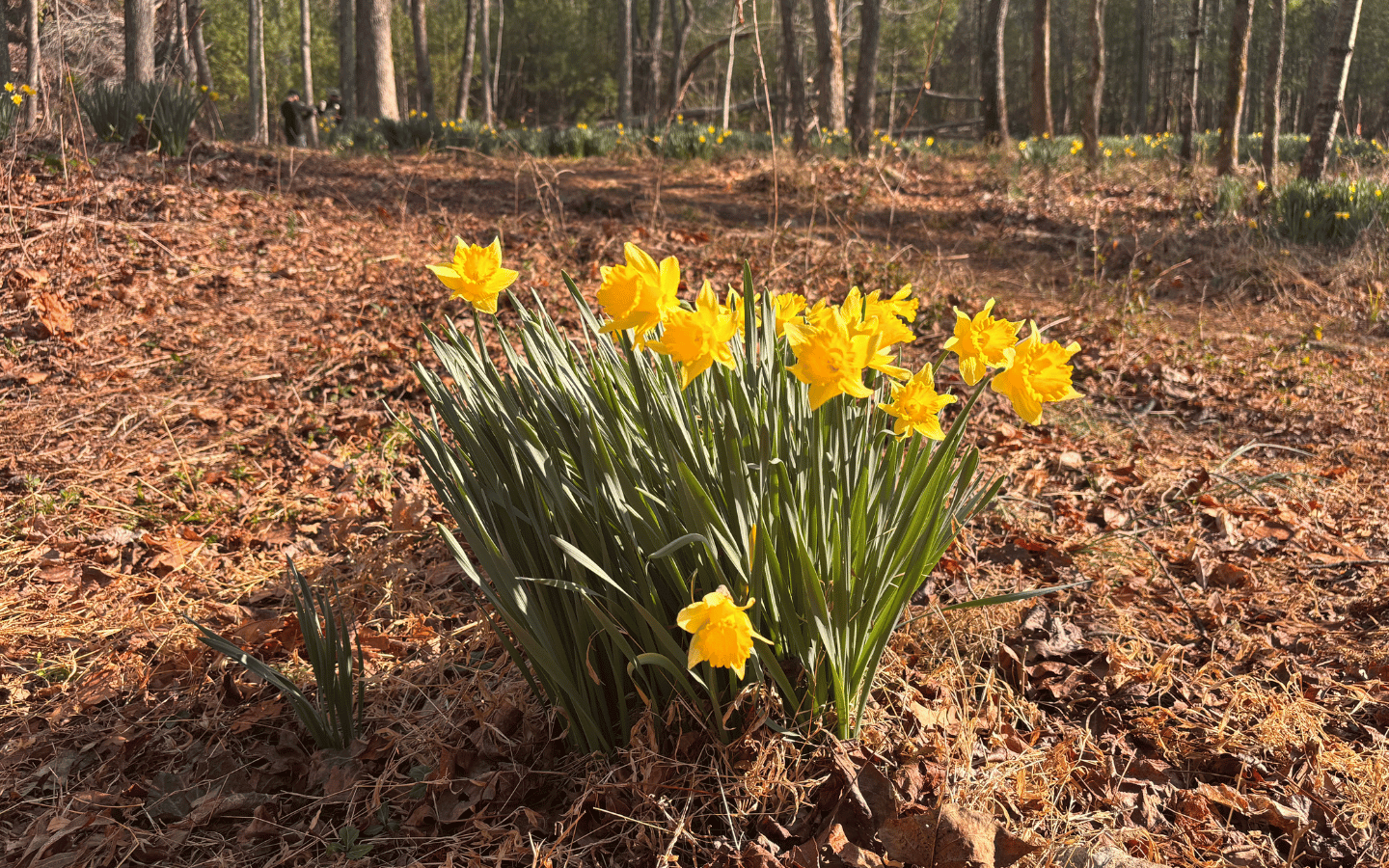
The Linville River moved steadily over granite and sand, its voice both constant and unhurried. And just beyond it, the field appeared—unassuming at first, then suddenly radiant. For a few weeks each year, that field becomes a sea of yellow daffodils, blooming where a homestead once stood.
The house is gone. The people are gone. But what they planted still rises, year after year, like a quiet act of resurrection.
There was one other hiker there, resting in a hammock strung between two trees, swaying gently above the flowers. We began to talk, as strangers sometimes do in sacred places. She told me she returns every spring.
“This is sacred space for me,” she said. “And I need as much sacred as I can get in our world.”
By any honest measure, something sacred is being diminished.
Creation and Consumption
That field, that river, that silence—they are held within the vastness of the Pisgah National Forest, part of a system of public lands once entrusted to careful stewardship. But in recent days and months, that trust feels increasingly fragile. Actions taken under the leadership of Donald Trump have not only weakened protections but have begun to hollow out the very institution designed to care for these places.
The dismantling of the United States Forest Service is no longer abstract. Offices are closing. Expertise is being dispersed. Long-held guardrails are being loosened in favor of more aggressive extraction and development.
And here is where we must speak plainly: a vision that treats public forests primarily as commodities to be consumed, rather than as communities to be sustained, is not just short-sighted policy. It is a failure of moral imagination.
More than a century ago, Gifford Pinchot helped found the Forest Service with a simple but profound conviction: that the nation’s forests should be managed “for the greatest good, for the greatest number, for the longest time.” It was not a perfect vision, but it was a moral one. It assumed that restraint was a virtue, that public lands belonged to the people, and that future generations mattered.
At its best, the Forest Service has embodied something deeply consonant with Christian faith: a commitment to stewardship over exploitation, to patience over profit, to care that stretches beyond the present moment.
What we are witnessing now is the erosion of that vision.
Scripture gives us language for what is at stake. The psalmist writes that “the trees of the forest sing for joy” (Psalm 96:12). Creation is not inert. It is alive with praise. Forests are not simply landscapes; they are liturgies—places where the goodness of God is rehearsed in wind and water, root and branch.
To diminish them is to quiet a choir.
And yet, the silencing is happening all around us, not always dramatically, but steadily. In policies that prioritize extraction over renewal. In decisions that weaken oversight. In the slow unraveling of institutions that once held a long view of the land.
Perhaps what is most troubling is how easy it is to look away.
The church, by and large, has struggled to find its voice here. Environmental care has been filed away as a political issue, rather than received as a theological one. But the opening chapters of Genesis do not give us permission to disengage. They give us a calling: to tend and to keep, to serve and to protect.
We are not owners of creation. We are participants in it.
Forgetting How to Listen
And so the question before us is not simply what is happening to the forests. The question is what is happening to us.
In The Overstory, Richard Powers writes, “Trees have long been trying to reach us. But they speak on frequencies too low for people to hear.” Perhaps the tragedy of this moment is not only that the forests are being diminished, but that we have forgotten how to listen.
Or worse—we have heard, and chosen silence.
Many people right now feel a quiet grief, even a rising anger, at what is being lost. That response is not something to suppress. In the language of Scripture, it is lament. And lament, when it is faithful, does not end in despair—it moves us toward action.
So what can ordinary citizens do with their disappointment and outrage?
Lament to Action
We can begin by refusing to let our concern dissipate into cynicism. Instead, we can root it in practices that are both grounded and hopeful. We can support local and national conservation organizations. We can pay attention to how public lands are being managed and make our voices known to those entrusted with leadership. We can show up, literally, by visiting, volunteering and bearing witness to these places so they are not reduced to abstractions.
We can also cultivate communities—churches included—that speak about creation not as a side issue, but as part of our shared discipleship. And we can make small, tangible choices in our own lives that align more closely with care than consumption.
None of these actions, on their own, will restore what is being lost.
But together, they form something stronger than outrage alone: they form a people who refuse to forget what is sacred.
There is a moment in the Gospel of Luke when Jesus says that if the people remain silent, “the stones will cry out” (Luke 19:40). I find myself wondering if the forests are already doing just that—not in words, but in fire and flood, in absence and ache, in the quiet disappearance of what once was.
The question is whether we will hear them. And more than that, whether we will respond. Because to follow Christ is to love what God loves.
And God, it seems, has always loved forests.
(Credit: Tyler Tankersley)
- About the Author
- Latest Posts
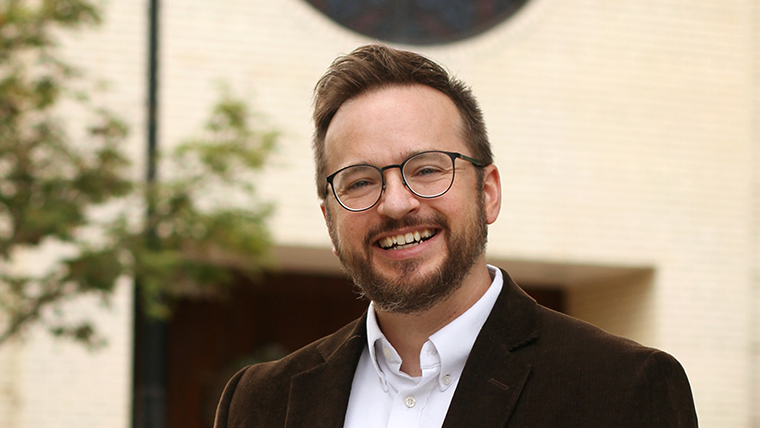
Tyler Tankersley is Senior Pastor at Ardmore Baptist Church in Winston-Salem, North Carolina.