

When Eugene Peterson was serving as a pastor in New York City, the church’s janitor was a man named Willi Ossa. Willi carried a deep suspicion of churches and Christians.
A German by birth, he had watched his childhood pastor become an ardent Nazi and witnessed churches across Germany accommodate themselves to the Third Reich. Religion, as an institution, had failed him catastrophically.
Still, Willi loved Eugene. He saw in him something sincere, something unguarded. What he could not understand was why this good young man would devote his life to such a compromised institution.
Though Willi worked as a janitor to pay the bills, he was, at heart, an artist. After months of friendship, he asked Eugene to sit for a portrait.
Eugene agreed. He put on his clerical robe and sat patiently as Willi studied him, brush in hand.
One day, Willi’s wife wandered into the room and peered over his shoulder at the emerging image. She grimaced.
Soon, the two were arguing in German, forgetting that Eugene could understand more than they realized. As the disagreement escalated, Eugene heard Willi say, “He’s not sick now, but that’s the way he will look when the compassion is gone, when the mercy gets squeezed out of him.”
When Willi finally showed Eugene the painting, it depicted a young, gaunt man wrapped in a drab black robe. His bony fingers clutched a closed red Bible in his lap. His eyes were lifeless.
Eugene thanked Willi politely and placed the portrait in a closet.
Willi eventually moved on, but Eugene kept the painting. Every so often, he would pull it out and stare into the jaded face staring back at him. Peterson later said he returned to the portrait whenever he needed to remember “what was possible—what I could become if I did not guard my soul.”
I keep a similar reminder in my church office. On a shelf sits an action figure of Rev. Timothy Lovejoy from The Simpsons, the long-suffering Presbylutheran minister of Springfield.
Years of ministry have worn him thin. He speaks with a pastoral cadence that no longer quite fits the world he inhabits. After hanging up on yet another anxious call from Ned Flanders, he mutters, “Damn Flanders.”
I keep Rev. Lovejoy there not to mock him, but to remember how easily a calling can calcify into a role and how readily pastoral care can shrink into professional detachment. I keep him there because, if I am not careful, that is exactly who I could become.
Default to Skepticism
I am not a naturally joyful person. The cruise-control setting of my inner life is skepticism and guardedness, a well-honed snark that I deceive myself into thinking passes for wisdom. And sometimes, the moderate and progressive waters in which I swim do not help me resist that drift.
Many of us serve in religious contexts very different from the ones that formed us. In the Southern Baptist and evangelical culture of my youth, earnestness was celebrated. Passion for God, even when misguided, was considered a virtue.
In many moderate or progressive spaces today, earnestness can feel suspect. The people who garner the most respect are often those most fluent in critique and deconstruction. Encountering someone who speaks openly about joy in God can feel almost embarrassing, like staring too long into the sun.
To be clear, we all need room to vent. There is such a thing as holy crankiness.
Psychologists tell us that cynicism often functions as a defense mechanism, protecting us from further disappointment or vulnerability. It frequently grows out of unprocessed grief and spiritual trauma.
Perhaps many of us have not yet fully reckoned with the past. Perhaps we linger in the shadows of cynicism because we fear that stepping into joy will pull us backward into the harmful, coercive expressions of faith we worked so hard to escape.
And yet, being cynical is no way to live.
The Quaker writer Thomas Kelly once confessed his own gravitational pull toward negativity. “I’d rather be jolly Saint Francis,” he wrote, “hymning his canticle to the sun than a dour old sobersides Quaker whose diet would appear to have been of spiritual persimmons.”
We live in a world that makes pastoral cynicism feel almost inevitable. Institutions we love have capitulated to cruelty and division.
The pastoral vocation has lost much of its cultural credibility. The news cycle seems calibrated to grind down hope. And still, especially still, this is precisely the moment when followers of Jesus must be intentionally formed by joy.
Joy Breaks Through
Hanna Reichel’s For Such a Time As This: An Emergency Devotional chronicles how Christians in 1930s and 1940s Germany navigated the rise of Nazism. In a chapter titled “Rejoice Always,” Reichel tells the story of Esther “Etty” Hillesum, a young Dutch woman murdered at Auschwitz in 1943, who refused to let the darkness extinguish her soul.
In her diaries, Etty wrote, “Life is beautiful. And I believe in God. And I want to be right in the thick of what people call ‘horror’ and still be able to say: life is beautiful.”
Joy, as Reichel reminds us, is not saccharine denial. It is the cultivation of an inner life sturdy enough to resist despair.
“Pay attention,” she urges, “to your body, your mind, your heart, your friends and chosen family. Where do joy, glory, and gratitude break through gloom and suffering? Make space for that joy and let it grow.”
I think often about Willi’s painting—the closed Bible, the lifeless eyes, the compassion already leaking away. And about Rev. Lovejoy, frozen in resignation on my shelf. These figures are not villains. They are warnings.
Joy, in a cynical age, is an act of defiance. The question before us is not whether cynicism is understandable. It is.
The question is whether it is forming us. Whether it is enlarging our love or quietly hollowing it out.
The gospel invites us to something braver: to guard joy like a fragile flame, to keep the Bible open rather than clutched shut, and to remain tender in a world that profits from our hardening. Not because the world is not dark—but because the light is still real and compassion is worth protecting.
- About the Author
- Latest Posts
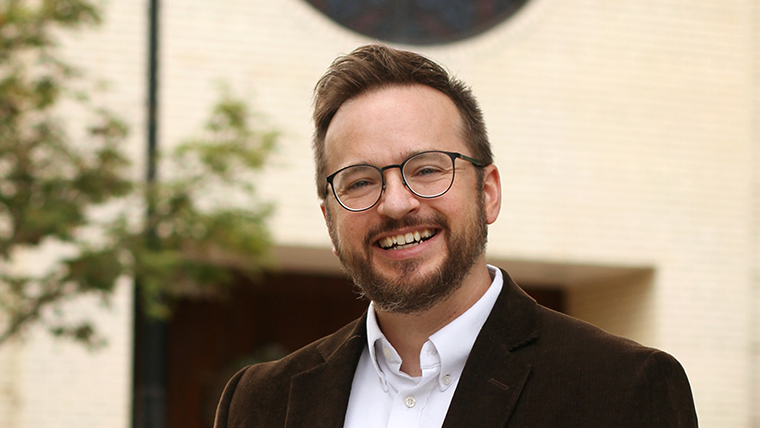
Tyler Tankersley is Senior Pastor at Ardmore Baptist Church in Winston-Salem, North Carolina.