
A line from Jason Isbell’s song “Cast Iron Skillet” often replays in my mind: “This town won’t get no better, will it?”
I have little hope these days that humans will act in the interest of others rather than themselves. I find it difficult to muster the confidence that people will resist the temptation to gain more and instead do what serves the common good.
This past weekend shook me out of pessimism, even if for a short time. My flirtation with optimism came from an unlikely source.
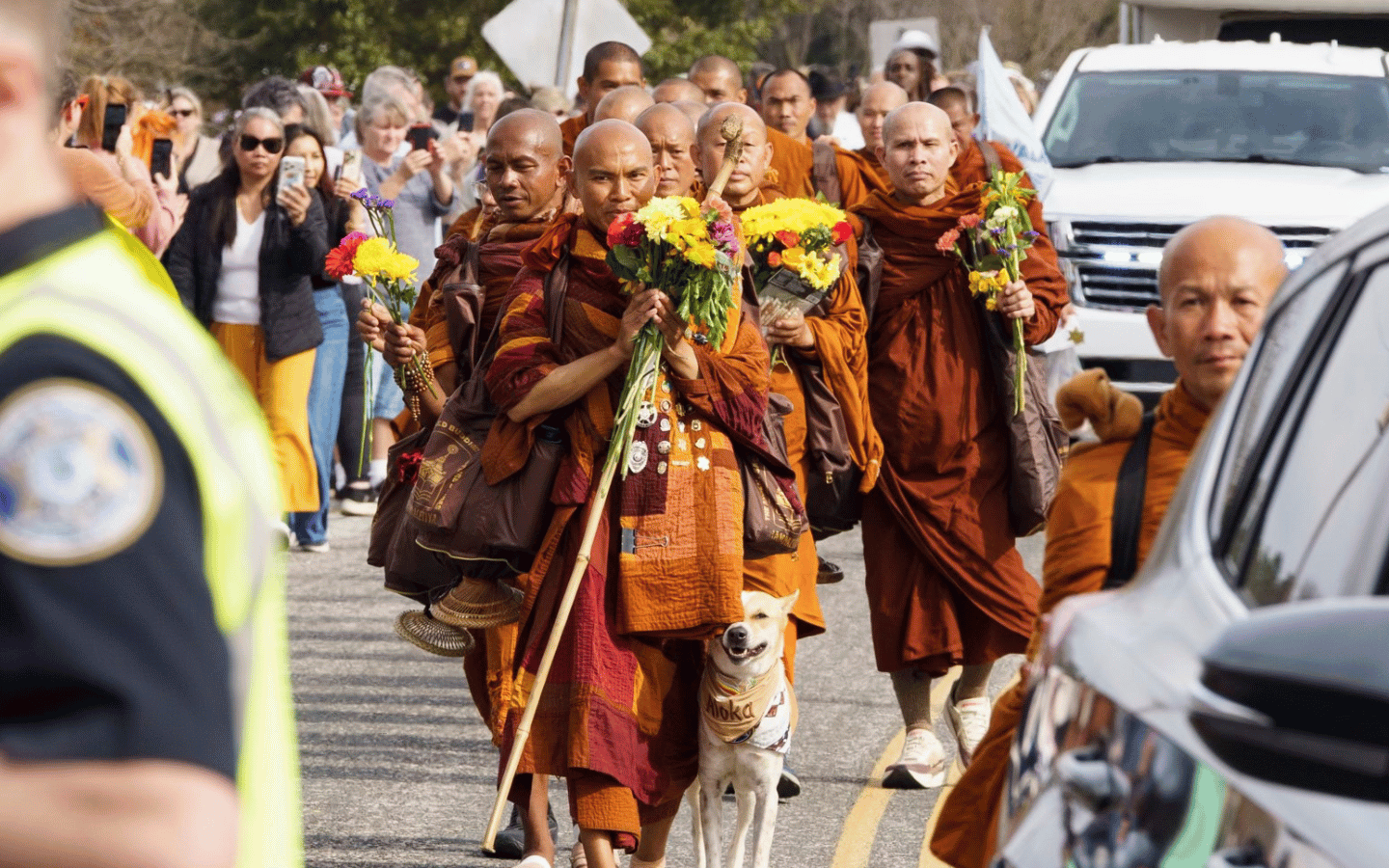
On Saturday, January 10, a Sangha of Buddhist monks, along with their Indian Pariah rescue, Aloka the Peace Dog, arrived in Columbia, South Carolina on their 2,300-mile “Walk for Peace” from Fort Worth, Texas to Washington, D.C. While I knew the monks’ mission had gained attention on social media (their Facebook and Instagram pages just hit one million followers), I never dreamed of the reception they would receive in a deep red state.
From town to town, law enforcement assisted the venerable monks as they walked. Officers rode alongside the travelers to protect them from vehicles, exchanged warm welcomes with everyone, and shared updates on progress and safety concerns on social media. Police forces, sheriff’s departments, EMS squads and fire stations offered badges and pins that Venerable Bhikkhu Paññākāra attached to his robe. Some even gave badges to Aloka.
Christian churches provided space for rest, meals and peace talks. The monks reciprocated the help with expressions of gratitude.
The Post and Courier reported that the arrival of the monks to the capital brought one of the largest crowds the city of Columbia has ever seen. The monks invited anyone who desired to meet them at West Columbia Riverwalk Park, then to walk with them across the Gervais Street Bridge into Columbia before convening at the State House just up the road.
Many accepted the monks’ offer. A sea of people swelled one step at a time, flanked by crowds offering signs of respect. Once at the State House, the monks and Aloka ascended the steps and offered a blessing and peace talk.
The Mayor of Columbia, Daniel Rickenmann, and State Senator Deon Tedder issued city and state proclamations and designated January 10 as “Walk for Peace Day.”
It is hard not to be hopeful when an event like this occurs with diverse people coming together in a time of political division and rampant violence. Thanks to a group of Buddhist monks meditatively walking halfway across the country, Saturday offered South Carolinians a chance to witness a peaceful way of being in the world and to hope that together we might build a better future after all.
Christian communities can learn something here.
I recalled over the weekend one of Stanley Hauerwas’s mantras: “The first task of the church is to make the world the world.” The church, he argued, should serve as an alternative community to the patterns of life around it. Followers of Jesus of Nazareth should create communities characterized by love, reconciliation and non-violence.
For Hauerwas, peace and non-violence always remained essential to the witness of the church Jesus established. He also noted pacifism is not passive; rather, it is a legitimate political position.
For me, the Walk for Peace serves as a witness to the world of a different way of life that calls others to embody peace in their communities. The monks show us one example of a community that rejects the human desire to dominate and resists the intoxicating pull of violence. (I also recognize, of course, that there are problematic power dynamics at play in all traditions).
That example aligns with the kind of community and witness followers of Jesus of Nazareth should be.
I also believe the response to the monks’ message shows that it is, in fact, an effective practice. The turnout for the walk across the Gervais Street Bridge, the throng of people who showed up at the State House and the thousands who appeared along the roads and at rest stops along the way testify to the power of the monks’ witness.
Most of the people who attended events on Saturday do not participate in the same religious tradition as the monks. I doubt many can recite the Four Noble Truths or the Eightfold Path, or define what a Sangha or an Arhat is. But they showed up.
The message of peace transcended religious commitments and compelled thousands to walk with a group of men whose tradition differed from theirs, as a sign of peace and unity.
The Walk for Peace offers Christian communities a chance to consider whether gaining political power and imposing beliefs and practices on a people is a prudent step. Moments like this call the church to rethink the impulse to unleash culture wars at every turn.
They remind the church that embodying a loving and peaceful community is not just a more effective way to communicate a message. It is also faithful to Jesus’ call.
The way of discipleship demands that Jesus-followers foster communities of peacemakers who resist the temptation to dominate, that communities recognize the destructive practices and systems in which we participate and seek to dismantle them, and that communities seek the good of all people and offer an alternative path of peace.
My optimism might wane in the coming days, but after this weekend, I am a little less pessimistic about making our towns and the world a bit better.
- About the Author
- Latest Posts

Associate Professor of Religion and Biblical Studies and Acting Chair of the Department of Humanities at Claflin University, South Carolina’s first HBCU in Orangeburg, SC.