
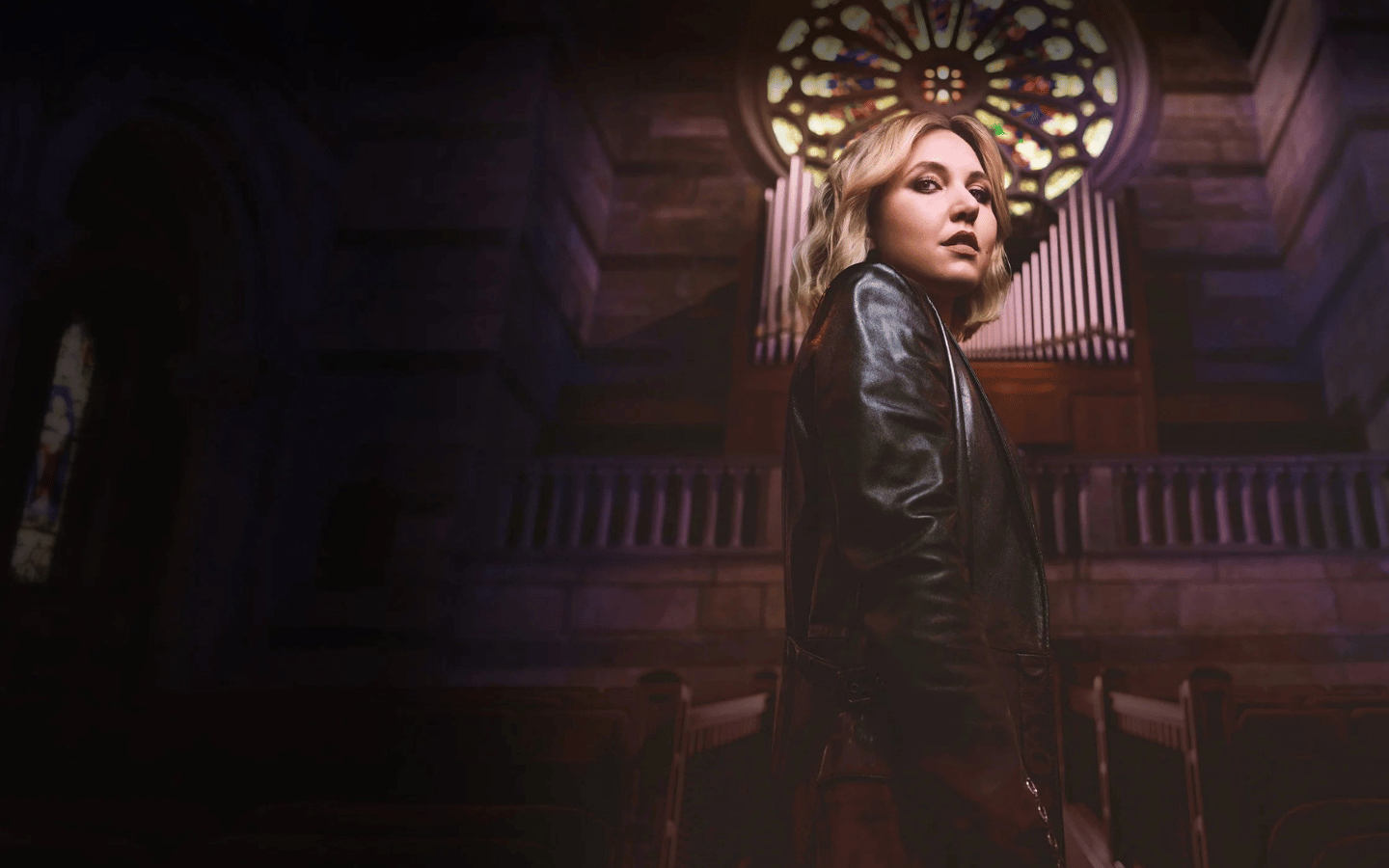
Tuesday evening, people all over the country gathered in their living rooms in front of the television. While many turned to the State of the Union Address—with heavy hearts and perhaps a stiff drink—I curled up with a blanket and opened Netflix on my TV. Instead of subjecting myself to what I knew would be an hour or more of blatant lies and unashamed gaslighting, I pressed play on Prodigal Daughter, Taylor Tomlinson’s new comedy special.
Tomlinson is a stand-up comedian who routinely discusses the religious trauma she experienced in her youth, as well as mental health, dating culture and navigating life as a millennial. While her jokes are often raunchy (a descriptor she proudly claims) and her vocabulary would fit in with the most foul-mouthed sailors, her social commentary around these issues is spot-on in a way that would make even the most seasoned preacher jealous.
Usually, she incorporates religious upbringing as isolated asides embedded in a couple of jokes within the set. In this new special, Tomlinson decides not to make Christianity one short bit in the show, but the entire focus of it. Partway through the set, she joked, “… it’s a lot of God stuff and a lot of gay stuff, and my agents are nervous.”
Going to Church
Prodigal Daughter was recorded in a church—a decision that was clearly intentional. The special opens with several shots of the outside of the gorgeous cathedral-esque church. The camera allows the viewer to experience entering the church—up the front stairs, past the LGBTQ+ pride flags, through the narthex, and into the sanctuary.
The camera then goes behind the scenes where Tomlinson is waiting. She braces herself with a breath, straightens her jacket, then starts walking toward the sanctuary while the pre-chorus of a notorious Abba song starts playing: “There’s not a soul out there. No one to hear my prayer.”
As she steps onto the stage to thunderous applause, the chorus blares, “Gimme, gimme, gimme a man after midnight. Won’t somebody help me chase the shadows away? Gimme, gimme, gimme a man after midnight. Take me through the darkness to the break of the day.” She then begins the hour-long show, which happens to be the length of most church services in the United States.
As she paced in front of the gorgeous organ, I couldn’t help but notice the litany that emerged: She told a story. The audience laughed. She asked a question. The audience responded. Back and forth the show went, like a service full of responsive readings and hymns.
But scattered throughout the jokes, she inserted vulnerable, contemplative observations about Christianity and her relationship with religion. “To be clear, I’m not an atheist,” she said, “I just don’t know what happens. Neither do you. Spoiler alert, nobody knows. I’ve never related to the certainty so many Christians feel…”
Her commentary on Christianity is more honest than what we hear from most pulpits on any given Sunday. Many of our sacred stories are weird, and she highlights this throughout the show.
Yet we’re too quick to forget that “weird” is not synonymous with “bad.” The weirdness means the stories have depth.
Tomlinson’s Sermon Text
She named the show Prodigal Daughter, partially because of her take on the parable of the Prodigal Son, which she feels does an injustice to the older brother: “If you ask a pastor about that story, they’ll tell you it’s about how you can go off and sin and lose your way spiritually, but you can always return to the Lord and he’ll forgive you. And if you ask me what that story is about, I will tell you that it is about how Jesus was an only child.”
But the special’s title is also a clapback to everyone who’s passive-aggressively told her, “I’m praying for you.” If you grew up in conservative evangelical spaces as I did, you know full well how offers for prayers are often judgment in disguise; goodness knows I had prayer used against me like that after I came out. Tomlinson makes it clear that she won’t let other folks’ “prayers” be weaponized against her humanity, and that is a beautiful, powerful thing.
Toward the end of her show, Tomlinson takes a more serious note that captures the frustration I’ve heard from people all over the country when it comes to how people pervert Christianity:
“Religion can either be used as a weapon or a tool. And to be clear, if you are using religion as a weapon to control, manipulate, scare people, to make yourself feel superior to everyone else, f*ck you. That’s not what it’s for. You are not using that correctly… Because if God does exist, he does not exist to make you feel better than other people. He exists to make you better for other people… Whatever makes you a better person for other people, that’s what you should be doing.”
Tomlinson’s gospel is exactly what Western Christianity needs to combat the toxicity of Christian Nationalism. We need to be able to look at our faith, laugh about the parts that are a little ridiculous (because some parts are, indeed, bizarre), and critically examine any harmful parts.
She is right; Jesus didn’t come for us to create superiority complexes. He came to show us how to love one another better. What other conclusion are we to draw from the Sermon on the Mount and the parables of the Good Samaritan, the Sheep and the Goats, or too many others to name?
Tomlinson ends the show by hilariously critiquing celebrities who use religion as an excuse to rebrand and regain popularity. It is the perfect conclusion to a comedy show that uses wit not only to critique shallow faith, but to call us to a better one if we indeed believe.
You may not agree with her vocabulary or “sermon illustrations.” Still, Tomlinson is one of the best preachers of our time—especially when it comes to challenging ourselves to take our faith seriously.
Taylor, you might not claim that title for yourself, and that’s okay. But from one queer preacher to another, well done. Keep at it.
- About the Author
- Latest Posts

A bivocational pastor, writer and spiritual director based in Williamsburg, Virginia, she currently works as a Spiritual Director at Reclamation Theology. Cawthon-Freels is the author of Reclamation: A Queer Pastor’s Guide to Finding Spiritual Growth in the Passages Used to Harm Us (Nurturing Faith Books), and a contributing correspondent at Good Faith Media.