

Some people grow up emotionally held, mirrored and known. Then there are those like me who grew up too fast because we had to become adults long before we ever had the chance to be a child.
Any type of neglect prevents growth. It creates gaps in emotional development, identity formation, the sense of being wanted, the sense of being seen by others rather than invisible, the experience of being mirrored, and a sense of connection in relationships.
You can’t “treat” something that never happened to begin with. Community can heal and hold these gaps and faith communities sit right in the middle of this tension.
When you grow up too fast, you don’t get to discover who you are. You learn who you need to be to survive.
For a long time, I thought the traits that defined me were my personality: the self‑containment, the hyper‑attunement, the steadiness, the ability to read a room before I ever entered it. I thought all that was “me.”
It wasn’t.
Those traits were survival adaptations, not identity. They were the scaffolding I built as a child who had to grow up too quickly—a child who learned to regulate alone, to anticipate others, to stay small, to stay steady, to stay out of the way.
When you grow up without much help, you build yourself from the outside in. You build a backbone first because you need structure before you can have freedom.
For years, that backbone was everything. It kept me upright and functioning.
It kept me from collapsing into the emotional worlds around me. It let me move through life with clarity and competence, even when I didn’t yet have a self to inhabit.
But something unexpected happens when your life finally becomes safe enough, stable enough, and honest enough to hold you. The scaffolding begins to fall away.
The traits that once kept you alive start to loosen their grip or suffocate you if you don’t focus on healing.
By working on dropping survival armor, the anxiety softens, the internalization cracks, and the hyper‑attunement dies.
And underneath all of that, something else begins to emerge…the real self.
Not the child who grew up too fast.
Not the survival self.
Not the role-based self.
Not the competent self.
Not the self that could hold everyone else.
The real self. The one that was buried under the trauma and growth.
When it comes to my experience, it feels like I spent my entire life facing outward—tracking, managing, anticipating—and now I’ve finally turned around the right way. I’m facing my own life instead of everyone else’s. I’m discovering what I want—not because I’m lost, but because I finally have a self to want things with.
This is the strange grace of growing up too fast: You get a second chance at becoming a person. You get to build the backbone first, and then, when the world is finally safe enough, you get to step into it.
Some of us don’t inherit a self; we build one. And when the building is done, we finally get to turn toward the life that was waiting for us.
- About the Author
- Latest Posts
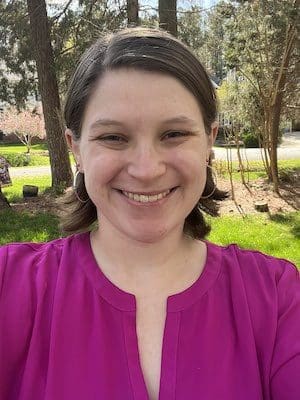
Chaplain Resident, an ordained Baptist minister, graduate of Campbell Divinity School, and a neurodivergent advocate. (Views expressed are those of Delaney and not intended to reflect those of her employer or other associates.)