
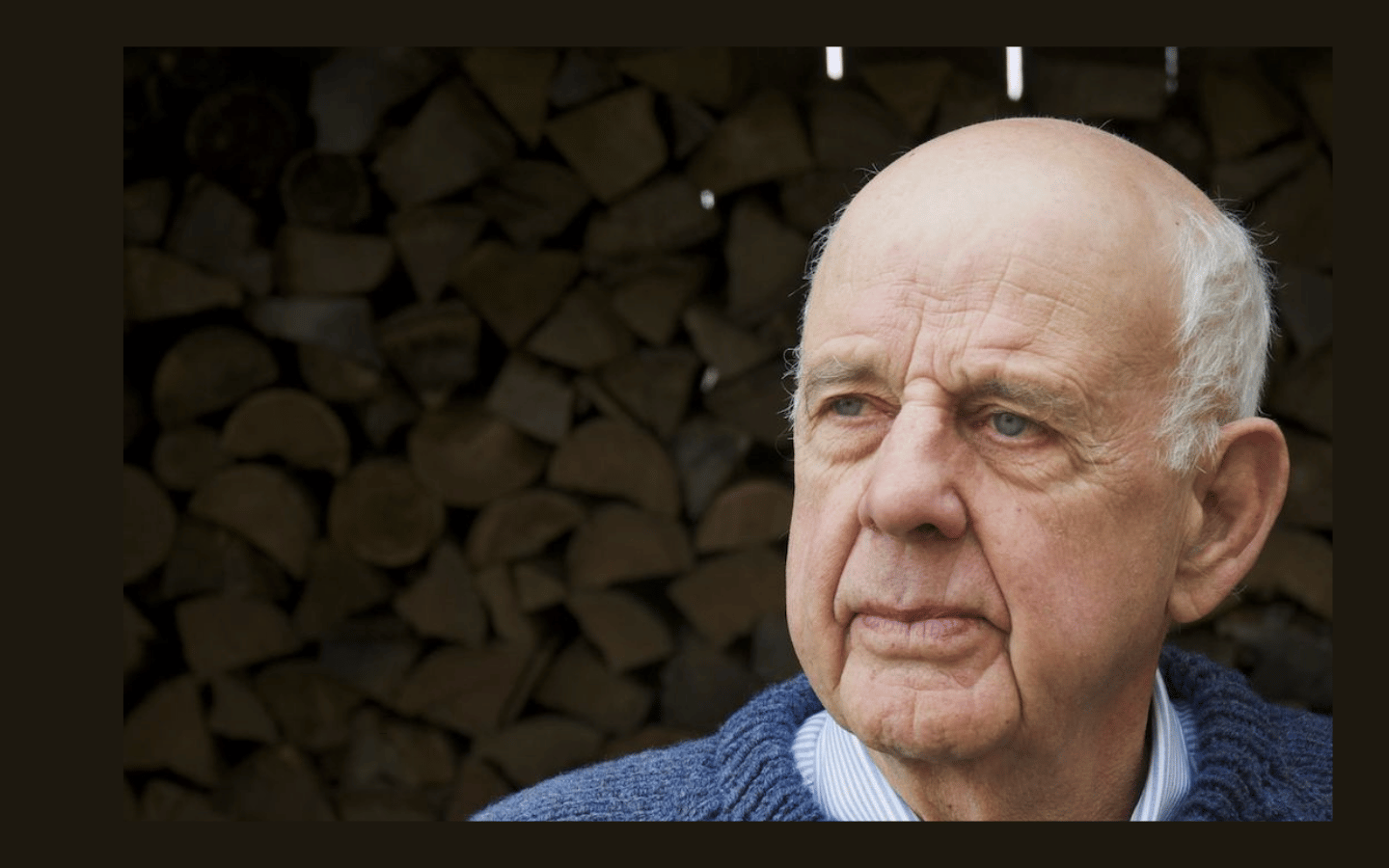
I first encountered Wendell Berry while wrestling with my own call to ministry. A friend loaned me his worn copy of Jayber Crow. I don’t remember exactly what I expected when I opened it. I certainly didn’t expect a 20th-century Kentucky novelist to have much to say about the unsettled questions I was carrying about God, vocation and the kind of life I wanted to live.
But I found Jayber Crow.
Faithful to Place
Jayber’s story is that of a young man who thinks he might be called to preach. He goes to study theology. He wrestles with Scripture. He wrestles with doubt. He wrestles, perhaps most of all, with the strange mystery of calling: How do we know what God is asking us to do with our one brief life?
I recognized something of myself in him.
I also recognized something I would come to understand about Wendell Berry: he was interested in the kinds of questions that cannot be answered quickly.
In Jayber Crow, one of Jayber’s professors tells him that he has been given questions to which he cannot be given answers; he will have to live them out, perhaps a little at a time. That line stayed with me. It still does.
Perhaps that is why Berry’s death feels personal to me, even though I never knew him.
I have now read and re-read my own worn copy of Jayber Crow, trying to live out those questions. I became a pastor. I learned, slowly, that ministry is less about having answers than about learning how to remain present to God and to people amid questions that cannot be resolved.
And I have come to believe that much of what Berry wrote about farming, community, place and faithful attention was also, in its own way, a theology of ministry. Through Jayber, Wendell Berry taught me that vocation is not always about doing something important.
Sometimes it is about becoming faithful to a particular place, a particular people, and the slow work God is doing there.
Wendell Berry chose to live in a place when nearly everyone else seemed intent on leaving. He farmed as agriculture became increasingly industrialized. He wrote poems when the culture told him that efficiency mattered more than beauty. He urged people to know their neighbors, tend their soil, eat locally, practice restraint and resist the seductions of endless growth.
And he had the audacity to suggest that this might not be foolishness at all.
Berry died this week at the age of 92, leaving behind one of the most remarkable bodies of American writing of the past century. He was a novelist, poet, essayist, farmer, Christian, pacifist and cultural critic. For more than half a century, he lived and farmed in Henry County, Kentucky, on land his family had known for generations. His work was rooted in a simple conviction: human beings flourish when we remember that we belong somewhere.
That conviction is why, for me, Wendell Berry has always sounded remarkably like the Hebrew prophets.
The prophets of Israel were not particularly good at being reasonable, either.
Amos was a shepherd and cultivator from Tekoa. Hosea spoke in the language of vineyards, grain and harvest. Isaiah imagined swords beaten into plowshares. Jeremiah warned of the consequences of abandoning the land and covenant. Again and again, the Hebrew Scriptures refuse to separate spirituality from the soil beneath our feet.
This is one of the great gifts of the Bible: it does not allow us to imagine that our relationship with God is merely an interior matter.
The prophets knew that what we do with the land reveals what we believe about God. They knew that an economy could become idolatrous. They knew that the exploitation of the poor was not merely a political problem but a theological one. They knew that a society could become so accustomed to injustice that the people who named it began to sound unreasonable.
The Mad Farmer
This is where Berry’s “Mad Farmer” enters the story.
In his poem “Manifesto: The Mad Farmer Liberation Front,” Berry creates a prophetic figure who tells us to do things that make little sense according to the prevailing wisdom.
Plant trees we will never live to harvest. Love the world. Work for nothing. Take what we have and be poor. Know our neighbors. Ask questions that have no answers. Put our faith in the slow work of the soil.
And then, near the end, comes the line that has become perhaps Berry’s most famous theological command:
Practice resurrection.
The Mad Farmer sounds crazy because the world around him has accepted a different definition of sanity. Our culture tells us that more is better. The Mad Farmer says enough is enough.
Our culture tells us that speed is efficiency. The farmer knows that some things cannot be hurried.
Our culture tells us that success means accumulation. The farmer asks what we are becoming while we accumulate.
Our culture tells us that the future belongs to those who can predict and control it. The farmer plants a tree whose shade he will never sit beneath.
Prophetic Wisdom
This is the sort of wisdom that the prophets offered. They were not primarily predictors of the future, but people who had learned to see the present differently.
They looked at a society everyone else called prosperous and saw injustice. They looked at religious devotion and saw hypocrisy. They looked at military strength and saw environmental exploitation. They looked at a people convinced that everything was fine and announced that everything was not fine.
And because they saw differently, they often sounded mad.
Perhaps that is part of what we need from prophets: not people who are simply louder than everyone else, but people whose lives are sufficiently rooted to recognize when the world has gone crazy.
Berry’s great prophetic word was not simply “go back to the farm.” He knew that most of us are not going to become farmers. His challenge was deeper. He wanted us to recover the disciplines of attention, affection, restraint, gratitude and responsibility that make human life possible.
In an essay published earlier this month, Berry returned to a word our culture has almost forgotten: enough. The problem, he argued, is that we have lost any meaningful concept of limits. We are taught that having some means needing more, and that needing more is simply common sense. Agrarian wisdom, by contrast, begins by asking how much is enough.
That sounds suspiciously like biblical wisdom.
The Sabbath itself is a kind of holy refusal to live without limits. The sabbatical year and Jubilee insist that land is not ultimately ours to possess. The manna in the wilderness teaches Israel to receive enough for the day rather than hoard enough for every possible tomorrow. The prophets repeatedly remind God’s people that the earth is not simply raw material for human consumption.
The Bible’s agrarian imagination is not nostalgic. It is theological.
The land belongs to God.
We belong to one another.
And neither the land nor our neighbors exist merely to serve our appetites.
Perhaps that is why Berry’s death feels like the loss of a prophet.
He was not perfect, and we should resist turning him into a saint. His work sometimes romanticized rural life, and his critiques of modernity could be maddeningly absolute. But prophets are rarely convenient people. Their vocation is not to make us comfortable, but attentive.
Berry spent his life reminding us that the things most essential to human flourishing are often the things our culture teaches us to overlook: soil, marriage, friendship, place, work, food, memory, community, beauty, limits and love.
And resurrection.
That final word is important.
The Mad Farmer does not tell us merely to retreat from the world. He tells us to practice resurrection. To plant what we will not live to see mature. To invest in a future we cannot control. To believe that the small acts of faithfulness we undertake today may become the soil in which someone else’s life flourishes tomorrow.
That is not foolishness, but faith.
The prophets knew it. The farmers know it. And Wendell Berry spent a lifetime trying to teach the rest of us.
So perhaps the best way to remember him is not to build a monument to Wendell Berry.
Perhaps we should heed the words of the mad farmer:
As soon as the generals and the politicos
can predict the motions of your mind,
lose it. Leave it as a sign
to mark the false trail, the way
you didn’t go. Be like the fox
who makes more tracks than necessary,
some in the wrong direction.
Practice resurrection.
I still have a worn copy of Jayber Crow sitting on my shelf. Its pages have become my own kind of field, marked by the places where I have returned again and again.
I suppose that is one way Wendell Berry practiced resurrection: he taught us to return—to the land, to our neighbors, to our questions, to the ordinary places where God is quietly making all things new.
- About the Author
- Latest Posts
Tyler Tankersley is Senior Pastor at Ardmore Baptist Church in Winston-Salem, North Carolina.