
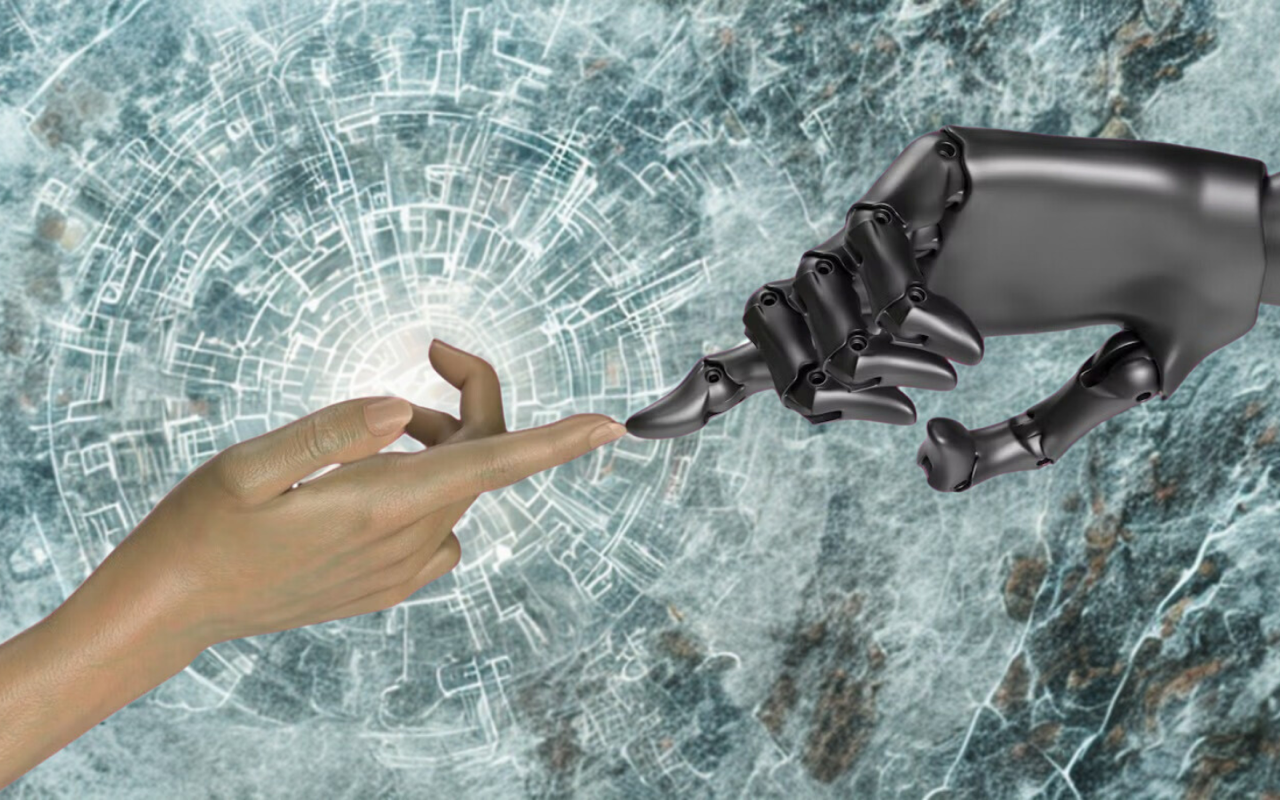
Artificial Intelligence (AI) is the new god on the block. AI is treated as a deity or ultimate authority with reverence for its divine-like, omniscient capabilities.
It is described as “the way of the future” with users claiming it has the miraculous power to cure diseases, offer immortality, increase wealth, and solve all our problems. ChatGPT, an AI-powered chatbot, even has a quicker response time than all the other gods.
No need to turn to a book. Just ask it a question and you’ll have your answer. Acting as a kind of cognitive partner, AI will even aid your thought processes and double as a sounding board.
Never mind the fact that it trained on web scrapes of books, articles, and websites, much of which is copyrighted material. Forget that AI learned conversational and humanlike language in part from Reddit discussion boards. Also, a 2025 MIT study titled “Your Brain on ChatGPT” found ChatGPT users could experience lower brain engagement and a decreased ability to remember content as they may become too accustomed to AI doing the thinking for them.
This technology offers the illusion of advancement while causing human cognitive skills to atrophy. Maybe this will be considered heresy, but AI operates by analyzing existing human-generated data rather than possessing a self-sustained, creative consciousness though imitating high intelligence and immediate responses. Ironically, continued engagement can reduce independent problem-solving abilities.
Its own televangelist, a techno-spiritual middleman, instead of the television screen, just touch your phone’s screen for answers. This faith requires only that you bow your head for hours to demonstrate your belief.
A portable, pocket god who is physically always with you, agrees with you, and knows exactly what you need, it is techno-religion and an emerging belief system that treats advanced technology as salvific, delivering us to a “post-human” utopia. This is known as transhumanism.
But like the other gods, AI allows suffering. In fact, the software requires massive amounts of electricity and water for its cooling systems, which has both environmental and communal impact.
“AI is neither artificial nor intelligent,” Kate Crawford declared in Atlas of AI: Power, Politics, and the Planetary Costs of Artificial Intelligence. “[There is an] enormous environmental footprint—the minerals, the energy, the water—that drives AI.”
She continued, “This is the opposite of artificiality. It’s profound materiality.”
AI is not just code, but a material and political system built on labor and power. The hidden costs include colonial-style extraction, resource depletion, worker exploitation in the Global South, and increased inequality. Digital colonialism exploits the land and its people under the guise of technological progress and optimization.
But AI can’t survive without humans. In fact, it requires ongoing human support known as “ghost work.”
“The great paradox of automation is that the desire to eliminate human labor always generates new tasks for humans,” Mary L. Gray and Siddharth Suri point out in Ghost Work: How to Stop Silicon Valley from Building a New Global Underclass – An Urgent Investigation into the Invisible Human Labor Powering AI and the Digital Economy. In a racialized society, the progress just depends on which humans will do the laboring.
Behind the shiny curtain, the AI boom also presents another case of environmental racism. Because data centers are increasingly located in low-income neighborhoods and marginalized communities, which disproportionately carry the burden of increased energy bills, water consumption, and air pollution.
Yet, for the sake of efficiency and validation, persons will allow it. In the name of AI, users will justify it.
While people are increasingly looking to AI for direction, it did not fall from the sky and into our hands. Like traditional religions, AI requires lots of money and people for it to run smoothly.
And it’s running like all the other systems in America: on racism. Evidence from researchers, developers, and reports indicates that artificial intelligence systems can and often do perpetuate, amplify, and automate racialized discrimination as “neutral” information. Rather than being inherently racist, AI reflects the data-driven biases present in the information it is trained on.
AI even has algorithmic bias, the spirit of which produces discriminatory outcomes, usually reflective of existing prejudices. These generated results most often harm marginalized groups.
It could be argued then that AI is an extension of white-body supremacy with embedded Eurocentric norms. In fact, a recent study titled “AI Generates Covertly Racist Decisions About People Based on Their Dialect” found instances of covert racism.
“Large language model developers spend significant effort fine-tuning their models to limit racist, sexist, and other problematic stereotypes,” Katharine Miller wrote. “But in a new study, Stanford researchers find that these models still surface extreme racist stereotypes dating from the pre-Civil Rights era.”
So, who is this generated intelligence that is anything but artificial repeating after then? To be clear, this is not a question for ChatGPT but for the reader.
Because AI is, in part, a mouthpiece for white supremacist talking points, which insert themselves whether we want to hear them or not. This is no different than the other handmade gods, which is why I have nothing to say to it.
- About the Author
- Latest Posts

Director of The Raceless Gospel Initiative, an associate editor, host of the Good Faith Media podcast, “The Raceless Gospel” and author of Take Me to the Water: The Raceless Gospel as Baptismal Pedagogy for a Desegregated Church.