
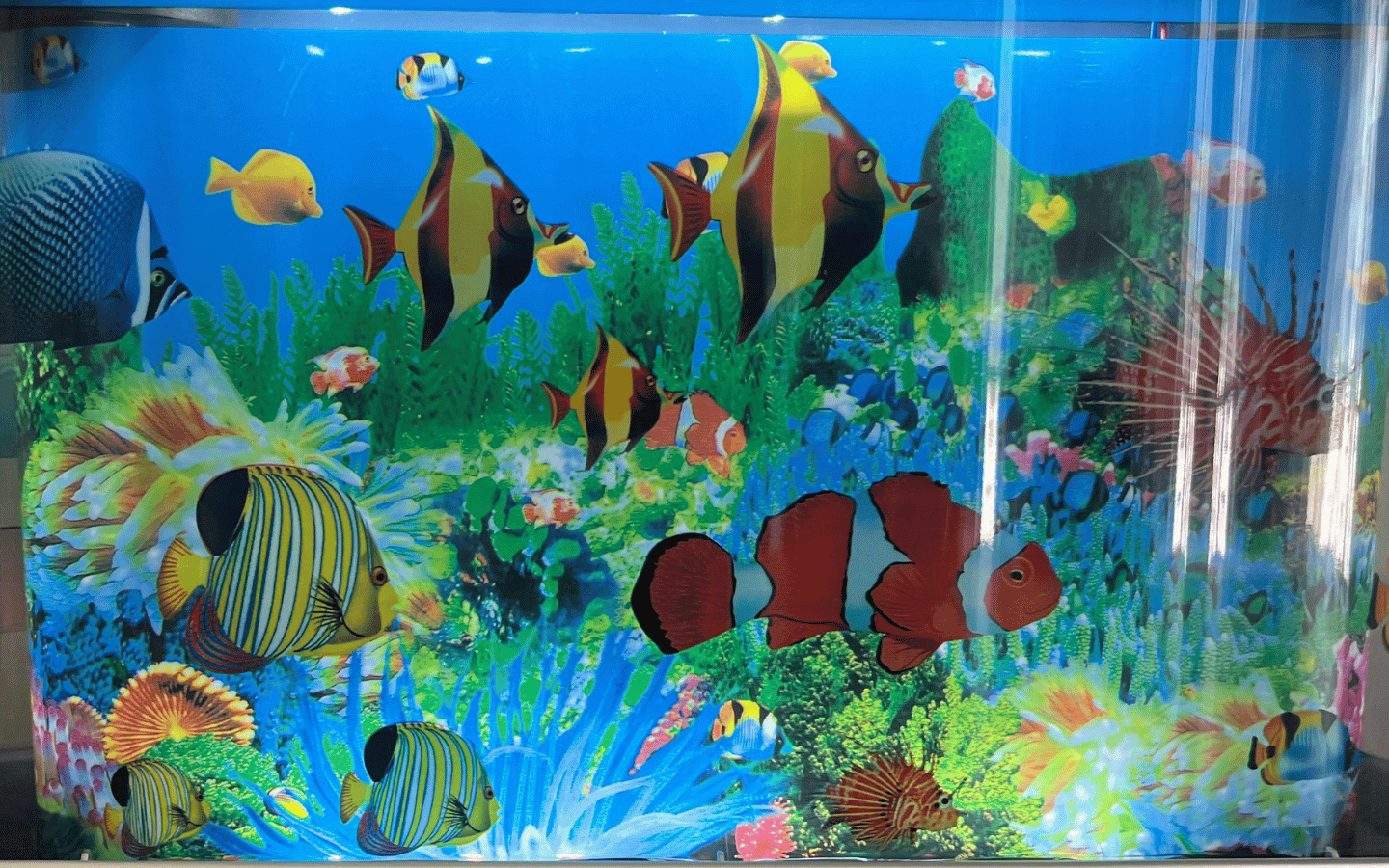
I bought a light‑up fish tank lamp because it was cheap, quiet and uncomplicated. It simply contains plastic fish drifting in a slow loop of color.
But that’s exactly why it works. It doesn’t need anything from me, but dang it makes me happy.
It doesn’t interrupt the room or demand attention. It just sits there, steady and predictable, giving a small return without requiring anything of me beyond the monetary cost.
Somewhere along the way, I realized that this is what real joy looks like for me now: low‑demand, low‑noise, and structurally compatible with the life I’m living.
I kept betta fish for years. They were fun, but they were also work: water changes, feeding the fish, and monitoring conditions.
At some point, though, I realized I didn’t want my living space to revolve around keeping something alive. I wanted something that could exist beside me without depending on me. The light-up fish tank lamp fits this perfectly.
For a long time, I assumed joy had to be loud to count as joy. Big gatherings, dramatic moments, the kind of experiences people talk about afterward. Joy was something you chased, something you earned, something that arrived with a dopamine hit.
Quiet things didn’t register. Simple things felt like placeholders for something more important. I didn’t have a category for joy that didn’t announce itself.
So the fact that a lamp can sit in my space without disrupting anything—and still make me consistently happy—tells me something has shifted. Not in a dramatic way, but in a practical one. I’m paying attention to what actually works for me, not what’s supposed to be meaningful.
What the lamp gives me isn’t excitement. It’s margin.
It’s a small, steady presence that doesn’t take anything out of me. It’s background-level joy; the kind that doesn’t need to be named or celebrated to be real.
It’s woven into the room instead of taking it over. It’s the kind of joy that fits a life built on clarity and steadiness rather than intensity.
There’s something refreshing about an object that doesn’t pretend to be more than it is. The lamp doesn’t try to elevate the space.
It doesn’t try to be symbolic. It doesn’t try to make a statement. It just does its one job without complication.
Maybe that’s why it feels like joy— not because it’s impressive, but because it’s uncomplicated.
There’s a kind of adulthood that emerges when you stop performing for the room and start choosing what actually fits your internal pace. I used to think joy had to be memorable to matter. But memorable joy is often expensive—in energy, in recovery time, in the way it pulls you out of your own rhythm.
The lamp doesn’t do any of that. It’s joy that doesn’t destabilize anything. Honestly, it feels like the best joy there is because it doesn’t make me exhausted.
That’s a new category for me.
It’s also a new category of permission. I didn’t buy the lamp because it was meaningful. I bought it because I liked it.
That’s it. No deeper justification. No external purpose. No audience. Just a quiet decision that didn’t need to be defended.
This lamp doesn’t solve anything. It doesn’t signal anything. It just exists in my space because I wanted it there.
That might be the most important part.
The older I get, the more I realize that joy isn’t something I have to hunt down. It’s something I have to stop overlooking. It shows up in the small, steady things that don’t pull me out of myself.
It shows up in objects that don’t require translation. It shows up in environments that don’t need to be managed. It shows up in the quiet, unremarkable moments that don’t need to be turned into anything else.
The light-up fish tank lamp isn’t profound. But the life that allows it to exist without disruption, that’s the real shift. That’s the part that feels like joy.
Real joy, it turns out, isn’t the thing that lights up the room. It’s what lets me stay steady inside it.
- About the Author
- Latest Posts

Baptist minister, graduate of Campbell Divinity School, and a neurodivergent advocate.