
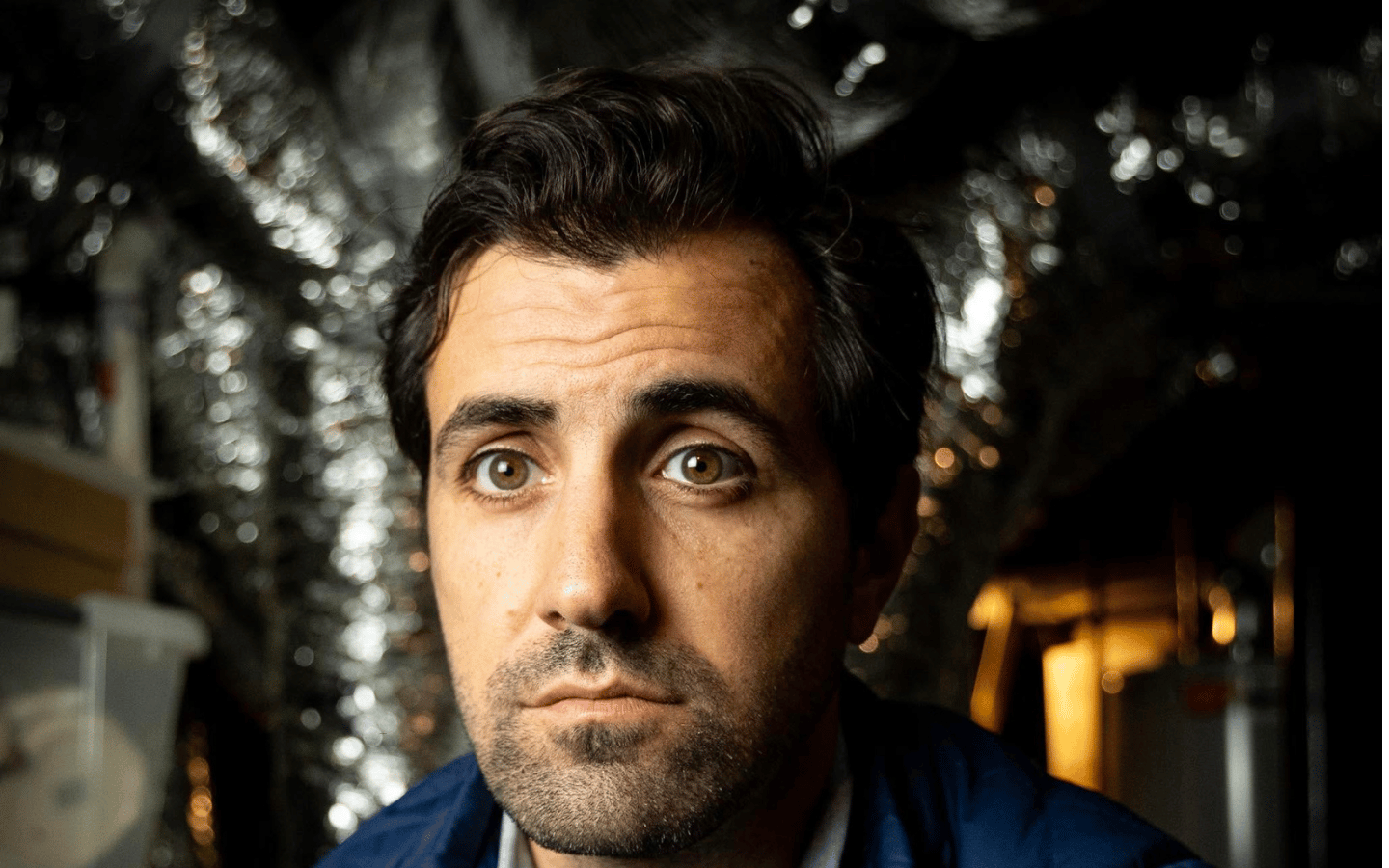
Shortly after Trump 2.0 began, I found myself listening to a lot of Rage Against the Machine. No disrespect intended toward the anger outlet of my college days, but it soon became clear I needed something more to speak directly to my soul in these unsettling times. I found that in modern resistance folk, especially through the music of Billy Simons Jr.
Simons is a folk Americana singer-songwriter, even though his music hasn’t always fit neatly into that box. But for the past two years, he’s created a compilation that captures the heartbreak of a nation sinking ever deeper into a Christian nationalist version of authoritarianism, as strangers, neighbors, and even family become increasingly polarized.
With songs like “Jesus Went to Heaven,” “Our Father,” and “The Apple,” plus an album titled The Gospel of Weapons, Simons’ lyrics often square up directly in opposition to Christian nationalism. He also incorporates biblical imagery and themes of justice, illustrating how a true sense of “love your neighbor” looks very different from Trump’s vision for America—or the religion of those who support it.
Often written in the key of sarcasm, with a heavy dose of wit and an occasional bit of whimsy, Simons’ songs carry a palpable sense of grief and in his words, “a general disappointment in humanity.”
I recently sat down with Simons and asked what inspired him to make this somewhat recent shift into resistance music. He shared that during Trump’s first term, his grief took the form of writing and illustrating his book, Earth Is Not a Planet. The book is a Shel Silverstein-like chronicle of life and times during the COVID pandemic, which served as partial inspiration for some of the music he’s written since.
But the primary catalyst for this shift comes down to a core human reality I think many of us are wrestling with:
How do we make meaning not only of the absurdities and atrocities we are witnessing in this second Trump term, but also how it is that so many people voted for this? And even more perplexing: “…people that [we] know and love.”
Simons admits several of his early songs were written with family members in mind. So, he thought, “I’m either going to call them on the phone and yell at them or I can just do this…And then I realized the more that I said, the more I had to say.”
When his song “Jesus Went to Heaven” gained attention on TikTok, it engendered a lot of talk among his family. “Which is the point, right?” he said. “If it’s not ruffling feathers and causing conversation, then is it accomplishing anything?”
At the same time, he began receiving messages from people saying his music was helping them through these disorienting times. He decided, “If it’s providing another purpose outside of my own therapy, then let’s keep it up.”
Many of those people fall into one of two camps: Christians who believe he is writing “Christian music” from a “Christian” perspective or non-Christians who believe he is writing “anti-Christian” music from a somewhat “anti-Christian” perspective.
Simons’ response? “It’s neither of those things.”
Raised Greek Orthodox in Massachusetts and moving to Georgia in recent years, Simons’ take on Christianity might be a little surprising to his fans. He described his childhood religious formation as “liturgical…a cultural thing” that instilled an appreciation for the literature and storytelling of the Bible. Whereas, in his current Anglican church and southern cultural context, the focus is more about “your relationship with God.”
While he acknowledges his admiration for “really bright people” who are steadfast in their personal faith and find great peace and joy in it, he admits, “I have a hard time getting there. And I’m trying…I’m searching and questioning more than living in it.”
Much of his recent songwriting is simply his own journey to understand how seemingly good people can use their “faith” as a weapon “to tear apart people that are just different than them; that make them uncomfortable.”
Take, for instance, the chorus of “Jesus Went to Heaven”:
Jesus went to heaven with an AK-47
Walked right up and kicked down the pearly doors
Then he preached about the ways
We should ostracize the gays
And he went and blew away the immigrants and poors
While those lyrics hit a nerve with a lot of people, Simons explains: “This is not about good-hearted Christian people. This isn’t mocking Jesus.”
But it is a satirical assessment of the Christian nationalism that is driving so much of the national narrative on any number of political issues, and tearing at the fibers of our collective humanity. Simons is happy if his songs appeal to people of faith and people of no faith and perhaps especially, people who (like him) find themselves somewhere in between.
Surprisingly, Simons had never even heard the term “Christian nationalism” prior to 2024. But songs like “Jesus Went to Heaven” point to a core problem with this brand of religiosity: Christian nationalism is one of the strongest indicators of opposition to stricter gun laws.
A full-time stay-at-home dad who often writes between school drop-offs and soccer practice, Simons weaves the theme of gun violence into several of his songs. But he’s also concerned about what his kids will hear when they listen to his music. This sometimes causes him to adjust his approach to such a difficult subject, adding a little more absurdity or silliness than one might expect.
Whatever silly or sarcastic lines might find their way into his music, perhaps his most convicting song on this subject is “He Was on Your Side”:
Well the shooter wore a red hat in a photo that I seen
But he wrote a check to Bernie back in 2017
And his uncle had an arsenal of automatic guns
But his sister held a sign up at a march in Washington
Oh-ooo-oh he was a bad guy
Oh-ooo-oh he was on your side
Here, Simons reminds us that perhaps Christian nationalism isn’t the worst problem we face. Perhaps it’s forgetting our own humanity when tragedy strikes, instead jumping immediately to whatever side of these divided states makes us feel morally superior to our designated enemies. And perhaps that’s why music is both a critical and mystical avenue for meaning-making in a world that often makes no sense at all.
You can listen to Simons anywhere you stream music and if you’re in Colorado, catch his live show in Denver on July 31.
- About the Author
- Latest Posts

Dr. Rebecca M. David Hensley holds a PhD in religious studies, with an emphasis in theological and social ethics. She is a member of the adjunct faculty for Iliff School of Theology and an ordained Deacon in the United Methodist Church.