
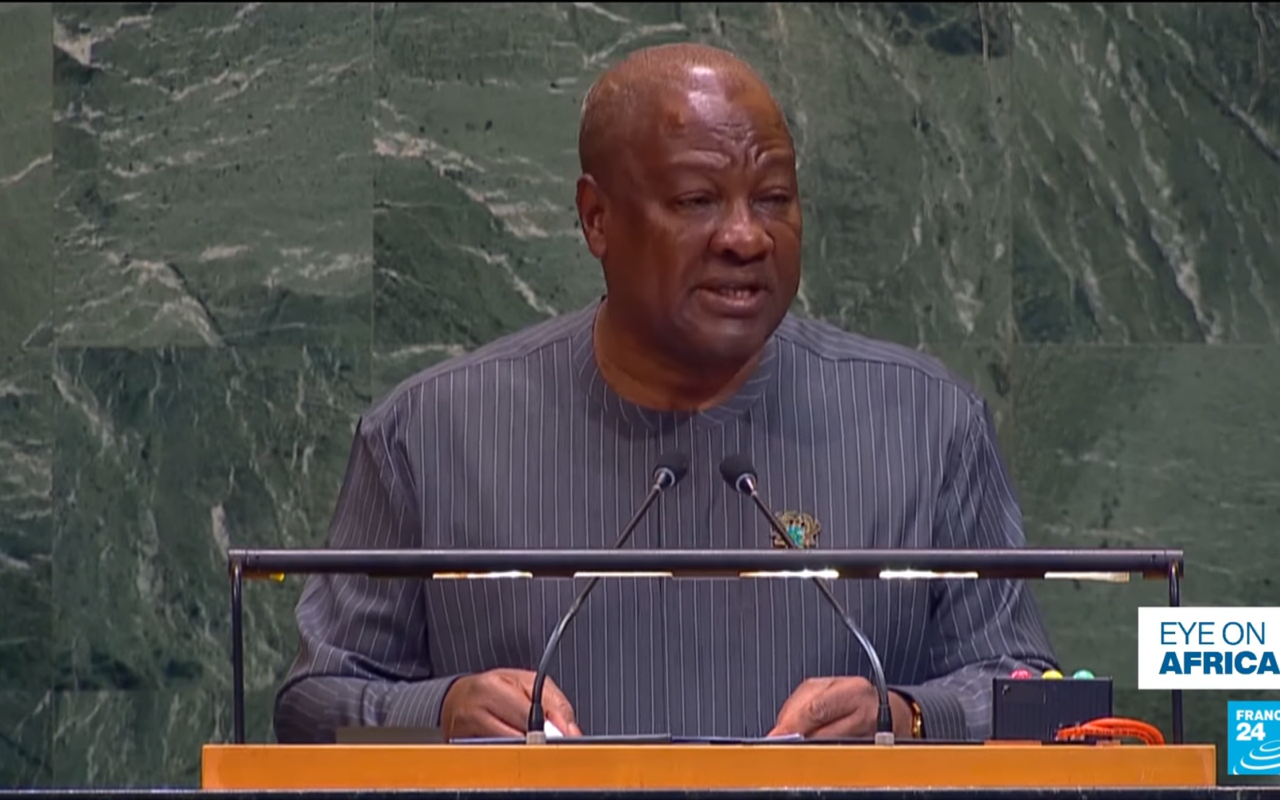
In March, the United States voted against a United Nations General Assembly resolution identifying the European Transatlantic Slave Trade as the “gravest crime against humanity.” Calls for reparations, including the return of stolen artwork, were described as “a concrete step towards remedying historical wrongs.”
The resolution was proposed by Ghana’s president, John Dramani Mahama, and backed by the African Union (AU) and the Caribbean Community (Caricom). “Let it be recorded that when history beckoned, we did what was right for the memory of millions who suffered the indignity of slavery,” Mahama said. “The adoption of this resolution serves as a safeguard against forgetting.”
“So many of the intersecting global challenges we now face are rooted in legacies of enslavement and empire: from geopolitical instability to racism, inequality, underdevelopment and climate breakdown,” the petition read. “To truly confront these issues, we must acknowledge where they come from.” The historic resolution was adopted [Resolution A/80/L.48] and emphasizes the incomparable scale and brutality as well as the systemic consequences of the chattel enslavement of Africans and African Americans.
Joined with Israel and Argentina against 123 nations that voted in favor, the United States, which self-identifies as “a city upon a hill” and “a beacon of democracy,” which positions itself as the model of freedom, got its start as a trafficker of human beings, namely chattel slavery and subsequent forms of exploitation thereafter. Consequently, the vote denies its own history.
Chattel slavery was a 16th to 19th century maritime system wherein millions of Africans were kidnapped, transported (with some persons being murdered in transit for insurance purposes), sexually violated, sold, held as personal property, and brutally murdered on plantations—soul and body—for hundreds of years. Africans, who were held as human appliances, suffered dehumanization, sexual abuse and violence, physical abuse and violence, backbreaking labor, malnutrition, family separation, and psychological trauma—for hundreds of years.
Africans, who were called “heathen,” “barbaric,” “uncivilized” and said to be in dire need of the salvation of Jesus Christ, were placed in chains, iron muzzles, masks, gags, pillories and stocks. Africans, who were forcibly brought to this country, were dismembered, cooked and eaten, and lynched from trees to maintain the racialized order.
Africans in America were “without sanctuary.”
“They seemed to justify their consciences with the doctrine that God created Africans to be slaves,” Linda Brent wrote in Incidents in the Life of a Slave Girl, published in 1861—despite anti- literacy laws, which first began to appear following the Stono Rebellion in 1739. Still, Brent records this:
Various were the punishments resorted to. A favorite one was to tie a rope round a man’s body and suspend him from the ground. A fire was kindled under him, from which was suspended a piece of fat pork. As this cooked, the scalding drops of fat continually fell on the bare flesh.
Africans who were enslaved wanted to turn the page on the brutal system, as explained by an unnamed woman of North Carolina, who is quoted on the book’s title page:
Northerners know nothing at all about Slavery. They think it is perpetual bondage only. They have no conception of the depth of degradation involved in that word, Slavery; if they had, they would never cease their efforts until so horrible a system was overthrown.
Instead, African Americans were deceptively diagnosed with “drapetomania,” considered mentally ill for attempting to escape enslavement. The medical community was in on it and experimented on African Americans without their consent and often without anesthesia. Still, today, the African American community feels the effects.
European Americans would later create ads and storylines, make jokes, movies, cartoons, dolls, keepsakes, and mementos. These racist objects served as perpetual mockery, imagining African Americans as other than human, nonbeing even. It has been an ongoing social death named and explained by Orlando Patterson.
The United States’ refusal to affirm the obvious and to raise its hand in acknowledgment of its hand in the “gravest crime against humanity” should make all Americans remove their hands from their hearts in allegiance—though I stopped pledging loyalty to this country at sixteen years old. It should be treated as cause to stop singing “God Bless America” and “My Country Tis’ of Thee.”
Because you’ve got to “call a thing a thing,” my elders advised. Because America as the “promised land” is a narcissistic narrative and I won’t perpetuate a lie.
Instead, a radical reversal of this narrative is needed and we have an accurate accounting of the hands willing to change it. Duly noted.
- About the Author
- Latest Posts

Director of The Raceless Gospel Initiative, an associate editor, host of the Good Faith Media podcast, “The Raceless Gospel” and author of Take Me to the Water: The Raceless Gospel as Baptismal Pedagogy for a Desegregated Church.