
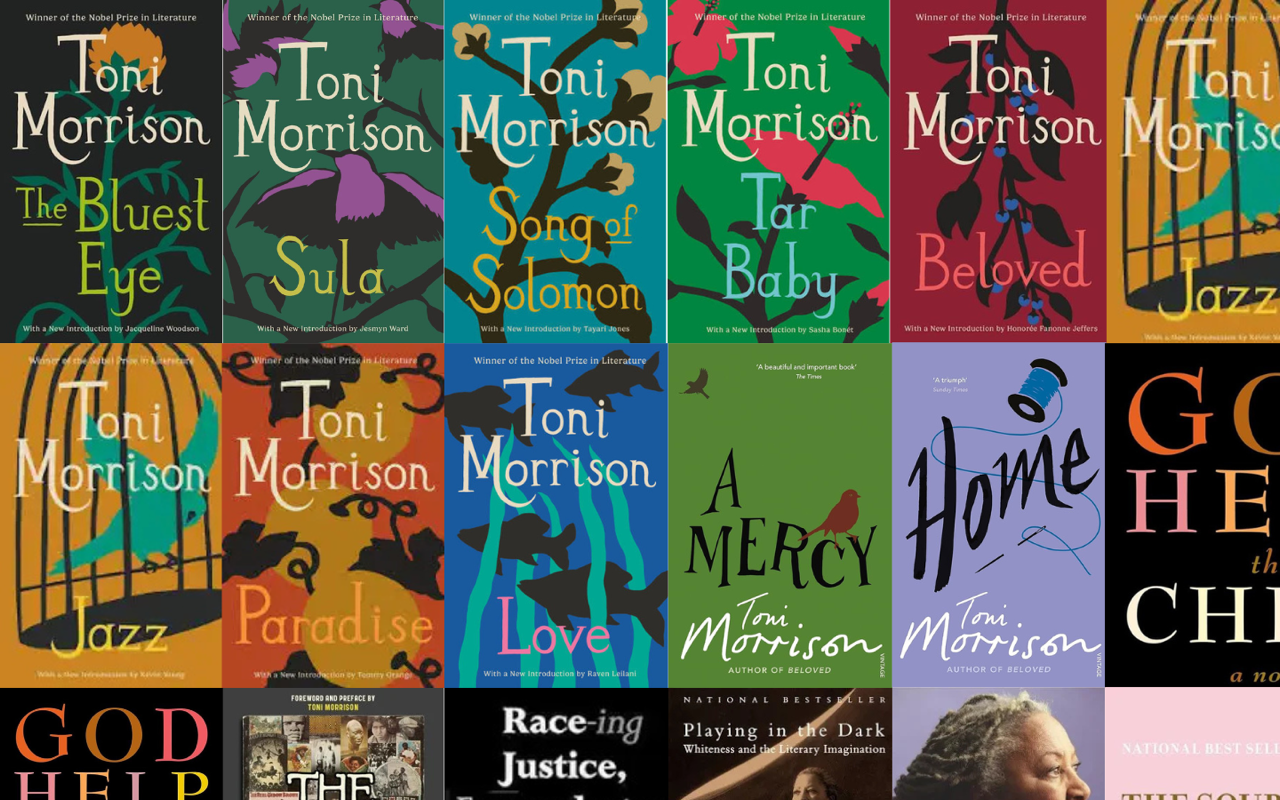
If we’ve ever needed the writings of Toni Morrison, it is now.
With political turbulence that threatens to bring down the right and left wings of American democracy, its citizens can only prepare for the crash, the fallout of this young empire. True to its capitalist spirit, the unprecedented event will somehow be repackaged as a scheduled bonfire, which is why we need truthtellers.
Toni Morrison believed truth-tellers are essential to American democracy because they disturb the silence of oppression, preserve memory against erasure, and restore humanity in a nation frequently blinded by racial myths and greed. As a novelist, essayist, and educator, Morrison positioned truth-telling as a radical, artistic and civic act necessary to prevent the “coma” of complacency and to ensure that freedom is actively practiced, not just passively enjoyed.
Truth-tellers are indispensable to a functioning democracy and their work is a necessary and often troubling disruption. She believed in times of crisis and social oppression, literature and truth-telling are vital to healing and maintaining human dignity.
“She asked her students to meet the writing where it lived, without shortcuts, without softening,” her eldest son, Ford Morrison, wrote in a foreword to Language as Liberation: Reflections on the American Canon. This time will be no different. We will have to meet this moment in history as it is—not how we wish it could be.
The Voting Rights Act of 1965 has been hollowed out by a recent Supreme Court decision in Louisiana v. Callais. The Supreme Court’s 6-3 conservative majority gutted Section 2, severely limiting the ability to challenge racially gerrymandered voting maps.
The decision necessitates proof of intentional racial discrimination rather than just discriminatory results, weakening protections for minority voting power ahead of the 2026 midterms. It also effectively makes it harder for minoritized voters to challenge district lines that dilute their voting power.
This decision has been largely criticized as upholding white-body supremacy, a system privileging “white” political power by prioritizing intent over outcome, mimicking historic voter suppression. Toni Morrison described this phenomenon as a “collapse of dignity,” driven by the desperate desire to maintain “white privilege.”
Responding to the African, or in Morrison’s words, “Africanistic” presence in the United States is a uniquely American problem. While teaching at Princeton, she outlined the work in a course titled “Studies in American Africanism,” which included:
“An examination of the ways in which the American literary tradition has responded to an Africanistic presence in the United States. Concentrating on authors who have imagined, explored, represented, and employed the narrative, the personae, and the idiom of Africans and their descendants, the course will analyze fictional strategies designed to accommodate Africanism; the imaginative uses to which African- Americans are put; the manner in which these engagements clarify the idea of an American ‘self.’”
Tested time and time again to demonstrate that the country is fair, just, and equitable, its leaders continue to fail us. And yet, it is also proof the citizenry doesn’t know itself or what the country is really made of.
Because there has never been a national and comprehensive truth and reconciliation study. Instead, they are localized and issue-specific, like the 1980 commission on Japanese internment.
The congressional Commission on Wartime Relocation and Internment of Civilians resulted in the 1983 report titled Personal Justice Denied. The report concluded the internment was not justified by military necessity but was caused, in part, by racism.
The findings prompted official apologies and redress payments of $20,000 to survivors. However, African Americans have never received compensation for the generational economic, social and spiritual harm of chattel slavery and systemic discrimination. Frankly, I don’t think the country ever intended to do so.
Consequently, this work will take more than a year, but there is no better time to begin. This year also marks a year-long celebration of the Lorain, Ohio native, a resident truth-teller.
“Beloved: Ohio Celebrates Toni Morrison” began on her birthday, February 26, 2026, and will conclude on February 18, 2027. The project is led by Literary Cleveland and Ohio Humanities and honors Morrison as the first African American woman to win the Nobel Prize in Literature.
The Nobel Prize-winner died at the age of 88 on August 5, 2019. Still, Morrison garners attention for her work and witness as an unapologetic teller of African American stories, a griot whose disinterest in the “white gaze” only solidified her position as legendary.
Instead, she invites readers to look to the community she gathered on each page, which ultimately beckons us to look inward and at our many selves. Morrison passes down faith in our shared humanity through literary imagination, faith, folklore and womanism, though she would not describe her novels with any “ism.”
And yet she is known for the truths she advocated for concerning our bodies and how we come to know them, for the healing balm so desperately needed, and for her thick application of it on African American women and children, especially. All of this is womanist in treatment.
“When I began, there was just one thing that I wanted to write about, which was the true devastation of racism on the most vulnerable, the most helpless unit in the society—a black female and a child,” Morrison said. Unfortunately, this remains true, which is why we still need to hear from her.
- About the Author
- Latest Posts
Director of The Raceless Gospel Initiative, an associate editor, host of the Good Faith Media podcast, “The Raceless Gospel” and author of Take Me to the Water: The Raceless Gospel as Baptismal Pedagogy for a Desegregated Church.