
“Power/ Power, Lord, Power/ Power, Lord/ Holy Ghost, power/ Power, Lord, Holy Ghost, power/ Power, Lord.” This was the call-and-response agreement I grew up with, that the only power a believer should want was that offered by the Holy Ghost.
And you had to ask for it, wait or tarry for it. It was not a given and it was the power of the Holy Ghost solely. It was a spiritual power and later soul power.
From Holy Ghost power to power concentrated in the hands of a wealthy few, from the power of Pentecost to political power, the current movement of the church in North America remains up in the air. Traditionally people-powered with the women holding the purse strings, the inspiration is not spiritual but neo-colonial domination for the practitioners of a “slaveholding religion.” Named by Frederick Douglass, he distinguished the true, liberating faith of Christianity from the hypocritical, oppressive version practiced by slaveholders to enforce obedience.
White Christian nationalism shares deep historical roots with the “slave-holding religion” of the antebellum South, using similar theological frameworks to justify a specific racialized and social hierarchy. Rather than offer genuine spirituality or “save souls,” the goal is to maintain political, economic and physical control over subjugated people.
A co-opted Christianity, discipleship dues have always been costly. According to the testimony of the Gospel writers, when push came to shove came to Calvary, the first disciples refused to follow in Jesus’s footsteps. They were afraid, just as Pontius Pilate was, of the potential for mob violence.
These days, they are the “Moral Majority.” Established in the 1970s, the movement marked a significant shift where conservative Christians actively mobilized to gain political power, aligning closely with the Republican Party to influence laws on social and moral issues.
Some theologians argue Christians should actively occupy government leadership to reform society, while others warn that pursuing political power inherently corrupts the church’s spiritual mission, citing Jesus’s statement that his “kingdom is not of this world.” Perhaps the Jesus route is viewed as the long way around to the point they are trying to make about their own ability to save society.
Yet, Matthew recorded the voice of Jesus saying, “If any wish to come after me, let them deny themselves and take up their cross and follow me. … For what will it profit them if they gain the whole world but forfeit their life? Or what will they give in return for their life?” (Matthew 16:24, 26).
This question about the soul’s exchange, the valuation of life and how it is lived, is a central question for human being and belonging. What will we take in exchange for power over our own lives?
Imagine my surprise when I learned about White Power. White Power is an ideology tied directly to white-body supremacy, neo-Nazism, and racialized separation. It is maintained by the hyper-surveillance of the “white gaze” and domestic terrorism.
How do African Americans survive it? The African American community’s response was Black Power, a political slogan and movement that emerged in the mid-1960s emphasizing cultural pride, self-reliance, and self-determination. Self-defense was a tenet of the Black Panther Party, namely against police brutality.
The fundamental difference between Black Power and White Power lies in their historical context, core objectives, and relation to systemic power. Black Power emerged as a civil rights and liberation movement focused on self-determination and defense against oppression, whereas White Power is an ideology rooted in white-body supremacy and the subjugation of all other people deemed non-white.
In fact, the Ku Klux Klan billed itself as a defender of American Protestantism. The hate group adopted and modified Christian symbols, such as the burning cross, twisting them into tools of terror, intimidation, and white nationalism. They even simulated baptism during the group’s initiation ceremonies.
Clearly, Ku Klux Klan members did not take the baptismal water seriously and, like early Christians, forgot their place soon after baptism. They got out of line, forgot this line from Jesus: “So the last will be first and the first will be last (Matthew 20:16). They forgot the new order of things, the repositioning of a new humanity, and the work of the coming kin-dom.
Today’s baptized believers aren’t much different than the twelve Jesus hand-picked or the crowd who raised their hands to follow him. Where is the proof of regeneration, of “Holy Ghost power”?
Instead, there is this exchange of soul for white power, for white-body supremacy, for domination and control. There is little to no consistent, prophetic challenge to white-body supremacy on Sunday mornings.
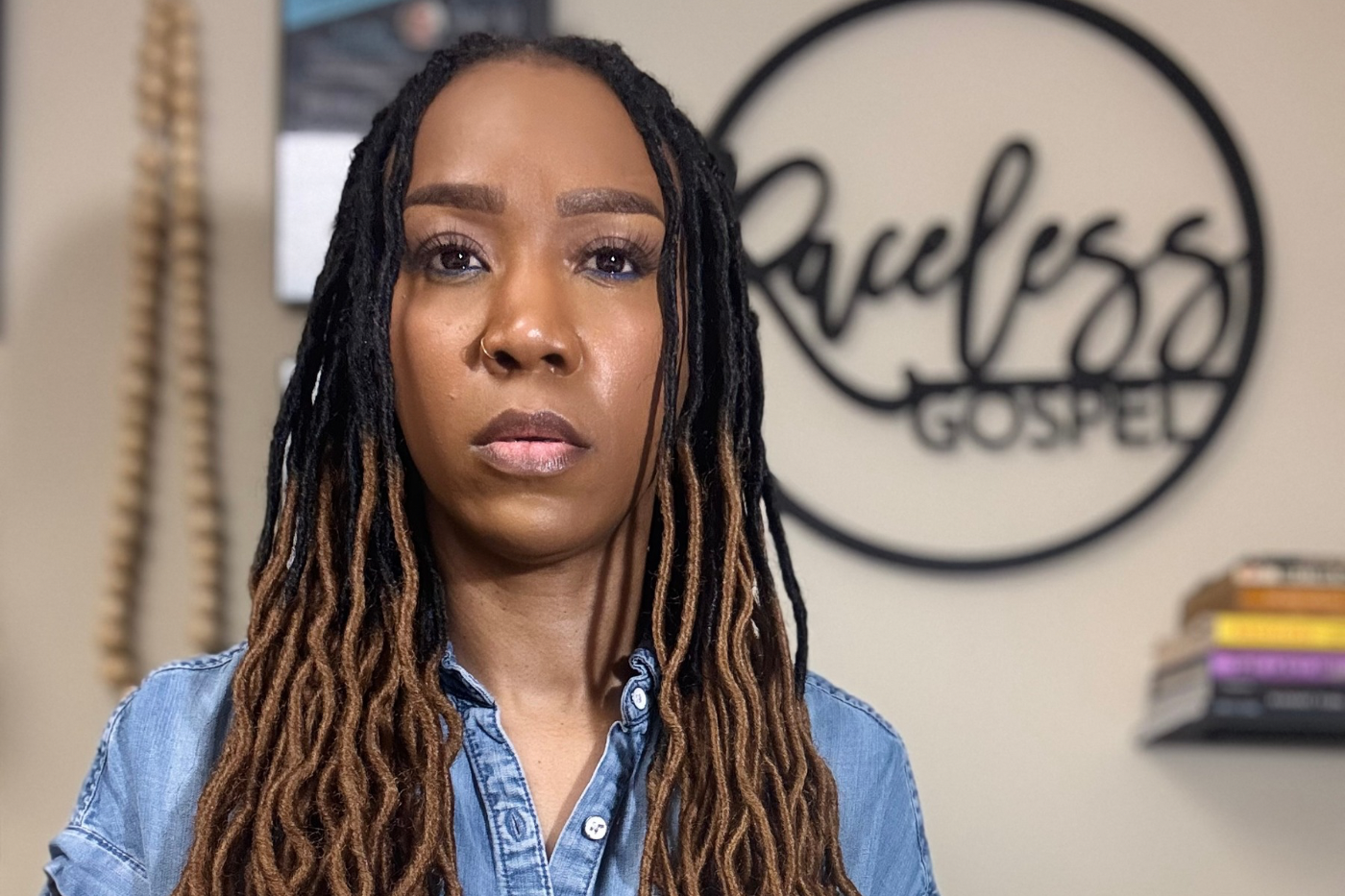
This is why we need the Raceless Gospel. Its core tenets include racial eliminativism, or the abolishing of race, viewed as a human-made caste system rather than a biological truth; the use of baptism to unite people beyond racialized categories; and the decolonization of faith by reexamining religious teachings that support social hierarchies and discrimination.
Luke A. Powery believes, “The Spirit can help us reclaim our humanity with all of its particularity of culture, language, and ethnicity.” But it would require us to declare with the psalmist, “All power belongs to God,” and maybe sing: “Power/ Power, Lord, Power/ Power, Lord, Holy Ghost, power/ Power, Lord, Holy Ghost, power/ Power, Lord.”
- About the Author
- Latest Posts

Director of The Raceless Gospel Initiative, an associate editor, host of the Good Faith Media podcast, “The Raceless Gospel” and author of Take Me to the Water: The Raceless Gospel as Baptismal Pedagogy for a Desegregated Church.